

TL;DR:
- Water stewardship is now a key ESG metric, emphasizing both reduction and replenishment efforts.
- Standardized, basin-contextual metrics like the Water Sustainability Index improve measurement credibility.
- Leading companies achieve measurable water impacts through integrated strategies, transparent reporting, and supply chain engagement.
Most businesses measure ESG water progress by how much less they consume. That number looks clean in an annual report, but it misses half the picture. PepsiCo achieved 100% water replenishment in high-risk areas by restoring an equivalent volume through nature-based projects, not just by using less. That shift from reduction-only thinking to full stewardship is exactly where ESG water strategy is heading. This article walks through why water efficiency is now a core compliance pillar, how to measure it credibly, and what industry leaders are doing to turn verified water savings into real competitive advantage.
Table of Contents
- Why water efficiency is central to ESG goals
- Quantifying water savings: Metrics and frameworks
- Case studies: Industry leaders achieving water impact
- Strategies for water savings: Practical ESG actions
- Beyond compliance: The uncomfortable truth about ESG water strategies
- Unlock your facility's water saving potential
- Frequently asked questions
Key Takeaways
| Point | Details |
|---|---|
| Water matters in ESG | Water efficiency and stewardship are essential for ESG compliance, brand trust, and future resilience. |
| Standardized metrics are vital | Transparent water savings frameworks like WSI ensure credible ESG reporting and prevent greenwashing. |
| Real-world impact is possible | Leading companies have achieved major water savings and replenishment through innovative actions and supply chain engagement. |
| Integrate practical strategies | Businesses should combine real-time monitoring, recycling, and contextual targets for best water savings results. |
Why water efficiency is central to ESG goals
Water has quietly moved from a footnote in sustainability reports to a front-line ESG metric. Investors, regulators, and supply chain partners are all asking harder questions about how facilities source, use, and return water. The answers affect ESG scores directly, and in industries with water-intensive footprints, the impact on valuations is real.
Consider the range of sectors with significant water exposure. Manufacturing uses enormous volumes in cooling and processing. Food and beverage companies depend on clean water for production quality and ingredient sourcing. Retailers face water risk embedded deep in their supply chains, from raw materials to finished goods. None of these industries can afford to treat water as a secondary concern when investors are using water metrics to screen risk.
Water stewardship is now as scrutinized as carbon and energy. ESG frameworks including CDP, GRI, and SASB all require water disclosures, and regulators in multiple jurisdictions are tightening those requirements. Facilities that cannot produce credible, verifiable water data are increasingly exposed to compliance risk, not just reputational damage.
The pressure is also coming from upstream. Industry water scarcity solutions are evolving rapidly because water stress in one region can disrupt an entire global supply chain. Businesses that depend on suppliers in water-stressed basins are already learning that their ESG water footprint does not stop at the property line.
Some of the most ambitious corporate water targets reinforce how seriously leading companies take this. P&G targets a 35% reduction in water use per unit of production versus 2010, recycles and reuses 5 billion liters annually, and is committed to restoring more water than it consumes across 18 water-stressed areas. That is a layered, multi-metric commitment, not a single headline number.
Key reasons water efficiency is essential for ESG performance:
- ESG scoring: Major rating agencies weight water use intensity and water risk exposure in their scoring models.
- Supply chain resilience: Water stress at a supplier site can halt production and trigger financial losses.
- Regulatory compliance: Disclosure requirements under frameworks like the EU Taxonomy and TCFD are including water risk.
- Investor scrutiny: Water-intensive industries face direct questions from institutional investors about stewardship targets.
- Reputational value: Credible water programs build trust with customers and communities.
"Water stewardship is no longer optional for industries with significant water footprints. It is the next major front in ESG accountability alongside carbon."
Cutting water costs for ESG is increasingly achievable with the right monitoring and reuse infrastructure. The key is treating water efficiency as an asset, not just a compliance checkbox.
Quantifying water savings: Metrics and frameworks
Even companies serious about water stewardship often struggle to measure and report it consistently. Without standardized metrics, disclosures become hard to verify, and the risk of greenwashing grows quickly. That is exactly the problem the proposed Water Sustainability Index is designed to solve.
The Water Sustainability Index (WSI) is a quantitative ESG metric that accounts for five key dimensions: withdrawals, water stress level, discharge quality, consumption, and reuse. Rather than relying on a single volume figure, it places water data in the context of basin-level stress, making two facilities in very different geographies genuinely comparable. The WSI has been tested on 55 US corporations, enabling scenario modeling for strategic water investment.
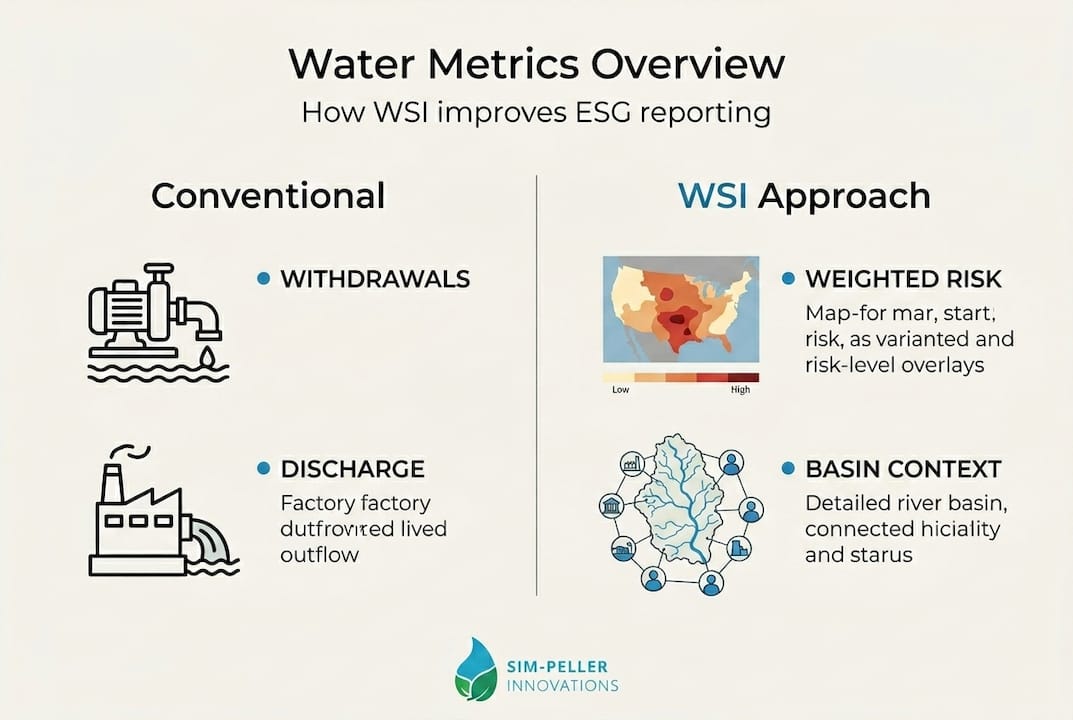
This kind of contextual measurement matters enormously. A factory using 1 million liters per year in a water-abundant region carries a very different ESG weight than the same factory operating in a high-stress basin. Basin-contextual metrics close that gap and prevent inflated claims about savings.
Here is how the WSI dimensions compare to conventional reporting approaches:
| Dimension | Conventional reporting | WSI approach |
|---|---|---|
| Withdrawals | Total volume only | Volume weighted by basin stress |
| Stress | Often omitted | Integrated as a core factor |
| Discharge quality | Rarely quantified | Included as a sustainability variable |
| Consumption | Sometimes included | Normalized per unit of production |
| Reuse | Noted anecdotally | Quantified and credited in the index |
Transparent water monitoring frameworks that align with the WSI structure give facility managers a credible foundation for ESG disclosures. Without that foundation, reported savings are hard to verify and easy to challenge.
Steps to build a credible water savings measurement program:
- Audit current usage across all site operations, including cooling towers, production processes, sanitation, and landscaping.
- Map your basins by identifying the water stress level of each facility's location using publicly available tools like the WRI Aqueduct platform.
- Set baseline metrics using the five WSI dimensions so your starting point is fully documented and comparable year over year.
- Deploy real-time monitoring with IoT sensors to capture granular usage data and flag anomalies like leaks or overconsumption.
- Model scenarios by projecting the financial and ESG impact of different investment options, from recycling systems to demand reduction programs.
Performance based water rewards tied to verified WSI metrics create real accountability and generate value from genuine savings, not just paper commitments.
Pro Tip: Use basin-level stress data alongside your volume metrics when building ESG disclosures. Two facilities saving the same number of liters can have very different ESG impacts depending on where they operate.
Case studies: Industry leaders achieving water impact
The most convincing evidence for what is possible comes from companies already delivering measurable water outcomes at scale. These examples show a range of approaches, from nature-based replenishment to supply chain engagement to technology-driven efficiency.

PepsiCo reached a milestone that most companies only put in their 2030 goals. PepsiCo achieved 100% water replenishment in high-risk areas, executing over 60 replenishment projects and restoring 29 billion liters in 2025. The approach combined wetland restoration, agricultural water efficiency programs, and community watershed projects. PepsiCo also adopted the Alliance for Water Stewardship (AWS) Standard across company-owned facilities in high-risk areas, giving their claims third-party credibility.
H&M Group tackled water at the manufacturing level, where fashion's water footprint is heaviest. H&M reduced freshwater consumption by 9.5% compared to a 2022 baseline in tier 1 and tier 2 factories, while achieving a water recycling rate of 19.6%. The group is targeting a 30% freshwater reduction by 2030, and their approach centers on supplier engagement in high-stress basins, not just operational efficiency at owned facilities.
RWE, operating in the energy sector, targeted 40% reduction in water per MWh of electricity generated by 2030. For an energy company, this means redesigning cooling processes, which are among the largest water consumers in power generation.
P&G completes the picture from a consumer goods perspective. Alongside its reduction targets, P&G has driven supply chain innovation so that certain product formulations save up to 20 gallons per load for end consumers, translating to an estimated 150 billion gallons per year across the industry.
| Company | Sector | Key water metric | Target year |
|---|---|---|---|
| PepsiCo | Food and beverage | 100% replenishment, 29B liters restored | Achieved 2025 |
| H&M Group | Fashion retail | 9.5% freshwater reduction, 19.6% recycling rate | 2030 for 30% |
| RWE | Energy | 40% reduction per MWh of electricity | 2030 |
| P&G | Consumer goods | 35% reduction per unit of production | Ongoing |
What these companies share is a commitment to water and energy innovation that goes beyond single targets. They use multiple levers, measure outcomes in basin context, and engage partners across the value chain.
Smart water management platforms are central to how these outcomes are tracked and verified. Without reliable data infrastructure, replenishment claims and recycling rates remain unverifiable assertions. The companies leading on water are investing in both the physical systems and the digital infrastructure to prove their results.
Strategies for water savings: Practical ESG actions
Understanding what leading companies have achieved is one thing. Translating those lessons into operational action at your facility is where ESG strategy becomes real. The following strategies give business owners and facility managers a structured path forward.
Start with a full site water audit. Most facilities underestimate their actual water footprint because significant volumes are hidden in processes like cooling, steam generation, and compressed air systems. Data centers and semiconductor facilities carry particularly high hidden water use for cooling and chip manufacturing, often far exceeding the water metered at the inlet. A thorough audit maps every use point across the site, not just the main meter reading.
Deploy IoT monitoring for real-time visibility. The gap between what facilities think they use and what they actually use is often significant. IoT water management systems place sensors at key use points and stream data to an AI platform that flags leaks, overconsumption, and inefficiency in real time. This closes the measurement gap and creates the verified data trail that ESG disclosures require.
Install onsite recycling and reuse systems. Onsite water recycling captures greywater from sinks, cooling circuits, and process flows, treating it for reuse in non-potable applications like toilet flushing, irrigation, or cooling tower makeup. Recycling rates of 15% to 20% are achievable with current technology, as H&M's supplier network has demonstrated.
Set basin-contextual targets. A global water target expressed only as total volume reduction can mask poor performance in high-stress areas. Set site-specific targets informed by each basin's stress level. This approach aligns with how the WSI transparent water metrics framework evaluates performance.
Engage your supply chain. H&M's factory-level engagement showed that tier 1 and tier 2 suppliers hold a large share of a brand's total water footprint. If you buy from water-intensive suppliers in stressed regions, your reported savings at owned facilities may be offset by supplier-level exposure. Map water risks across your full supply chain, not just your owned sites.
Steps to implement a practical water stewardship program:
- Audit every water use point on site, including hidden uses in cooling and production.
- Install real-time IoT monitoring to capture granular consumption data.
- Set targets at the basin level, factoring in local water stress.
- Build or retrofit onsite recycling systems targeting a minimum 15% reuse rate.
- Engage tier 1 and tier 2 suppliers with water benchmarking and shared targets.
- Report against standardized metrics like the WSI for credible ESG disclosures.
Use the water efficiency guide to benchmark your starting position and identify where the greatest savings opportunities exist in your specific industry context.
Pro Tip: Map water risks across your entire supply chain before setting your headline ESG water target. A facility that reduces in-house use by 20% while sourcing from heavily water-stressed suppliers may be reporting progress that does not reflect the full picture.
Beyond compliance: The uncomfortable truth about ESG water strategies
Here is what most ESG guides will not tell you directly. A reduction target, even an ambitious one, can become a shield against real accountability. If your disclosures show consistent year-over-year volume reduction but your data is not basin-contextualized, not third-party verified, and does not account for reuse or replenishment, you are reporting progress that investors and regulators will increasingly see through.
Current ESG water reporting risks greenwashing precisely because metrics are opaque and non-uniform. The WSI was proposed specifically to address that gap by making performance genuinely comparable and transparent. Choosing frameworks that quantify both reduction and restoration is not just good ethics. It is risk management.
The brands gaining real competitive advantage from water stewardship are not the ones hitting the lowest consumption numbers. They are the ones whose data is verifiable, whose replenishment is credible, and whose supply chain engagement is documented. That visibility builds investor confidence and community trust in ways that a single headline metric never can.
Aligning with robust frameworks like those covered in ESRS2 strategies is part of making water stewardship structurally visible across all sustainability reporting. The path forward is transparency, not just reduction.
Unlock your facility's water saving potential
At Simpeller, we work with businesses and facility managers to make water efficiency measurable, verifiable, and financially rewarding. Our SmartSink IoT devices and AI platform turn invisible water waste into actionable data, track verified performance improvements, and convert efficiency gains into ESG-credible outcomes. Whether you are building your first water stewardship program or looking to strengthen existing disclosures, we offer the tools and expertise to move from commitments to verified results.
Explore how water saving solutions from Simpeller can help your facility reduce operational costs, meet ESG disclosure requirements, and build a credible water story that investors and regulators can trust. The technology is proven. The outcomes are measurable. Now is the moment to act.
Frequently asked questions
How do I benchmark my facility's water use for ESG reporting?
Start by quantifying withdrawals, stress level, discharge quality, consumption, and reuse using a framework like the Water Sustainability Index, which has been tested on 55 US corporations and supports scenario modeling for investment decisions.
What are the most effective water saving strategies for manufacturing facilities?
Integrate onsite recycling systems, deploy water-efficient equipment, and monitor site-specific usage at every process point including supply chain exposure. H&M Group achieved a 9.5% freshwater reduction with a 19.6% recycling rate by engaging both owned facilities and tier 1 and tier 2 factories.
How does transparent water reporting prevent ESG greenwashing?
Standardized metrics like the WSI provide clear, basin-contextualized quantification that makes disclosures credible and directly comparable, giving investors verified data rather than opaque volume claims.
Is water replenishment as important as water reduction for ESG?
Yes, replenishing water through nature-based projects is now a leading ESG metric alongside reduction. PepsiCo replenished 29 billion liters in high-risk areas in 2025, demonstrating that true water stewardship includes giving back what is used.
What are hidden water uses businesses often overlook?
Data centers and semiconductor manufacturing require large volumes of water for cooling and chip production, volumes that rarely appear in simple inlet-meter readings but significantly affect a facility's true ESG water footprint.