
TL;DR:
- Performance-based water rewards link incentives directly to measurable water savings rather than equipment installation.
- These programs motivate ongoing operational improvements, leading to significant water and cost reductions.
- Implementing effective programs involves proper metering, transparent metrics, and continuous monitoring to maximize sustainability and financial gains.
Most commercial and industrial facilities leave significant water savings on the table, not because they lack interest, but because their incentive programs are built on outdated, one-size-fits-all logic. Flat rebates and generic conservation targets rarely reflect the operational complexity of a real facility. Performance-based programs directly tie rewards to water savings metrics in commercial buildings, making every liter saved a measurable, rewarded outcome. This guide breaks down what performance-based water rewards are, why they outperform static incentives, how they work in practice, and the exact steps to design and launch a program that delivers real financial and environmental returns.
Table of Contents
- Understanding performance-based water rewards
- Key benefits for facilities and sustainability goals
- How performance-based programs work in practice
- Designing and implementing a performance-based water rewards program
- Why most facilities underuse performance-based rewards (and how to break the pattern)
- Ready to power next-level water savings?
- Frequently asked questions
Key Takeaways
| Point | Details |
|---|---|
| Outcome-driven incentives | Performance-based rewards link tangible water savings to real benefits for facilities. |
| Significant cost reductions | These systems can cut facility water costs by up to 50 percent. |
| Stepwise implementation | Launching with a pilot and clear measurement simplifies adoption and scales results. |
| Supports ESG goals | Performance-based programs align with reporting requirements and sustainability targets. |
Understanding performance-based water rewards
A performance-based water reward is exactly what it sounds like: a system where the reward you receive is proportional to the water efficiency you actually achieve. Instead of getting a fixed rebate for installing a low-flow fixture, your facility earns rewards based on how much water it measurably saves over a defined period. The difference sounds subtle, but in practice it changes everything about how teams prioritize and sustain conservation efforts.
Traditional or input-based incentives reward action. You install equipment, you get a rebate. Whether that equipment actually reduces consumption is largely irrelevant to the reward calculation. Performance-based models, by contrast, reward outcomes. Savings are verified through metering and monitoring, and rewards scale with results. This shift from action to outcome is what makes these programs so well-suited to complex facility environments where water use varies by season, occupancy, and production cycle.
Why does this matter for facility managers? Because static incentives often fail to motivate sustained behavior change. A one-time rebate creates a one-time action. A performance-based reward creates an ongoing incentive to keep improving, to fix that dripping valve, to optimize the cooling tower, to reuse greywater more aggressively.
"The facilities that see the biggest long-term water savings are those where every operational decision is connected to a measurable outcome and a meaningful reward."
Here is a quick comparison of the two models:
| Feature | Static incentives | Performance-based rewards |
|---|---|---|
| Reward trigger | Equipment installation | Verified water savings |
| Measurement required | Minimal | Continuous metering |
| Scalability | Low | High |
| Ongoing motivation | One-time | Sustained |
| ESG reporting value | Limited | High |
Key characteristics of effective performance-based water reward programs include:
- Verified baselines: A documented starting point against which savings are measured
- Real-time monitoring: Sensor-driven data collection that removes guesswork
- Transparent reward calculation: Clear formulas so participants understand exactly what they earn
- Flexible reward types: Financial credits, operational perks, or sustainability tokens
- Regular review cycles: Quarterly or annual recalibration to reflect operational changes
The CRE water reuse results from commercial real estate portfolios show that when rewards are tied to verified outcomes, facilities consistently outperform those operating under flat incentive structures.
Key benefits for facilities and sustainability goals
The case for performance-based water rewards goes well beyond saving water. For facility managers and sustainability officers, these programs create a direct line between operational decisions and financial returns, which is exactly the kind of business case that gets budget approved.
-
Direct cost reduction: When water savings are rewarded, teams are motivated to find and fix inefficiencies that would otherwise go unnoticed. Leaking pipes, inefficient cooling systems, and underutilized greywater recycling systems all represent costs that performance-based programs put a spotlight on.
-
Improved ROI on water infrastructure: Capital investments in water-efficient equipment deliver stronger returns when paired with a reward structure that recognizes ongoing performance, not just the initial installation.
-
Stronger ESG reporting: Sustainability officers increasingly need verified, quantified data for ESG disclosures. Performance-based programs generate exactly that: auditable records of water savings tied to specific operational changes.
-
Sustained operational improvement: Unlike one-time rebates, performance-based rewards keep teams engaged over time. Each review cycle is an opportunity to identify new savings opportunities and earn additional rewards.
-
Alignment across departments: When financial rewards are tied to water performance, facilities management, operations, and finance teams all have a shared interest in the outcome. That cross-departmental alignment is hard to achieve with passive incentive structures.
The numbers back this up. Facilities using targeted reward systems cut water costs by up to 50%, a figure that reflects not just reduced consumption but also lower energy costs from pumping and heating less water.
Statistic to note: A 50% reduction in water costs is achievable when performance-based rewards are combined with active monitoring and greywater reuse strategies.
Pro Tip: Layering smart water management tools on top of your reward program amplifies results. Digital monitoring platforms give you the granular data needed to identify savings opportunities that manual tracking simply misses, and that data feeds directly into your reward calculations.
The environmental benefits are equally compelling. Every liter saved reduces the energy needed for water treatment and distribution, shrinks your facility's carbon footprint, and contributes to broader watershed health. For organizations with science-based targets or net-zero commitments, that connection between water savings and carbon accounting is increasingly important.
How performance-based programs work in practice
Understanding the mechanics of these programs removes a lot of the perceived complexity. At their core, performance-based water programs leverage measurable outcomes and real-time data to link operational behavior to tangible rewards. Here is how that plays out step by step.
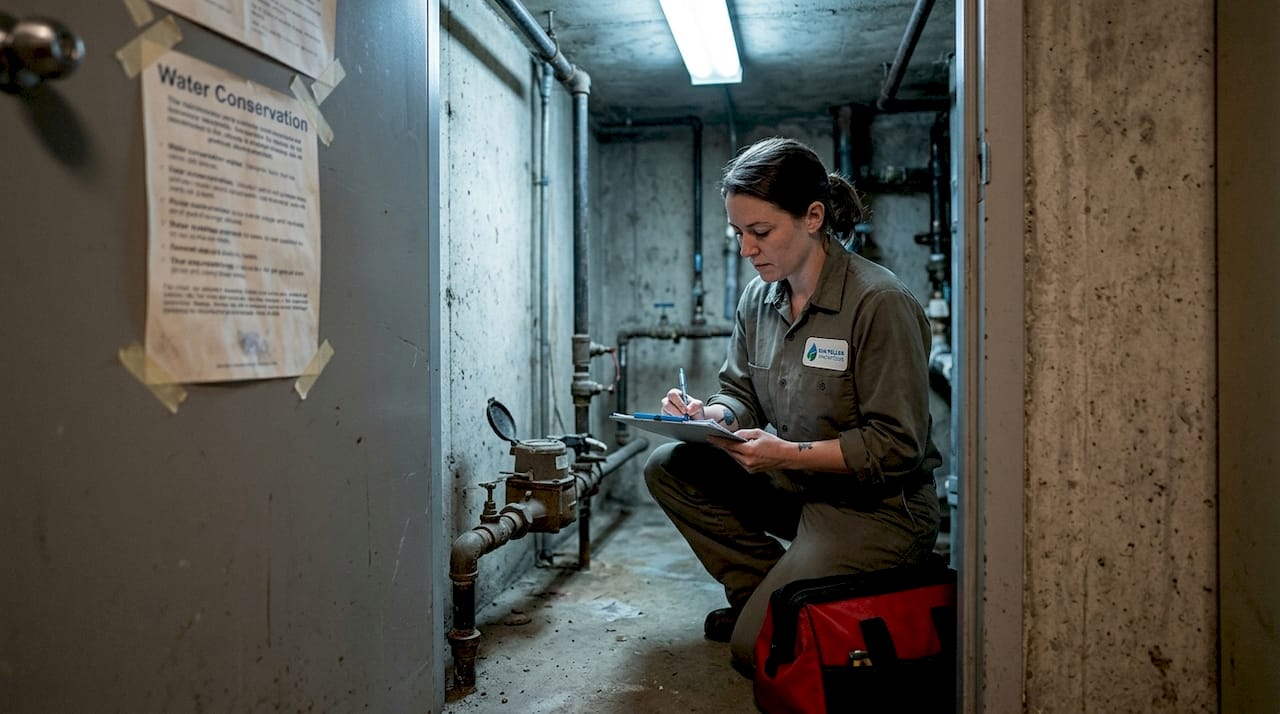
Step 1: Establish a verified baseline. Before any rewards can be calculated, you need a credible starting point. This means metering current water use across all major consumption points: cooling towers, restrooms, irrigation, process water, and any existing onsite recycling systems. The baseline period typically runs three to twelve months.
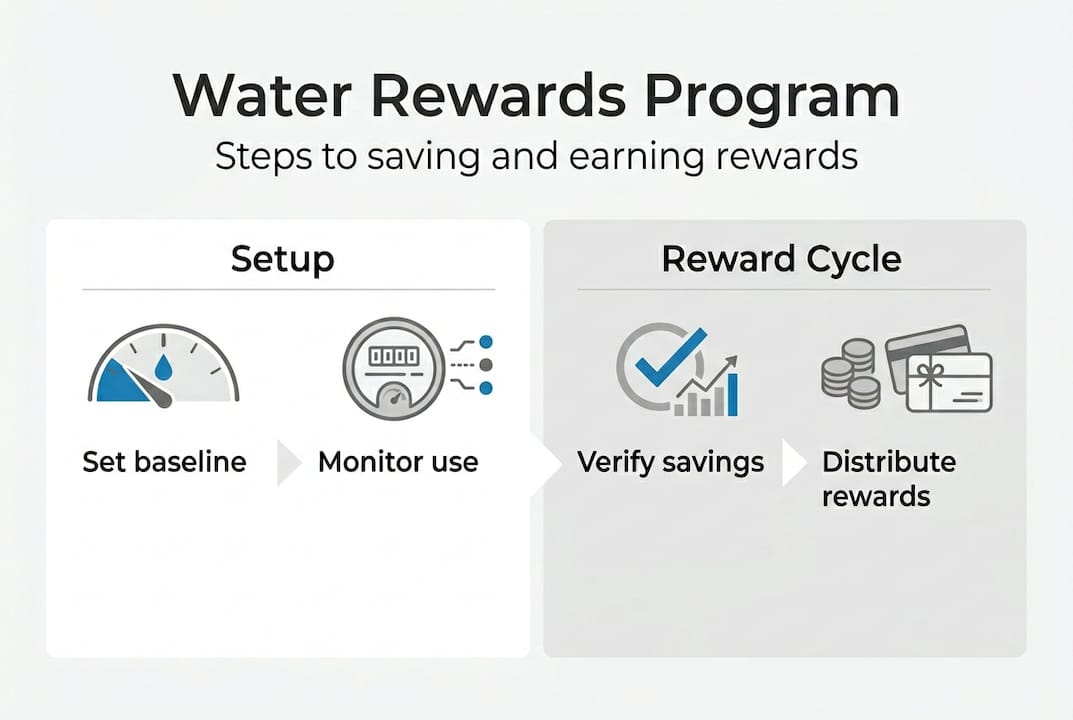
Step 2: Define performance thresholds. Rewards are triggered when consumption drops below the baseline by a defined percentage. Thresholds are usually tiered, so a 10% reduction earns a base reward, a 20% reduction earns more, and so on.
Step 3: Select reward mechanisms. The most effective programs offer a mix of reward types:
- Financial credits applied to utility bills or operational budgets
- Sustainability tokens or credits that can be reinvested or traded
- Public recognition through ESG reports or industry certifications
- Operational perks such as priority access to shared infrastructure upgrades
Step 4: Distribute and verify rewards. Rewards are calculated and distributed at the end of each review cycle, with full transparency into the data and methodology used.
Here is how performance-based programs compare to traditional incentives in practice:
| Dimension | Traditional incentives | Performance-based rewards |
|---|---|---|
| Data requirements | Low | High |
| Reward frequency | One-time | Recurring |
| Participant engagement | Passive | Active |
| Verification rigor | Minimal | Continuous |
| Scalability across sites | Difficult | Designed for it |
Common pitfalls to avoid include:
- Poor baseline data: If your starting point is inaccurate, your savings calculations will be too. Invest in proper metering before launching.
- Overly complex reward formulas: If participants cannot understand how rewards are calculated, engagement drops fast.
- Ignoring behavioral factors: Technology alone does not drive savings. Communication and team buy-in are just as important as sensors and software.
- Infrequent review cycles: Annual-only reviews miss the opportunity to course-correct and maintain momentum.
Designing and implementing a performance-based water rewards program
Moving from concept to operational program requires a structured approach. Effective program design requires clear metrics, transparent reporting, and ongoing adjustment. Here is a practical framework for getting it right.
-
Conduct a facility water audit. Map every water consumption point, identify the largest users, and assess existing metering infrastructure. This audit forms the foundation of your baseline and your metric selection.
-
Set a credible baseline. Use at least six months of metered data, adjusted for seasonal variation and occupancy changes. A weak baseline undermines the entire program.
-
Select meaningful metrics. Choose metrics that reflect real operational performance: liters per square meter, liters per unit of production output, or percentage reduction against baseline. Avoid vanity metrics that are easy to game.
-
Design the reward structure. Decide on reward types, thresholds, and distribution frequency. Keep the formula simple enough that every team member can understand their contribution.
-
Communicate the program clearly. Launch with a briefing for all relevant teams. Explain the metrics, the rewards, and the review schedule. Transparency builds trust and drives engagement.
-
Monitor continuously and review regularly. Use digital monitoring tools to track performance in real time. Schedule quarterly reviews to assess progress, recalibrate thresholds if needed, and distribute rewards.
-
Scale what works. Once your pilot demonstrates results, expand the program across additional sites or consumption categories.
Pro Tip: Start with a single building or process area before scaling facility-wide. A focused pilot generates proof of concept, surfaces implementation challenges early, and creates internal champions who can advocate for broader rollout.
Key pitfalls to watch for during implementation:
- Data inaccuracy from poorly calibrated meters or inconsistent logging
- Unclear goals that leave teams unsure what they are working toward
- Lack of leadership buy-in, which signals to teams that the program is optional
- Failure to connect innovative water scarcity strategies to the reward framework, missing savings opportunities in process water and reuse systems
Why most facilities underuse performance-based rewards (and how to break the pattern)
Here is an uncomfortable truth: most facilities are not failing at water conservation because the technology is too complex or the costs are too high. They are failing because the incentive structure rewards the wrong things. A culture built around static rebates and compliance checkboxes does not naturally evolve into one that rewards continuous performance improvement.
The misconception that performance-based programs are too complicated to manage is increasingly outdated. Modern IoT monitoring platforms, AI-driven analytics, and tokenized water reuse frameworks have made bespoke, data-driven reward programs accessible to mid-sized facilities, not just large industrial operators with dedicated sustainability teams.
The real barrier is inertia. Facilities default to familiar structures because change requires internal advocacy, and internal advocacy requires a visible win. That is exactly why a small, well-designed pilot program is so powerful. It breaks the inertia, generates a concrete ROI story, and gives sustainability officers the evidence they need to drive broader adoption. The facilities that act now will not just save water. They will build the operational infrastructure for a fundamentally more efficient future.
Ready to power next-level water savings?
If your facility is serious about translating water efficiency into measurable financial and sustainability outcomes, the tools to do it exist right now. Simpeller's IoT-enabled platform tracks verified water savings in real time, converts efficiency gains into tokenized rewards, and feeds directly into your ESG reporting framework. Whether you are designing your first performance-based water rewards program or optimizing an existing one, Simpeller water rewards gives you the data infrastructure and reward mechanisms to make every liter count. Explore the platform, schedule a demo, and see how performance-based water management can slash operational costs while building a credible, auditable sustainability record.
Frequently asked questions
How do performance-based water rewards differ from traditional water incentives?
Traditional incentives offer fixed rewards for specific actions like equipment installation, while performance-based programs tie rewards directly to measurable water savings or verified efficiency increases over time.
What types of rewards are most effective in these programs?
The most effective rewards are financial incentives, public recognition, or operational perks that align with organizational priorities and create ongoing motivation rather than one-time action.
How can facility managers measure performance for water reward programs?
Use continuous metering, digital monitoring platforms, and baseline comparisons to track and verify savings. Real-time data from IoT sensors provides the verification rigor these programs require.
Is it difficult to implement a performance-based water rewards system?
Start with a pilot program in one building or process area with clear, simple metrics. Modern monitoring tools make implementation manageable for most mid-sized to large facilities without requiring a dedicated data science team.