
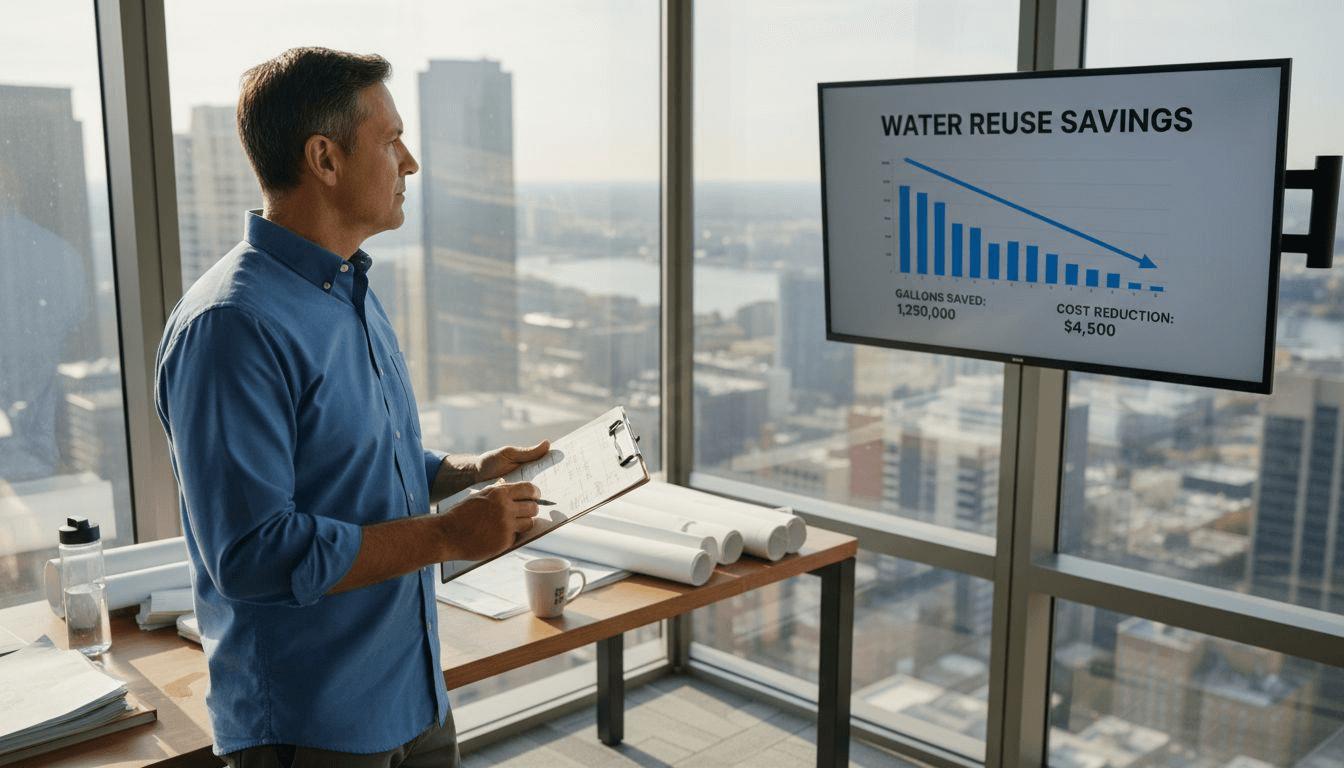
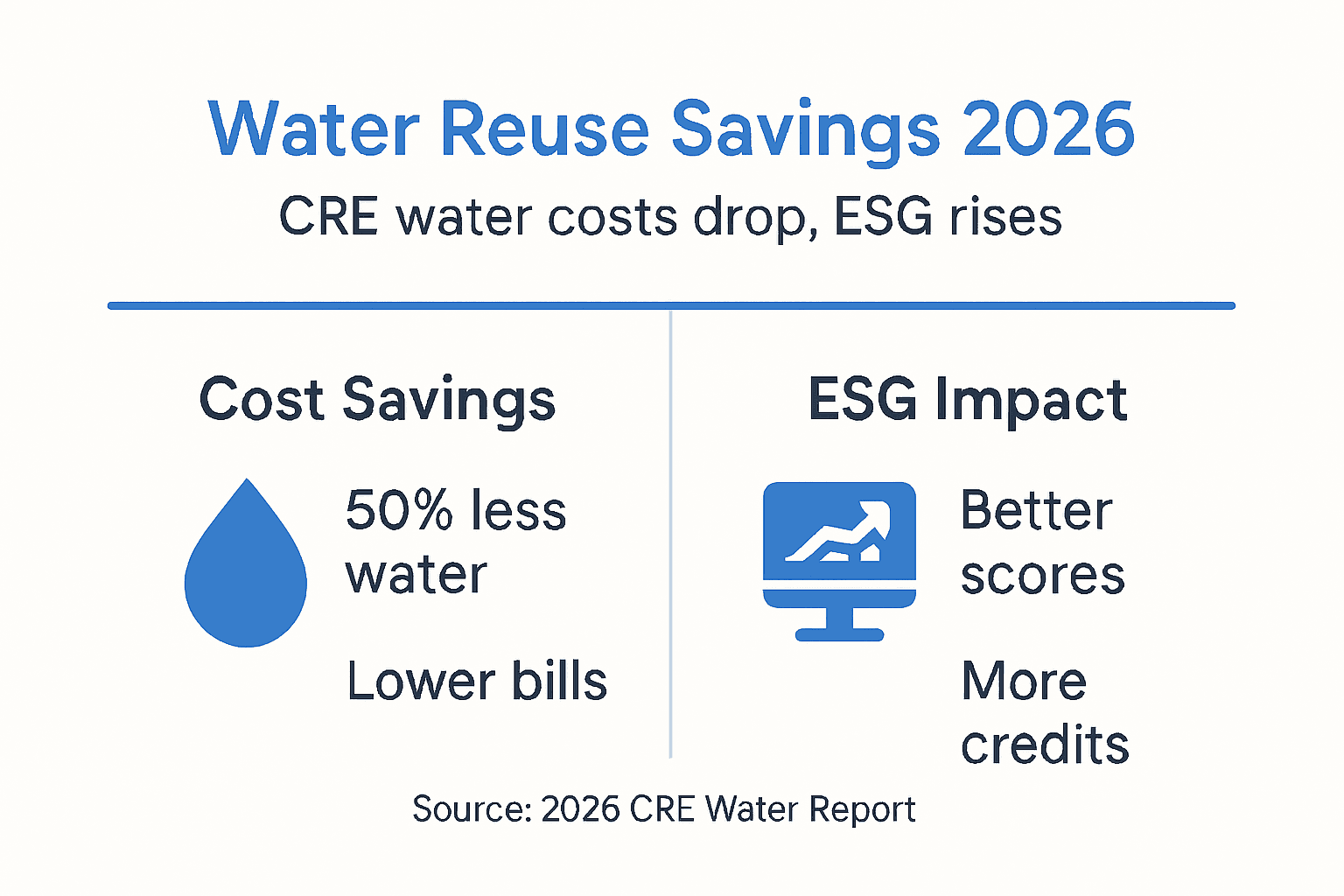
Commercial buildings can reduce potable water use by up to 50% through water reuse strategies. Yet sustainability managers struggle to prove ESG improvements and cost savings from these initiatives. This guide clarifies water reuse's role in ESG frameworks, outlines implementation steps, and enhances your reporting capabilities to demonstrate measurable impact to investors and stakeholders.
Table of Contents
- Understanding Water Reuse Within ESG Frameworks For Commercial Real Estate
- Environmental Benefits And Cost Savings Of Water Reuse
- Social Benefits And Tenant Engagement Through Water Reuse
- Governance Challenges And Regulatory Environment
- Measurement, Verification, And Transparent ESG Reporting
- Common Misconceptions And Economic Realities
- Practical Steps And Real-World Case Studies
- Partner With Simpeller For Advanced Water Reuse Solutions
- Frequently Asked Questions
Key Takeaways
| Point | Details |
|---|---|
| Water Savings | Water reuse can reduce potable water use by up to 50%, cutting costs significantly. |
| Investor Focus | 70% of CRE investors consider water management in ESG scoring. |
| Technology Impact | IoT sensors improve water reuse data accuracy by 30%. |
| Tenant Engagement | Tenant cooperation is crucial for successful water reuse projects. |
| Financial Returns | Water reuse projects often recoup costs within 3 to 5 years. |
Understanding Water Reuse within ESG Frameworks for Commercial Real Estate
ESG stands for Environmental, Social, and Governance. In commercial real estate, it measures how properties manage sustainability risks and opportunities. Water reuse directly strengthens all three components.
The environmental dimension benefits most obviously. Implementing water reuse strategies contributes directly to improved ESG ratings by demonstrating environmental stewardship and resource efficiency. You reduce freshwater extraction, lower wastewater discharge, and minimize drought vulnerability. These actions signal climate resilience to investors who increasingly scrutinize water management.
Social factors include tenant wellbeing and community impact. Buildings with water reuse benefits in commercial real estate often see improved tenant satisfaction because occupants value sustainable operations. You also contribute to broader water equity by reducing strain on municipal supplies.
Governance encompasses policy frameworks, transparency, and stakeholder alignment. Strong governance ensures accurate water data collection and credible ESG disclosures. It requires coordinating landlords, property managers, and tenants around shared sustainability goals.
Investor pressure drives adoption. Approximately 70% of CRE investors factor water management into ESG scoring decisions. Properties demonstrating water resilience command premium valuations and attract capital more readily.
The virtuous cycle works like this:
- Environmental gains reduce operational costs
- Social benefits improve tenant retention
- Governance improvements enable transparent reporting
- Better reporting attracts investment
- Investment funds further environmental improvements
Pro Tip: Start by mapping your building's water flows to identify high-impact reuse opportunities before designing systems.
Environmental Benefits and Cost Savings of Water Reuse
Water reuse delivers quantifiable environmental and financial returns. Potable water consumption drops up to 50% when graywater systems capture water from sinks, showers, and laundry for toilet flushing and landscape irrigation. This reduction translates directly into lower water utility bills.
Energy savings accompany water conservation. Water-related energy use decreases by 20% because you pump and treat less water. Heating water for reuse applications also consumes less energy than heating fresh municipal supplies. These savings compound over time.
Direct financial benefits include:
- Reduced water purchase costs from utilities
- Lower wastewater discharge fees
- Decreased water heating expenses
- Reduced maintenance from equipment operating in less harsh water conditions
- Avoided infrastructure upgrade costs as municipal water prices rise
The environmental and cost savings of water reuse create compelling business cases. Properties in water-stressed regions see faster payback periods because water rates and scarcity risks run higher.
| Metric | Before Reuse | After Reuse | Improvement |
|---|---|---|---|
| Potable Water Use | 100% baseline | 50-60% of baseline | 40-50% reduction |
| Energy for Water | 100% baseline | 80% of baseline | 20% reduction |
| Monthly Water Costs | $10,000 example | $5,000-6,000 | $4,000-5,000 savings |
| Annual Savings | Baseline | Baseline | $48,000-60,000 |
Pro Tip: Assess your building's water baseline carefully to target high-impact reuse strategies and maximize ROI.
These numbers vary by building type, occupancy, and local water rates. Office buildings with high restroom usage see different results than retail centers. Conduct site-specific analysis to project your actual savings.
Social Benefits and Tenant Engagement Through Water Reuse
Water reuse advances social ESG goals by boosting tenant satisfaction and retention. Modern tenants, especially corporate occupiers with sustainability mandates, actively seek buildings demonstrating environmental responsibility. Buildings that adopt sustainable water reuse practices attract tenants more effectively, leading to lower vacancy rates and higher rents.
Tenant retention improves measurably. Properties implementing comprehensive water sustainability programs report 10 to 15% higher tenant retention compared to conventional buildings. Tenants value visible sustainability commitments and the cost stability that comes from reduced utility exposure.

Community benefits extend beyond your property boundaries. Reducing potable water demand eases pressure on municipal infrastructure and supports water equity. In drought-prone regions, your water conservation helps ensure adequate supplies for residential users and essential services.
Successful tenant engagement requires:
- Clear communication about water reuse benefits and safety
- Transparent reporting of water savings and ESG impact
- Educational materials explaining system operations
- Incentive programs rewarding tenant participation
- Regular feedback loops to address concerns
Tenant cooperation matters because water reuse systems depend on occupant behavior. If tenants contaminate graywater sources or resist fixture changes, system performance suffers. Building trust through transparent communication prevents resistance.
Pro Tip: Maintain clear communication and incentives to foster tenant cooperation on reuse initiatives.
Health and safety concerns sometimes arise. Address them proactively by explaining treatment processes, water quality testing protocols, and regulatory compliance. Most modern water reuse systems treat water to standards exceeding public health requirements for intended applications.
Governance Challenges and Regulatory Environment
Governance complexity increases with water reuse implementation. You must coordinate multiple stakeholders, comply with evolving regulations, and maintain transparent reporting. Over 40% of CRE managers report tenant engagement and regulatory alignment as major barriers to water reuse projects.
Regulatory frameworks vary significantly across US jurisdictions. California's Senate Bill 606 requires commercial properties to report water use annually with incentives for reuse technologies. Other states like Texas, Arizona, and Florida have developed distinct codes governing onsite water reuse. You need expertise navigating local requirements.
Tenant coordination presents governance challenges because lease agreements rarely address water reuse responsibilities. Who pays for system installation? How do savings get allocated? What happens if a tenant objects? These questions require clear governance frameworks established before project launch.
Best practices to overcome governance hurdles:
- Establish multi-tenant steering committees for shared decision making
- Draft water reuse addendums to lease agreements clarifying responsibilities
- Engage regulatory consultants early to ensure compliance
- Create transparent cost and benefit allocation formulas
- Implement robust data governance for ESG reporting
- Schedule regular stakeholder reviews of system performance
Transparent ESG reporting demands strong governance. Investors and rating agencies scrutinize water data quality. Manual tracking creates gaps and errors that undermine credibility. Automated systems with clear data governance protocols produce audit-ready reports.
Governance policies should define data ownership, access controls, reporting frequencies, and verification procedures. Assign clear roles for data collection, analysis, and disclosure. These protocols ensure stakeholder confidence in your ESG claims.
Measurement, Verification, and Transparent ESG Reporting
Reliable measurement transforms water reuse from an operational initiative into a strategic ESG asset. Technology choices directly impact reporting accuracy and stakeholder confidence. IoT sensor deployment can reduce unnoticed water waste by 30%, improving measured water reuse efficiency.
Manual water metering requires staff to read meters periodically and record data manually. This approach introduces human error, delays in anomaly detection, and gaps in historical records. You lack real-time visibility into system performance.
IoT sensor systems provide continuous monitoring with automated data transmission to cloud platforms. Sensors track flow rates, water quality parameters, and system status in real time. AI algorithms detect leaks, predict maintenance needs, and flag efficiency declines immediately.
Benefits of IoT-based monitoring:
- Real-time leak detection preventing waste
- Automated ESG data integration eliminating manual entry
- Predictive maintenance reducing downtime
- Granular usage analytics by zone or tenant
- Instant anomaly alerts enabling rapid response
- Audit-ready historical records for compliance
Manual measurement risks include delayed leak detection costing thousands in wasted water, incomplete data undermining ESG reports, and missed optimization opportunities. These gaps erode investor confidence when discovered during due diligence or audits.
| Approach | Accuracy | Response Time | ESG Integration | Cost |
|---|---|---|---|---|
| Manual Metering | ±5-10% error | Days to weeks | Manual data entry | Low upfront, high labor |
| IoT Sensors | ±1-2% error | Real-time alerts | Automated API feeds | Higher upfront, low ongoing |
| Manual + Spot Checks | ±3-5% error | Days | Semi-automated | Medium overall |
| IoT + AI Analytics | <1% error | Instant | Fully automated | Highest value long-term |
Transparency demands robust verification. Third-party audits of water data increase credibility for ESG disclosures. Automated systems with tamper-evident logging provide audit trails that manual systems cannot match.
Investors and rating agencies increasingly require verified water data. GRESB, CDP, and other frameworks ask detailed questions about measurement methodologies. Properties with IoT-verified data score higher than those relying on estimates.
Common Misconceptions and Economic Realities
Several myths discourage water reuse adoption despite strong evidence supporting implementation. Addressing these misconceptions helps sustainability managers build internal support.
Myth: Water reuse costs too much. Reality: Water reuse installations often have payback periods between 3 and 5 years due to substantial utility and maintenance cost savings. System costs have declined as technology matures. Financing options and utility rebates further improve economics.
Myth: Technical complexity prevents adoption. Reality: Modern plug-and-play systems require minimal technical expertise to operate. Over 40% of CRE managers report tenant engagement and regulatory alignment as major barriers, not technical issues. Social and governance challenges outweigh technical concerns.
Myth: Manual measurement suffices for ESG reporting. Reality: Manual data collection introduces 5 to 10% error rates and lacks real-time visibility. Investors demand verified, continuous data that manual approaches cannot reliably provide. Automated systems cost less over time when labor and error correction factor in.
Myth: Tenants will resist water reuse. Reality: Surveys show 75% of commercial tenants support building sustainability initiatives when properly communicated. Resistance stems from poor communication, not inherent opposition. Transparent education about safety and benefits builds support.
Common misconceptions corrected:
- Water reuse only works in dry climates → It delivers value anywhere water and energy have cost
- Systems require constant maintenance → Modern systems operate with minimal intervention using smart controls
- Reused water poses health risks → Properly treated water meets or exceeds safety standards for intended uses
- Only new buildings can implement reuse → Retrofit solutions exist for existing properties
- Benefits take decades to materialize → Savings begin immediately upon system operation
Correct planning and technology selection mitigate implementation risks effectively. Conduct feasibility studies, engage experienced vendors, and phase deployments to manage complexity. These steps turn water reuse from a perceived risk into a strategic advantage.
Practical Steps and Real-World Case Studies
Implementing water reuse requires systematic planning and stakeholder coordination. Follow these sequential steps to maximize success:
-
Conduct baseline water assessment. Measure current consumption by end use to identify reuse opportunities. Prioritize applications with high volume and low treatment requirements.
-
Engage stakeholders early. Build consensus among property owners, managers, and key tenants. Address concerns proactively and establish shared goals.
-
Design system architecture. Work with engineers to specify treatment processes, storage, and distribution based on your baseline assessment and local regulations.
-
Install IoT monitoring infrastructure. Deploy sensors at key points to enable real-time performance tracking and automated ESG data collection.
-
Integrate data systems. Connect water monitoring platforms to your building management system and ESG reporting tools for seamless data flow.
-
Launch tenant communication program. Educate occupants about system benefits, operations, and their role in success.
-
Commission and optimize. Start operations, monitor performance, and adjust controls to optimize efficiency.
-
Review and report regularly. Track KPIs monthly, report quarterly to stakeholders, and annually to ESG frameworks.
Critical success factors:
- Clear regulatory compliance verification before launch
- Robust tenant communication addressing safety and benefits
- Automated measurement eliminating manual data gaps
- Defined governance for cost and benefit allocation
- Ongoing performance monitoring with rapid issue response
Case Example 1: A 500,000 square foot office tower in San Diego installed a graywater reuse system treating sink and shower water for toilet flushing. The building reduced potable water use by 45% annually, saving $65,000 in utility costs. Tenant satisfaction scores improved 12% post-implementation. The system paid for itself in 4.2 years.
Case Example 2: A multi-tenant retail center in Phoenix implemented rainwater harvesting combined with HVAC condensate reuse for landscape irrigation. The property eliminated 2.5 million gallons of potable water use annually and improved its GRESB score by 8 points. One challenge was coordinating different tenant lease terms, resolved by creating a water reuse addendum all tenants signed.
Lesson learned: Both projects succeeded because they prioritized tenant engagement alongside technical implementation. Properties that skip stakeholder alignment face resistance that delays or derails projects regardless of technical merit.
Water reuse implementation strategies benefit from vendor partnerships providing turnkey solutions. Experienced providers handle design, installation, commissioning, and ongoing support, reducing your internal resource requirements.
Partner with Simpeller for Advanced Water Reuse Solutions
You've seen how water reuse strengthens ESG performance while cutting costs. Simpeller accelerates your journey with innovative technology purpose-built for commercial real estate. Our plug-and-play IoT sensors and AI-driven platform make water waste visible, trackable, and actionable.
Simpeller water reuse solutions automate monitoring, engage tenants through transparent dashboards, and integrate seamlessly with ESG reporting frameworks. We transform verified water savings into measurable value, supporting your carbon accounting and transparent disclosures.
Our smartsink devices detect leaks instantly, optimize consumption, and generate renewable credits from efficiency gains. You achieve comprehensive water savings while enhancing tenant satisfaction and investor confidence.
Explore how Simpeller helps commercial buildings water efficiency by turning every drop into demonstrable ESG impact. Visit our website to discover solutions tailored for sustainability managers seeking measurable results.
Frequently Asked Questions
What are the main environmental benefits of water reuse in commercial real estate?
Water reuse conserves potable water supplies by up to 50%, reducing stress on municipal infrastructure and natural water sources. It also cuts energy consumption by approximately 20% because you pump and heat less water. These reductions lower your carbon footprint and improve climate resilience during droughts, directly strengthening environmental ESG scores.
How long does it take to see financial returns from water reuse investments?
Most commercial water reuse systems achieve payback within 3 to 5 years through reduced utility costs and maintenance savings. Buildings in water-stressed regions or with high occupancy often see faster returns. Financing options, utility rebates, and rising water rates can accelerate payback further.
Do water reuse systems require extensive tenant cooperation?
Yes, tenant engagement significantly impacts success. Systems work best when occupants understand operations, follow guidelines for fixture use, and support conservation goals. Clear communication about safety, benefits, and individual impact builds cooperation. Properties with strong tenant communication programs report 10 to 15% higher retention rates.
What regulations govern water reuse in commercial buildings?
Regulations vary by state and municipality. California mandates annual water use reporting for large properties and incentivizes reuse technologies. Texas, Arizona, and Florida have distinct codes for onsite water reuse. You need local regulatory expertise to ensure compliance. Most jurisdictions require treatment standards, backflow prevention, and dual plumbing identification.
How does IoT technology improve water reuse ESG reporting?
IoT sensors provide continuous, accurate water flow monitoring with real-time leak detection and automated data transmission to ESG platforms. This eliminates manual measurement errors, provides audit-ready records, and enables instant response to anomalies. Automated systems improve data accuracy by 30% compared to manual approaches, increasing investor confidence in your ESG disclosures.