
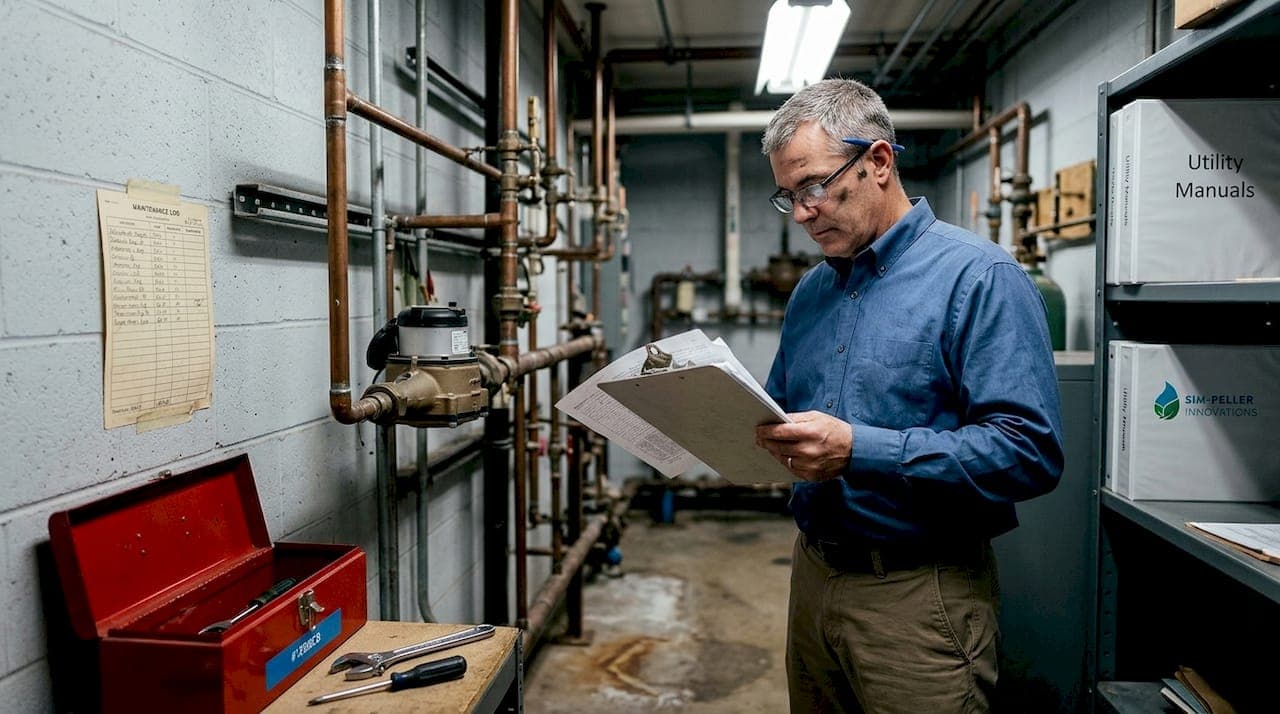
Commercial buildings waste up to 30% of their water supply through leaks, aging fixtures, and inefficient mechanical systems. For facility managers and sustainability directors, that number represents real budget loss and measurable climate impact. The good news is that most of those losses are recoverable with targeted, practical action. This guide walks you through auditing your facility, upgrading key systems, optimizing mechanical operations, and building a culture that keeps savings compounding year after year. Every section is designed to move you from awareness to action, fast.
Table of Contents
- Assess your facility: Audit and monitoring essentials
- Upgrade fixtures: Quick wins with high-efficiency technology
- Optimize mechanical systems and water reuse
- Sustain results: Training, culture, and ongoing verification
- Why every drop matters: Lessons most guides skip
- Unlock your facility's full water savings potential
- Frequently asked questions
Key Takeaways
| Point | Details |
|---|---|
| Audit drives results | Regular facility water audits reveal waste and create an actionable savings blueprint. |
| Fixtures offer quick ROI | Upgrading toilets, urinals, and faucets cuts water use and usually pays for itself in 1–3 years. |
| Technology magnifies savings | Real-time monitoring and leak detection prevent losses and speed up repairs. |
| Culture sustains improvements | Long-term water savings rely on engaged teams and ongoing feedback, not just hardware. |
| Know regulations | Before adopting water reuse solutions, check local and state compliance requirements. |
Assess your facility: Audit and monitoring essentials
With the problem clear, the first step is understanding your facility's baseline water use and pinpointing waste. You cannot reduce what you cannot measure, and that principle drives everything in a successful water management program.
A formal water audit maps consumption across every end use: restrooms, cooling towers, kitchens, process equipment, and irrigation. Regular water audits identify usage patterns, leaks, and inefficiencies that monthly utility bills simply cannot reveal. Submetering, which means installing separate meters on individual systems or zones, lets you isolate exactly where consumption spikes occur.
Real-time IoT sensors accelerate this process significantly. Early anomaly detection with connected pressure and flow sensors enables up to a 19% reduction in losses by catching leaks within hours rather than billing cycles. That speed matters in large facilities where a single undetected pipe failure can waste thousands of gallons before anyone notices.
Once audit data is collected, use it to set clear key performance indicators (KPIs). Typical waste hotspots by system type are shown below:
| System | Typical share of building water use | Common waste cause |
|---|---|---|
| Restrooms | Up to 90% | Leaking toilets, old fixtures |
| Cooling towers | 25-40% | High blowdown, drift losses |
| Irrigation | 10-20% | Unscheduled or sensor-free runs |
| Kitchen/process | 5-15% | Continuous-flow equipment |
Here is a practical sequence to follow after your audit:
- Rank systems by total volume consumed.
- Flag any anomalies or usage spikes versus benchmarks.
- Assign KPIs to each system (e.g., gallons per occupant per day).
- Schedule follow-up checks at 30, 60, and 90 days.
- Review CRE water savings strategies to benchmark your results against industry peers.
Pro Tip: Start your audit in the highest-usage zones first. Restrooms and cooling towers typically account for the largest share of consumption, so early wins there fund the rest of your program.
Upgrade fixtures: Quick wins with high-efficiency technology
Once wasteful use is mapped, the fastest savings often come from targeted hardware upgrades. Fixtures are the most straightforward intervention because the technology is proven, the payback is fast, and the installation rarely requires major infrastructure changes.
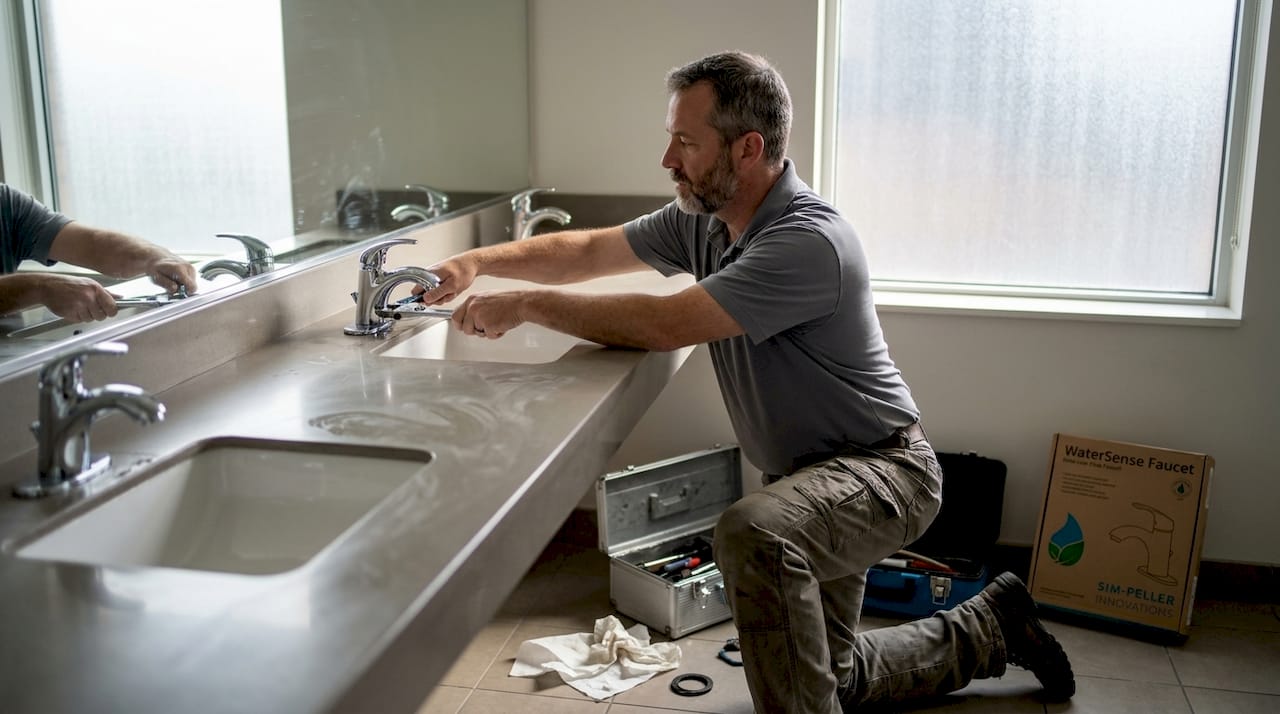
WaterSense-labeled fixtures set the performance benchmark: toilets at or below 1.28 gallons per flush (gpf), urinals at or below 0.5 gpf, faucets at or below 0.5 gallons per minute (gpm), and showerheads at or below 2.0 gpm. Upgrading to these specs can reduce restroom water use by 30 to 50%, which is significant given that restrooms account for up to 90% of total building water consumption.
The financial case is equally strong. Most retrofit projects pay back within one to three years when utility rebates are factored in. Here is a quick comparison of old versus new fixture performance:
| Fixture type | Standard model | High-efficiency model | Savings potential |
|---|---|---|---|
| Toilet | 3.5 gpf | 1.28 gpf | Up to 63% per flush |
| Urinal | 1.0 gpf | 0.5 gpf | 50% per flush |
| Faucet | 2.2 gpm | 0.5 gpm | Up to 77% per use |
| Showerhead | 2.5 gpm | 2.0 gpm | 20% per minute |
To implement upgrades without disrupting operations, follow these steps:
- Inventory every fixture by type, age, and current flow rate.
- Prioritize restrooms with the highest daily occupant traffic.
- Source WaterSense-certified products and confirm local utility rebate eligibility.
- Schedule replacements in phases to avoid service interruptions.
- Document pre- and post-installation flow readings to verify savings.
- Pair upgrades with building water retrofit strategies for a complete efficiency roadmap.
Pro Tip: Contact your local water utility before purchasing. Many utilities offer rebates of $50 to $200 per fixture, which can cover 20 to 40% of total retrofit costs and shorten your payback period considerably.
Optimize mechanical systems and water reuse
After tackling fixtures, major gains can come from addressing mechanical and industrial water systems. Cooling towers, irrigation controllers, and process water recycling loops are where the next tier of savings lives, and where the technical complexity rises.
Cooling towers are among the largest water consumers in commercial and industrial buildings. Optimizing cooling towers by monitoring cycles of concentration, reducing unnecessary blowdown, and using efficient pH controllers can cut water use by 20 to 45%. Cycles of concentration (CoC) refers to how many times makeup water has been concentrated before blowdown occurs. Increasing CoC from 3 to 6 can cut cooling tower water consumption by roughly 20% on its own.
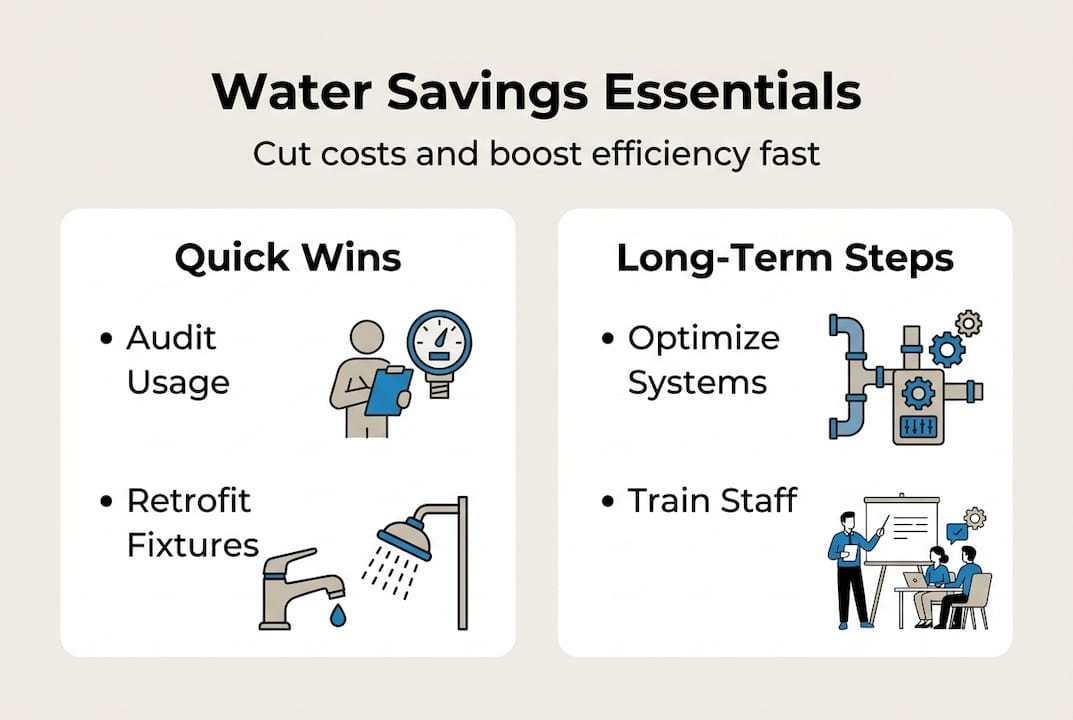
For irrigation, smart controllers that adjust schedules based on weather data and soil moisture sensors can slash outdoor water use by 30 to 50% compared to timer-only systems. Drip irrigation in landscaped areas adds further efficiency.
Water reuse systems, including greywater recycling and condensate recovery, can reduce potable water use by 20 to 50% when properly designed. Condensate from HVAC systems is especially clean and easy to redirect for cooling tower makeup or irrigation. For a detailed implementation framework, the onsite recycling guide covers system sizing, filtration, and compliance considerations.
Here are the key actions to boost mechanical system efficiency:
- Test and adjust cooling tower CoC monthly.
- Install automated pH and conductivity controllers.
- Retrofit irrigation with weather-based smart controllers.
- Capture HVAC condensate for non-potable reuse.
- Map process water loops for recycling opportunities.
Safety note: Do not push cooling tower CoC above recommended limits without verifying your disinfection program. Elevated CoC without adequate biocide treatment raises Legionella risk. Always balance conservation with a validated water treatment protocol.
Sustain results: Training, culture, and ongoing verification
Even the best technology is only as effective as the people and processes supporting it. Hardware upgrades create the conditions for savings, but sustained results depend on the humans operating the facility every day.
Staff training and signage, combined with shutting off unused equipment, directly supports a culture of efficiency. A one-time training session is not enough. Quarterly refreshers, updated procedures when systems change, and visible leadership commitment all reinforce the message that water conservation is a shared operational priority.
Effective signage placement and messaging makes a measurable difference:
- Post reminders above sinks and in kitchen areas to report drips immediately.
- Place water-use data dashboards in break rooms or common areas where staff gather.
- Label irrigation control panels with scheduled run times and responsible contacts.
- Add "report a leak" QR codes near mechanical rooms and restrooms.
- Display monthly water savings progress to build team ownership.
Ongoing verification is equally important. Monthly meter readings against your KPIs catch backsliding early. Quarterly audits confirm that upgraded systems are still performing to spec. Annual reviews let you reassess priorities as the facility evolves.
Pro Tip: Run a department-level water savings competition tied to quarterly meter data. Facilities that have tried this approach report both stronger engagement and measurable reductions in discretionary water use, because people respond to visible progress and a little friendly rivalry.
Tie every improvement back to the facility's climate and cost goals. When staff see that their actions translate into lower utility bills and verifiable ESG metrics, conservation stops feeling like a compliance obligation and starts feeling like a contribution.
Why every drop matters: Lessons most guides skip
Bringing all these strategies together reveals a pattern that most efficiency guides overlook. The facilities achieving 30 to 45% water reductions are not the ones with the most advanced reuse systems. They are the ones that prioritize efficiency fixtures before reuse, following what the 5R principle calls "reduce first."
High-tech greywater and rainwater harvesting systems are compelling, but they add regulatory complexity, maintenance obligations, and upfront capital that can delay results by months or years. Fixing leaks, replacing old fixtures, and optimizing cooling tower cycles costs less, delivers faster ROI, and carries zero compliance risk in most jurisdictions.
The second lesson is that retrofits are the starting line, not the finish line. We see this clearly in facilities that install new fixtures and then watch savings erode within 18 months because no one is monitoring performance or maintaining equipment. Culture and regular review are where value compounds. A facility with average hardware and excellent operational discipline will consistently outperform one with premium equipment and no follow-through.
The third lesson is regulatory awareness. Water reuse rules vary sharply by state, and some jurisdictions restrict greywater reuse to outdoor irrigation only. Skipping this check before installing a reuse system can mean costly retrofits or shutdowns. Review CRE water efficiency results from peer facilities to understand what is actually achievable within your regulatory environment before committing capital.
Unlock your facility's full water savings potential
If you are ready to move beyond the guide and into measurable action, Simpeller's IoT-powered platform gives facility managers and sustainability directors the real-time visibility and verified performance data needed to drive lasting results. Our smartsink sensor devices make invisible leaks and waste visible instantly, while our AI platform converts those efficiency gains into trackable ESG metrics and tokenized savings. Explore facility water solutions tailored to commercial and industrial operations, or go deeper on system design with our onsite guide. Every drop you save is a drop you can measure, report, and reinvest.
Frequently asked questions
How often should we conduct a commercial water audit?
Industry best practice is at least annually, but semi-annual audits give better leak and usage visibility, especially in high-occupancy or process-intensive facilities.
What's the fastest water-saving upgrade for offices and schools?
Replacing old restroom fixtures with WaterSense-labeled models delivers immediate 30 to 50% restroom water savings with a payback period of one to three years.
Is water reuse always allowed for commercial buildings?
Water reuse regulations vary widely by state, so always verify local codes and permit requirements before designing or installing any reuse system.
How much can real-time water monitoring reduce losses?
Connected sensor monitoring has demonstrated up to 19% loss reduction by detecting pressure anomalies and leaks within hours rather than waiting for billing cycle discrepancies.
Do staff engagement programs make a real difference?
Yes. Ongoing training and signage are critical for sustaining savings long-term, because behavioral consistency prevents the gradual erosion of gains that hardware upgrades alone cannot prevent.