

Fewer than one in ten sustainability leaders can accurately explain how tokenised water reuse differs from a carbon credit, yet the technology is already generating verified environmental outcomes at scale. While carbon markets have dominated ESG conversations for years, water tokenization represents a measurable, traceable, and locally grounded alternative that many organizations are only beginning to explore. This guide explains exactly how tokenised water reuse works, what separates it from legacy offset systems, and what practical steps your organization can take to adopt it with confidence.
Table of Contents
- Understanding tokenised water reuse
- How the technology works: from water meter to token
- Benefits of tokenised water reuse for businesses and the environment
- Risks, challenges, and emerging best practices
- Why focusing on local impact is crucial for water tokenization
- Take the next step in water-positive action
- Frequently asked questions
Key Takeaways
| Point | Details |
|---|---|
| Verifiable sustainability impact | Tokenised water reuse converts real recycled water volumes into blockchain-verified credits for genuine environmental outcomes. |
| Business advantages | Adopting tokenisation can improve ESG scores, reputation, and direct funding to community water initiatives. |
| Importance of local focus | To ensure real value, businesses should prioritize buying local, audited water reuse tokens tied to regional stewardship. |
| Technology workflow | Tokens are generated from metered water reuse and tracked from source to retirement with full transparency. |
Understanding tokenised water reuse
Now that we've set the stage, let's look closer at what tokenised water reuse actually involves and how it changes the landscape compared to legacy approaches.
Tokenised water reuse refers to treating wastewater or recycled water and converting verified volumes into blockchain-based digital tokens that businesses can purchase to offset their water usage and support sustainability goals. Each token represents a real, measured cubic meter of water that has been reused rather than wasted. Blockchain technology, a distributed digital ledger that records transactions transparently and permanently, ensures every token is traceable from the moment water is recycled to the moment the credit is retired.
This is fundamentally different from traditional voluntary water credits, which often rely on paper-based tracking, self-reported data, and fragmented governance. Traditional systems struggle with verification gaps and double-counting, where the same water saving is claimed by multiple parties. Tokenised systems eliminate that problem by recording each transaction immutably on-chain.
Here is a quick breakdown of what tokenised water reuse is and is not:
- It is: A verified, blockchain-recorded credit representing one cubic meter of physically reused water
- It is: A tool for achieving water-positive status and supporting boosting ESG with water credits
- It is not: A speculative cryptocurrency or financial instrument disconnected from physical water
- It is not: Interchangeable with carbon credits or renewable energy certificates
- It is not: A substitute for reducing your organization's direct water consumption
"The core mechanism is straightforward: verified reuse volumes become digital assets that fund water infrastructure while giving buyers a credible, auditable offset." This framing, supported by case studies of water tokenization, shows how the model bridges environmental accountability with financial incentive.
The environmental and financial rationale for adoption is strong. Organizations gain verifiable ESG reporting data, reduce reputational risk tied to water scarcity, and directly fund reuse infrastructure in water-stressed regions. The technology is no longer theoretical.
How the technology works: from water meter to token
With the basics clear, let's walk through how tokenised water reuse works in a real operational setting.
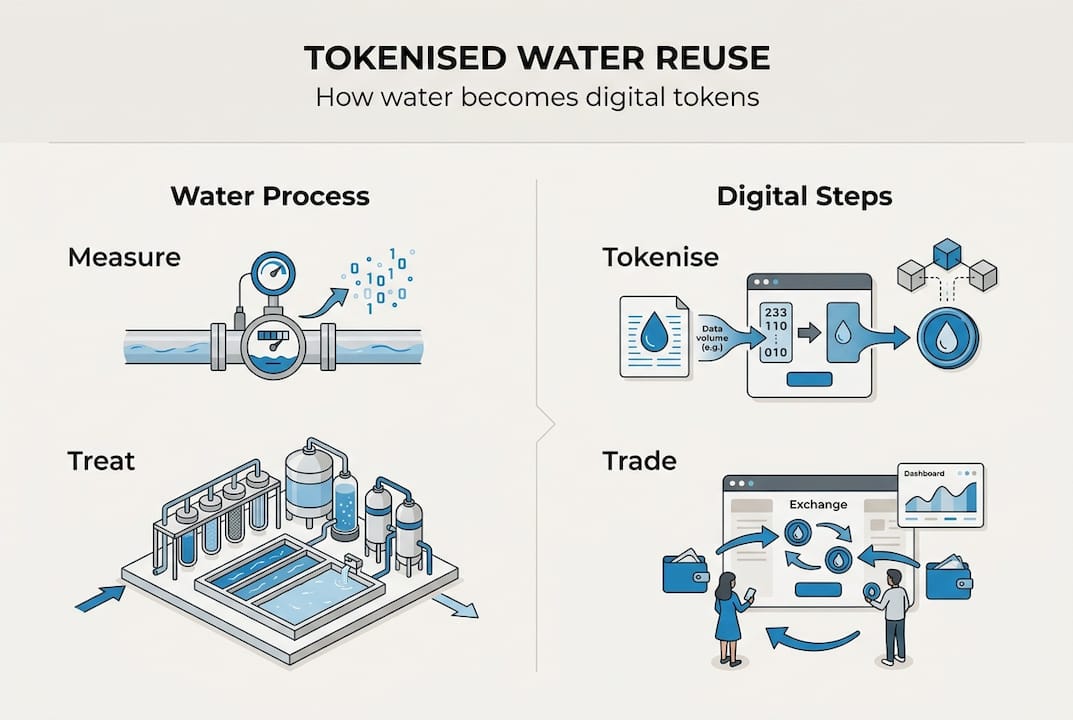
The process follows a clear sequence. Flowmeters connected via APIs register each cubic meter of recycled water on a blockchain such as Algorand, where one WTR token equals one cubic meter reused. Tokens are then audited, issued, sold to water-intensive companies for retirement as offsets, and proceeds are reinvested in water projects. Here is how each stage breaks down:
- Measurement: Smart meters and flowmeters capture real-time water reuse volumes at the treatment facility
- API registration: Meter data is transmitted via application programming interfaces directly to the blockchain, removing manual entry errors
- Token issuance: Each verified cubic meter triggers the creation of one digital token on-chain
- Third-party audit: An independent auditor reviews the data to confirm accuracy before tokens enter the market
- Sale and transfer: Water-intensive businesses purchase tokens through a regulated marketplace
- Retirement: Purchased tokens are permanently retired on-chain, preventing reuse and confirming the offset claim
| Stage | Key actor | Output |
|---|---|---|
| Measurement | IoT smart meter | Verified volume data |
| Registration | API integration | On-chain record |
| Issuance | Blockchain protocol | Digital token (1 m³) |
| Audit | Third-party verifier | Certified credit |
| Sale | Marketplace platform | Transfer of ownership |
| Retirement | Purchasing organization | Permanent offset record |
Blockchain technology ensures data integrity at every stage. Because records are distributed across thousands of nodes, no single party can alter or delete an entry. This makes the audit trail far more robust than spreadsheet-based tracking.
Pro Tip: Before purchasing tokens, verify that the provider uses a recognized blockchain water recycling standard, conducts independent third-party audits, and reinvests proceeds into the local basin where the water was reused. These three criteria separate credible programs from superficial ones.
Benefits of tokenised water reuse for businesses and the environment
Now, let's consider why sustainability-minded companies are prioritizing tokenised water reuse over conventional methods.
Tokenised water reuse enables businesses to achieve water-positive status through verifiable offsets that fund reuse technology in water-stressed areas. That is a meaningful distinction from simply buying a credit that funds a distant, unrelated project.
| Feature | Tokenised water reuse | Traditional water offsets | Carbon credits |
|---|---|---|---|
| Verification method | Blockchain, immutable | Paper-based, variable | Registry-dependent |
| Traceability | Full, on-chain | Limited | Partial |
| Local basin impact | Required by design | Optional | Rarely required |
| Double-counting risk | Eliminated | Moderate | Documented issue |
| ESG reporting quality | High, auditable | Moderate | Variable |
The business benefits extend well beyond compliance. Here is what organizations gain:
- Verifiable ESG data: Every token retirement generates an immutable record suitable for sustainability reports and investor disclosures
- Positive brand reputation: Demonstrable water stewardship builds trust with customers, regulators, and supply chain partners
- Direct project funding: Token purchases channel capital into water reuse infrastructure where it is needed most
- Water-positive certification: Organizations can credibly claim water-positive status backed by audited data
- Alignment with global frameworks: Tokenised credits map directly to water stewardship case studies and recognized standards like AWS and CDP Water Security
Local reinvestment is one of the most compelling features. When a company in a water-secure region purchases tokens generated by a treatment plant in a water-stressed basin, the proceeds flow back into that basin through wetland restoration, infrastructure upgrades, or community water access programs. The ESG benefits of water reuse compound when offset purchases are paired with direct operational reductions.
Risks, challenges, and emerging best practices
Despite the many advantages, the field isn't without challenges. Here's what businesses need to know to navigate risks responsibly.
The most significant risk is financialization. When water credits become tradable assets, market dynamics can push buyers toward the cheapest available tokens regardless of geographic relevance. Blockchain ensures no double-counting and provides immutable verification that carbon markets have historically lacked, but local reinvestment is what adds genuine environmental impact. Buying cheap credits generated in a distant basin does nothing for the watershed your operations actually affect.
Here are the primary challenges organizations face when adopting tokenised water reuse:
- Governance gaps: No universal regulatory standard governs water token issuance across jurisdictions
- Misplaced offsets: Global token markets allow buyers to ignore local basin conditions
- Liquidity limitations: Markets are still maturing, and token availability varies by region
- Technical integration: Connecting existing water infrastructure to blockchain-ready APIs requires investment
- Greenwashing risk: Purchasing tokens without reducing direct consumption undermines credibility
"The debate within the industry centers on whether tokenisation incentivizes genuine reuse infrastructure or simply creates a new speculative layer. The answer depends entirely on governance for water credits and whether basin-specific outcomes are built into the token standard from the start."
Best practices are emerging quickly. Leading programs require that token projects demonstrate impact within the same watershed as the purchasing organization. Audit transparency, meaning publicly accessible verification reports, is becoming a baseline expectation. Organizations should also review whether token proceeds are contractually committed to local water projects rather than general operating funds.
Pro Tip: When benchmarking token providers, ask for their basin specificity policy and a sample audit report. If a provider cannot answer both questions clearly, that is a signal to look elsewhere.
Why focusing on local impact is crucial for water tokenization
Perspectives differ on whether tokenisation inherently solves local water issues, and the honest answer is that it does not do so automatically. Blockchain-enabled water credits are only as impactful as the governance structures built around them. The technology itself is neutral.
The most important insight we've drawn from watching early programs develop is this: water is not a global commodity in the way carbon is. A cubic meter reused in Bristol does not relieve stress in Chennai. When organizations treat water tokens like carbon offsets and shop for the lowest price regardless of location, the environmental rationale collapses. Contrasting viewpoints within the industry acknowledge that tokenisation can incentivize reuse infrastructure and transparency for ESG goals, but it also carries the risk of speculation crowding out real local stewardship.
Businesses that demand basin-specific transparency before participating are not being overly cautious. They are setting the standard. Pairing token purchases with onsite solutions for water reuse ensures that your organization's water story is grounded in measurable, local action rather than distant accounting.
Take the next step in water-positive action
If your organization is ready to move from insight to action, here's where to start.
At Simpeller, we combine IoT sensor technology, AI-driven analytics, and tokenised water reuse assets to help businesses turn every liter saved into a measurable, reportable outcome. Our smartsink devices make water waste visible in real time, and our platform converts verified efficiency gains into credits that support ESG reporting and cross-subsidy models for underserved communities. Whether you are managing a commercial facility, a manufacturing operation, or a multi-site portfolio, Simpeller's water solutions are designed to align with exactly the kind of basin-specific, audit-ready approach this article describes. Connect with our team to explore what tokenised water reuse can look like for your operations.
Frequently asked questions
How does tokenised water reuse differ from carbon credits?
Tokenised water reuse links actual volumes of recycled water to blockchain-verifiable tokens, ensuring traceability and local impact. Carbon credits, by contrast, face well-documented double-counting and verification gaps that water tokenization is specifically designed to eliminate.
Can any business purchase water reuse tokens?
Most water-intensive industries and sustainability-focused organizations can participate, but availability depends on regional project supply and governance standards. Tokens are audited and issued through regulated platforms before they reach buyers, so market access varies by location.
What due diligence should buyers perform before investing in water tokens?
Buyers should verify independent audit reports, confirm that the project operates within the relevant local basin, and check adherence to recognized water reuse standards. Blockchain's immutable verification makes audit trails accessible, so there is no reason to accept a provider that cannot share them.
How do water tokenization projects reinvest in local communities?
A portion of token sale proceeds funds water-centric projects such as wetland restoration or local infrastructure upgrades. For example, YTL Enterprises partners with Hypercube to generate credits from a Bristol recycled water plant, with sales proceeds directed into local environmental projects.