

TL;DR:
- Coastal ecosystems like mangroves and salt marshes sequester more carbon per hectare than many forests, providing long-term environmental benefits.
- Blue carbon projects primarily involve conservation and restoration, supported by verification standards, with co-benefits like flood protection and biodiversity.
- Implementing blue carbon principles in property management through water flow mapping, natural landscaping, and monitoring can enhance ESG performance and operational savings.
Forests get most of the credit for carbon storage, but coastal ecosystems quietly outperform them. Coastal ecosystems sequester CO2 at higher rates per hectare than many terrestrial forests, yet they rarely appear in commercial sustainability strategies. For property developers and facility managers, that gap is an opportunity. Blue-carbon innovation connects directly to water efficiency, natural land management, and measurable ESG outcomes. This article breaks down what blue carbon means, how the broader ecosystem of projects and standards works, and how you can apply these insights to reduce operational costs and sharpen your sustainability reporting.
Table of Contents
- Understanding blue carbon: Nature's powerhouse for carbon storage
- Inside the blue-carbon innovation ecosystem: Key players and frameworks
- Challenges and opportunities: Financing, co-benefits, and measurement
- Applying blue carbon insights: Practical strategies for commercial properties
- Why blue carbon innovation demands a new mindset in commercial sustainability
- Explore innovative blue-carbon solutions for your properties
- Frequently asked questions
Key Takeaways
| Point | Details |
|---|---|
| Powerful natural carbon sinks | Coastal blue carbon ecosystems outperform many forests in carbon storage and offer tangible inspiration for property managers. |
| Ecosystem approach pays off | Integrating water, energy, and land management inspired by blue carbon elevates sustainability and cost efficiency. |
| Blended business models work best | The most scalable blue carbon projects combine conservation, community engagement, and financial innovation. |
| Actionable for commercial properties | Facility managers can adapt blue carbon frameworks and tools to cut costs and meet ESG goals. |
Understanding blue carbon: Nature's powerhouse for carbon storage
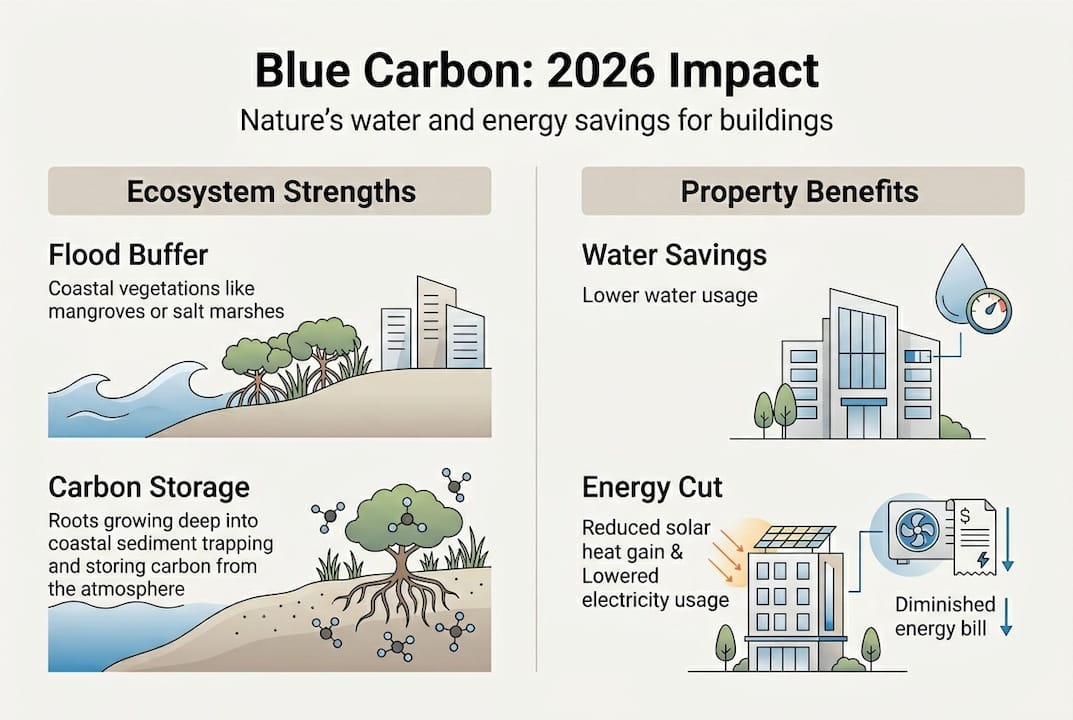
Blue carbon refers to the carbon captured and stored by coastal and marine ecosystems, primarily mangroves, salt marshes, and seagrass beds. These ecosystems do something remarkable: they pull carbon dioxide from the atmosphere through photosynthesis and lock it away in waterlogged, oxygen-poor sediments where decomposition is extremely slow. The result is carbon storage that can persist for centuries, far longer than most land-based systems.
The numbers are striking. Blue carbon ecosystems store up to 1023 Mg C/ha belowground in their sediments, a figure that dwarfs most temperate forests. The key mechanism is anoxic burial: CO2 is sequestered via photosynthesis and then stored in sediments where oxygen is absent, preventing the carbon from re-entering the atmosphere.
How blue carbon compares to other ecosystems
| Ecosystem type | Avg. carbon storage (Mg C/ha) | Storage duration |
|---|---|---|
| Mangroves | Up to 1,023 (belowground) | Centuries |
| Salt marshes | 200 to 600 | Decades to centuries |
| Seagrass beds | 140 to 300 | Decades |
| Temperate forests | 100 to 300 | Decades |
| Tropical forests | 150 to 400 | Decades |
Three ecosystem types drive most blue carbon activity:
- Mangroves: Dense root systems trap sediment and organic matter, building carbon-rich soils over time.
- Salt marshes: Tidal grasses accumulate organic layers that resist decomposition due to salinity and low oxygen.
- Seagrass beds: Underwater meadows capture fine particles and store carbon across vast areas of seafloor.
For commercial property developers, the lesson here is not just ecological. The same principles that make these ecosystems efficient, capturing inputs, minimizing waste, and storing value long-term, apply directly to smart water management strategies on your sites. Designing systems that mimic nature's efficiency means less waste and more measurable impact.
Inside the blue-carbon innovation ecosystem: Key players and frameworks
With a clear grasp of blue carbon's potential, it's vital to understand who drives progress in this space and how projects are structured.
99% of blue carbon projects involve mangrove conservation or restoration, with credit standards such as Verra VCS providing the verification backbone. This concentration tells you something important: the market is still maturing, and early movers have a real advantage in shaping how standards evolve.
The major players fall into three groups:
- Governments and regulators: National and regional authorities set policy frameworks, grant tenure rights over coastal land, and increasingly integrate blue carbon into national climate commitments.
- NGOs and research institutions: Organizations like Conservation International and IUCN develop methodologies, run pilot projects, and publish data that underpins credit verification.
- Commercial developers and investors: Private capital is entering the space through blended finance structures, where public or philanthropic funding de-risks early-stage projects so commercial investors can participate.
A typical blue carbon project follows a structured path:
- Site assessment and baseline carbon stock measurement
- Community and tenure rights negotiation
- Restoration or conservation activity begins
- Third-party verification against a recognized standard (e.g., Verra VCS)
- Carbon credits issued and sold to corporate buyers
- Ongoing monitoring and reporting
Business models are evolving rapidly. Some projects blend protection with aquaculture or sustainable fisheries, generating revenue from multiple streams while maintaining carbon integrity. Others focus purely on credit generation for corporate offset buyers.
Pro Tip: If you are evaluating blue carbon credits for your ESG portfolio, prioritize projects with verified tenure rights and community benefit agreements. These factors significantly reduce the risk of project reversal, which is when stored carbon is re-released due to land-use conflict or mismanagement.
For facility managers exploring how tokenisation for sustainability fits into this picture, blue carbon credits are a natural fit. Tokenized carbon assets can be tracked, traded, and reported with the same transparency that water reuse metrics demand.
Challenges and opportunities: Financing, co-benefits, and measurement
Having defined the innovation ecosystem, it's important to face both the persistent obstacles and the unique upsides blue carbon projects offer.
The core challenge is scale. Carbon credits tap only about 2% of the blue carbon ecosystem's potential, and reaching meaningful scale requires blended finance structures that most commercial developers have not yet engaged with. The gap between what is possible and what is funded remains enormous.
Permanence, monitoring, and tenure rights remain the three major hurdles for scaling blue carbon solutions. Carbon permanence is uncertain because coastal ecosystems face rising sea levels, storm damage, and land-use pressure. Monitoring is technically demanding, requiring remote sensing, field surveys, and ongoing data analysis. Tenure rights are often contested, particularly in developing regions where coastal land governance is weak.
Key barriers to watch:
- High upfront restoration costs with long payback periods
- Uncertainty around how long carbon stocks take to recover after disturbance
- Complex monitoring requirements that demand specialized expertise
- Risk of "green grabbing," where communities lose access to coastal resources they depend on
Yet the opportunities are equally compelling. Blue carbon projects generate co-benefits that go well beyond carbon:
"Coastal restoration delivers flood protection, biodiversity gains, improved fisheries productivity, and water quality improvements, all of which have direct economic value for adjacent properties and communities."
For commercial property developers, flood protection and water quality improvements are directly relevant to operational risk. Properties near restored coastal zones face lower insurance exposure and benefit from natural water filtration that reduces treatment costs.
Pro Tip: When assessing a blue carbon project for investment or offset purposes, request a co-benefits report alongside the carbon verification documents. Quantified biodiversity and flood protection data strengthens your water reuse and ESG reporting and adds resilience to your sustainability narrative under ESRS2 sustainability frameworks.
The inclusion of local communities is not optional. Projects that bypass community engagement consistently underperform on permanence metrics because local stakeholders are often the most effective monitors and protectors of restored ecosystems.
Applying blue carbon insights: Practical strategies for commercial properties
Understanding theory is essential, but actual impact comes from putting blue carbon thinking into action, especially for those in charge of large facilities.
Blue carbon tools like the Blue Carbon Cost Tool support project prioritization and business model structuring, giving developers a data-driven foundation for decision-making. You do not need to own coastal land to apply these frameworks. The underlying logic translates directly to commercial site management.
Here are five practical steps facility managers can take now:
- Map your site's water flows. Use sensor data to identify where water enters, moves through, and exits your property. This mirrors the sediment-trapping logic of mangrove root systems and reveals reuse opportunities.
- Integrate natural landscaping. Wetland-inspired planting on commercial sites reduces stormwater runoff, lowers irrigation demand, and creates measurable biodiversity co-benefits that support ESG reporting.
- Adopt portfolio-level water reuse tracking. Apply the same rigor used in blue carbon monitoring to your greywater recycling systems, tracking volumes, quality, and cost savings across multiple buildings.
- Tokenize your efficiency gains. Convert verified water and energy savings into tradeable credits using platforms built for transparency, creating a financial incentive structure similar to blue carbon credit markets.
- Prioritize data continuity. Blue carbon projects fail when monitoring lapses. The same applies to building efficiency programs. Continuous IoT-based monitoring through tools like water management strategies ensures your data stays audit-ready.
Pro Tip: Start with a baseline audit of your site's water consumption and natural drainage patterns before investing in any new infrastructure. Knowing your starting point is the single most important factor in measuring real impact, whether you are managing a coastal restoration project or a commercial building's water systems.
The crossover between blue carbon methodology and commercial property management is more direct than most developers realize. Both require verified baselines, continuous monitoring, transparent reporting, and a long-term commitment to maintaining performance.
Why blue carbon innovation demands a new mindset in commercial sustainability
Most commercial sustainability programs focus on what is visible: solar panels, LED lighting, energy management systems. These are valuable, but they represent only one layer of what is possible. The conventional green building checklist rarely asks whether the site's water flows, landscaping, and land management are doing active environmental work.
Blue carbon thinking challenges that. It asks: what if your property's natural systems were generating measurable carbon and water value, not just reducing harm? That shift from mitigation to active contribution is where the next era of commercial sustainability is heading.
Combining blue carbon frameworks with modern monitoring tools, like IoT sensors and tokenisation and blue carbon platforms, produces results that compliance-only approaches cannot match. You get verified data, tradeable value, and a sustainability story that holds up to investor and regulatory scrutiny. The developers who move first on this integration will not just meet future standards. They will set them.
Explore innovative blue-carbon solutions for your properties
Blue carbon innovation is no longer a niche topic for coastal ecologists. It is a practical framework for commercial property developers and facility managers who want to slash water costs, strengthen ESG credentials, and generate measurable environmental value. At Simpeller, our IoT-enabled smartsink devices and AI-driven platform make it possible to track, verify, and tokenize your water and energy efficiency gains with the same rigor that blue carbon projects demand. Whether you are managing a single facility or a large portfolio, water and energy savings start with visibility. Connect with us to see how our tools can map directly to your sustainability goals and turn every efficiency gain into a reportable, tradeable asset.
Frequently asked questions
What are blue carbon ecosystems and why do they matter for property developers?
Blue carbon refers to carbon captured by coastal ecosystems like mangroves, salt marshes, and seagrasses, which store more carbon per acre than most forests. For developers, engaging with these ecosystems or applying their principles to site management reduces carbon footprint and strengthens sustainability credentials.
How can commercial properties participate in blue carbon projects?
Commercial-scale blue carbon projects generate credits and often blend production with protection, meaning developers can fund restoration for offset credits or integrate blue carbon-inspired water and land management techniques directly into their operations.
What are the biggest risks or downsides to blue carbon initiatives?
Permanence, monitoring, and tenure rights are the primary risks, alongside high restoration costs and potential community conflicts. Restoration can recover 50 to 90% of original carbon stocks, but only over decades with sustained investment.
Are there direct water and energy savings from blue carbon for buildings?
Natural blue carbon processes can be adapted for property water flow monitoring and management, with direct savings coming from applying similar adaptive strategies to site drainage, natural landscaping, and greywater reuse systems.
How can I measure the impact of blue carbon innovations on my property's ESG rating?
ESRS2 addresses monitoring and efficiency in commercial buildings, making it directly relevant to blue carbon-inspired strategies. Combining operational metrics with ecosystem service outcomes gives you a defensible, auditable ESG impact record.