

TL;DR:
- Tokenisation converts verified resource savings into digital, tradable assets for transparency and monetization.
- Most facilities benefit from hybrid, off-chain approaches over full public blockchain deployment.
- Starting with pilot projects on high-consumption systems enables risk reduction and regulatory alignment.
A commercial real estate portfolio of 15 buildings saved $2M per year in energy costs through IoT-driven HVAC optimization, a 29% reduction. A single office tower cut HVAC spend by 28%, saving $392K annually. A multifamily property slashed water consumption by 63%, saving 12.9 million gallons and $155K per year. These aren't projections; they're verified outcomes. Yet few facility managers realize that the next frontier isn't just achieving these savings. It's tracking, reporting, and monetizing them through tokenisation. This guide clarifies what tokenisation is, how it applies to commercial properties, and the practical steps you can take to turn efficiency gains into measurable, tradeable assets.
Table of Contents
- What is tokenisation and why does it matter for facilities?
- How tokenisation unlocks measurable energy and water savings
- Addressing reliability, verification, and greenwashing risks
- Getting started: Tokenisation pilots and best practices
- A fresh perspective: Most facilities don't need full on-chain tokenisation yet
- Advance your facility's sustainability with tokenisation solutions
- Frequently asked questions
Key Takeaways
| Point | Details |
|---|---|
| Tokenisation demystified | Converting energy and water savings into digital assets boosts transparency and reporting power. |
| Concrete savings | Facilities have realized up to 63% water and 29% energy savings, making verification vital. |
| Trust through verification | Hybrid frameworks and regulated chains keep tokenisation credible and compliant. |
| Pilots over perfection | Start with small-scale projects and grow as regulations and technology mature. |
What is tokenisation and why does it matter for facilities?
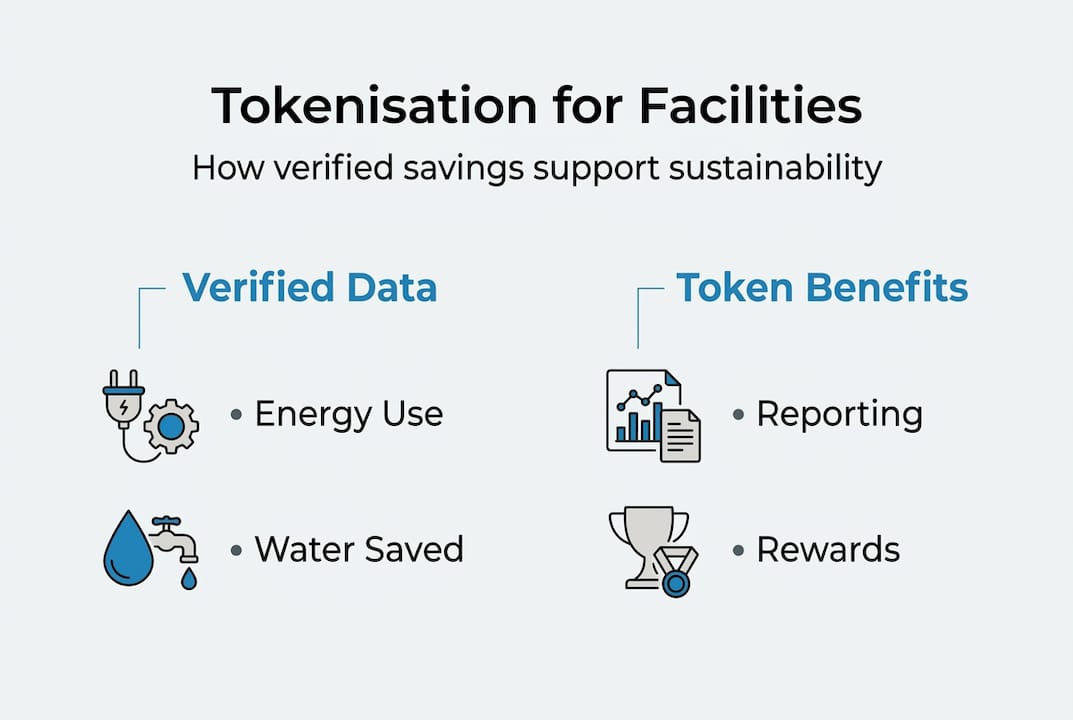
Tokenisation is the process of converting real-world assets or utility metrics, such as kilowatt-hours saved or gallons of water recycled, into digital tokens that exist on a ledger. Think of each token as a verified receipt for a measurable action. Instead of a spreadsheet showing reduced consumption, you hold a digital record that can be audited, reported, or exchanged.
There are two main approaches. On-chain tokens are recorded on a public or permissioned blockchain, making them visible and tamper-resistant. Off-chain tokens exist in a private database or hybrid system, offering more control but less external verifiability. For most facility managers, the distinction matters because it affects how credible your sustainability claims are to regulators, investors, and tenants.
The core advantages of tokenisation for commercial properties include:
- Transparency: Every saving is logged with a timestamp and data source, making audits straightforward.
- Tradability: Verified tokens can potentially be exchanged for renewable energy credits, material vouchers, or used in cross-subsidy programs.
- Automated compliance reporting: Token records can feed directly into ESG dashboards, reducing manual reporting labor.
- Accountability: Tokens tie performance claims to real sensor data, not estimates.
This is where the stakes get real. As the GDF Report on tokenization for net zero notes:
"Tokenization enhances transparency and liquidity but risks greenwashing if savings are unverifiable. Regulated chains and robust verification are essential."
The risk of greenwashing, making sustainability claims that can't be independently confirmed, is significant. Facilities that generate tokens without verified data behind them expose themselves to regulatory and reputational risk. This is precisely why tokenisation uptake has been slower in facility management than in energy production. Power plants have standardized metering and established regulatory frameworks. Commercial buildings, by contrast, have fragmented systems, inconsistent metering, and complex ownership structures that make standardized data collection harder.
Still, the opportunity is real. Tokenised water reuse is already showing how verified conservation actions can be converted into measurable value, pointing the way for broader facility adoption.
How tokenisation unlocks measurable energy and water savings
The path from raw meter data to a verified digital token follows a clear sequence. Understanding each step helps you identify where your current infrastructure fits and where gaps need to be filled.
The process looks like this:
- Sensing and data collection: IoT sensors and smart meters capture real-time consumption data for water, electricity, and HVAC systems.
- Token generation: A platform converts verified consumption reductions into digital tokens, each representing a defined unit of savings.
- Verification: An independent or algorithmic process confirms the data is accurate and the savings are real.
- Trading or reporting: Tokens are used for ESG reporting, exchanged for credits, or held as proof of performance.
Here's how the numbers shift when digital optimization is applied:
| Facility type | Baseline consumption | Post-optimization savings | Annual financial impact |
|---|---|---|---|
| CRE portfolio (15 buildings) | Baseline energy spend | 29% energy reduction | $2M per year |
| Office tower | Baseline HVAC spend | 28% HVAC reduction | $392K per year |
| Multifamily property | 20.5M gallons per year | 63% water reduction | $155K per year |
These figures aren't theoretical. They reflect what happens when you connect existing infrastructure to a monitoring platform and act on the data.
Pro Tip: Start with your highest-consumption systems, typically HVAC and irrigation. These generate the clearest data signals and produce the largest savings, which makes them ideal candidates for your first tokenisation pilot.
IoT water monitoring is one of the fastest ways to generate the verified data streams that tokenisation requires. Once your sensors are in place and your smart water management platform is running, the data foundation for token generation is already there. The key insight is that you don't need to build a new system from scratch. You need to connect what you already have to a verification and reporting layer.

Addressing reliability, verification, and greenwashing risks
Not every tokenisation project delivers real value. Some generate tokens without the verification backbone to support them, which creates legal exposure and undermines trust with stakeholders. Here's how to tell the difference between a robust framework and one that's mostly hype.
| Feature | Weak token framework | Robust token framework |
|---|---|---|
| Data source | Manual entry or estimates | Verified IoT sensor data |
| Verification | Self-reported | Independent or algorithmic audit |
| Chain type | Unregulated or opaque | Regulated, permissioned, or hybrid |
| Audit trail | Incomplete | Full timestamp and source log |
| Regulatory alignment | Undefined | Mapped to MiCA or equivalent standards |
Common pitfalls to avoid:
- Unverifiable baselines: If you can't prove what your consumption was before optimization, your savings tokens have no credibility.
- Single-source data: Relying on one meter or one sensor creates gaps that auditors will flag.
- Ignoring regulatory timelines: Frameworks like MiCA in the EU are evolving fast. Projects that don't account for compliance now will face costly retrofits later.
- Overpromising tradability: Not all tokens are liquid. Understand what your tokens can actually be used for before building a business case around trading them.
The GDF report is direct on this point: regulated chains and independent verification are non-negotiable for credible outcomes. Research on hybrid verification for tokenisation reinforces this, recommending that facilities prioritize hybrid on/off-chain systems that combine the auditability of blockchain with the operational flexibility of private databases.
For token verification methods, the strongest approach pairs IoT sensor data with a third-party verification layer before any token is issued. Start small, prove the model, then scale.
Getting started: Tokenisation pilots and best practices
For facility managers ready to move from theory to action, a structured pilot is the most reliable path forward. Pilots reduce financial risk, generate the internal data you need to build a business case, and give your team time to learn the compliance landscape before committing to full deployment.
Steps for running a tokenisation pilot:
- Select a high-consumption area: Choose one system, such as HVAC, irrigation, or hot water, where you have existing metering and clear baseline data.
- Choose a suitable ledger approach: For most facilities, a Layer 2 blockchain or hybrid off-chain system offers the right balance of auditability and operational simplicity.
- Define your metrics: Decide what one token represents, for example, one kilowatt-hour saved or 100 gallons of water recycled. Consistency here is critical for reporting.
- Partner with a verifier: Engage a third-party auditor or use a platform with built-in algorithmic verification to validate your data before tokens are issued.
- Report and iterate: Use your pilot results to refine your model, demonstrate ROI to stakeholders, and prepare for broader rollout.
Pro Tip: If you already have IoT sensors installed, you're closer than you think. Export your historical consumption data and use it to establish a verified baseline before your pilot begins. This step alone can save weeks of setup time.
Building the internal business case matters as much as the technical setup. Present your pilot in terms of cost reduction, ESG reporting improvement, and regulatory readiness. Onsite water recycling projects are particularly strong candidates because they generate both financial savings and verifiable environmental impact, two things that translate directly into token value.
Regulatory preparation is also essential. Water reuse and ESG frameworks are tightening globally, and facilities that build compliance into their tokenisation model from day one will have a significant advantage. As hybrid verification research confirms, starting with pilots and ensuring compliance with emerging regulations is the most defensible path forward.
A fresh perspective: Most facilities don't need full on-chain tokenisation yet
Here's the uncomfortable truth that most industry coverage skips: rushing to operate fully on a public blockchain is often the wrong move for commercial facilities in 2026. The operational complexity is real, the regulatory environment is still forming, and the cost of getting it wrong is high.
What actually works for most buildings is a hybrid or "token-simulated" approach. You capture verified savings data, structure it in a token-compatible format, and use it for ESG reporting and internal accountability without necessarily settling every transaction on a public chain. You get 80% of the benefit with a fraction of the risk.
The facilities that are winning right now aren't the ones chasing headlines about blockchain. They're the ones running disciplined pilots, building clean data infrastructure, and iterating fast. A water savings guide grounded in verified IoT data is more valuable than a token on an unregulated chain. Smart pilots and compliance beat industry hype every time. Scale responsibly, and the full on-chain transition becomes a natural next step rather than a gamble.
Advance your facility's sustainability with tokenisation solutions
The connection between verified savings and tokenised assets is where operational efficiency becomes strategic value. If your facility is already generating water and energy savings, the next step is making those savings visible, reportable, and rewarding. Simpeller's IoT sensor platform and AI-driven tools are built to do exactly that, turning consumption data into verified performance records that support ESG reporting, cost reduction, and climate impact. Whether you're running your first pilot or scaling an existing program, facility sustainability solutions from Simpeller give you the infrastructure to track, manage, and tokenize every efficiency gain. Explore what's possible for your portfolio today.
Frequently asked questions
How does tokenisation help reduce water and energy waste in buildings?
Tokenisation tracks verified savings in real time, making reductions measurable, reportable, and even tradeable, which drives more consistent and accountable resource management across your portfolio.
Can tokenisation be used for both energy and water management?
Yes, the same verified data stream principles apply to both energy and water systems, and digital tokens can represent either asset class, giving facility managers a unified framework for tracking all resource efficiency gains.
What are the biggest risks when implementing tokenisation in facility management?
The main risks are unverifiable data, greenwashing exposure, and regulatory non-compliance. Hybrid verification pilots with robust audit trails are the most effective way to mitigate all three before scaling.
Do I need to use a public blockchain for tokenising facility savings?
Not necessarily. Hybrid or private approaches often deliver the core benefits of auditability and reporting with lower operational risk and better alignment with current regulations.
Recommended
- What is tokenised water reuse? A guide for 2026
- Every drop of water saved, powers a new ray of light.
- Smart water management: 50% savings & sustainability
- Water Reuse Cuts CRE Water Costs 50% & Boosts ESG in 2026
- How Energy Statements Contribute to Lowering Carbon Emissions in London - Complete EPC
- Real-time energy management: 36% savings unlocked