
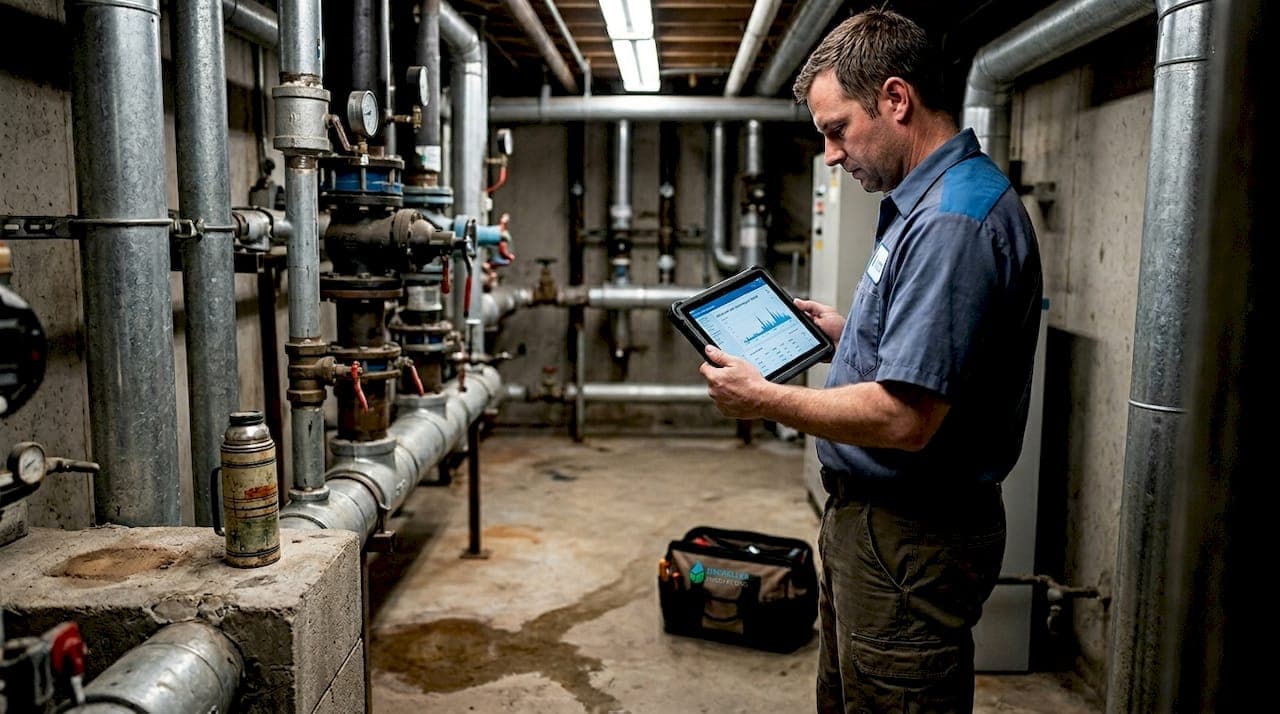
Undetected leaks and unchecked water consumption quietly drain facility budgets while undermining sustainability commitments. Many facility managers only discover the damage after reviewing a monthly utility bill, by which point thousands of gallons are already gone. IoT-powered monitoring workflows change that equation entirely. By deploying connected sensors and AI-driven analytics, facilities can achieve 20% annual reduction in water use through early leak detection alone. This guide breaks down every step of that workflow, from sensor selection and deployment to anomaly detection, alerting, and ESG reporting, so you can act before waste becomes a crisis.
Table of Contents
- Understanding water consumption monitoring workflows
- Preparing for IoT deployment: requirements and best practices
- Step-by-step process for monitoring and managing water consumption
- Troubleshooting and optimizing your monitoring workflow
- Why most water monitoring initiatives fail (and how to beat the odds)
- Ready to transform your water management?
- Frequently asked questions
Key Takeaways
| Point | Details |
|---|---|
| IoT workflow advantage | IoT-driven workflows enable real-time water monitoring and cut costs by up to 20% in the first year. |
| Non-intrusive sensors | Retrofits using ultrasonic sensors avoid facility downtime while boosting coverage and accuracy. |
| Automation boosts ROI | Linking monitoring with automated alerts and work orders maximizes savings and reduces damage severity. |
| Continuous optimization | Ongoing calibration and data analysis ensure workflows stay effective and compliant for years. |
Understanding water consumption monitoring workflows
A water consumption monitoring workflow is the structured process by which a facility collects, transmits, analyzes, and acts on water usage data. Think of it as the operational backbone that connects physical sensors to human decisions. Without that backbone, water data is fragmented, delayed, and nearly impossible to act on at scale.
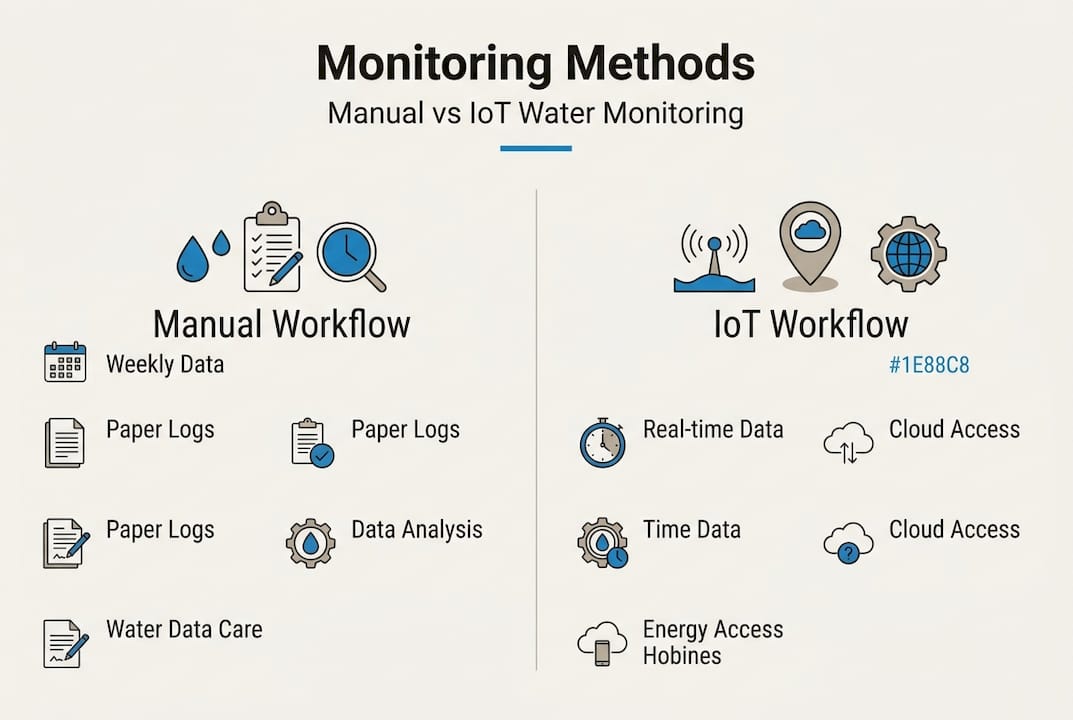
Traditional manual monitoring relies on periodic meter reads, often weekly or monthly. That approach is reactive by design. A leak that starts on a Tuesday might not surface until the next billing cycle. IoT-enabled workflows flip that model entirely, capturing data at continuous 15-second intervals rather than periodic snapshots. The difference in response time is measured in minutes versus weeks.
Despite this, 46% of commercial buildings still lack real-time monitoring. That gap represents enormous, recoverable cost. A well-designed IoT workflow follows a clear sequence: sensor integration, anomaly detection, automated alerting, work order creation, and structured reporting. Each step feeds the next, creating a closed loop that keeps your facility accountable.
Here is a quick comparison of manual versus IoT-enabled monitoring:
| Feature | Manual monitoring | IoT-enabled monitoring |
|---|---|---|
| Data frequency | Weekly or monthly | Every 15 seconds |
| Leak detection speed | Days to weeks | Minutes to hours |
| Anomaly detection | Human review | AI/ML automated |
| Reporting | Manual compilation | Automated dashboards |
| ESG documentation | Labor-intensive | Real-time export |
The practical benefits of moving to a data-driven workflow go beyond leak detection. Multi-parameter sensor arrays can simultaneously track flow rate, pressure, temperature, and water quality, giving you a far richer picture than any single-sensor setup. This matters especially in industrial facilities where process water and cooling systems interact in complex ways.
Key advantages of IoT-enabled workflows include:
- Proactive detection of leaks and pressure anomalies before they escalate
- Zone-level visibility across multiple buildings or production lines
- Automated compliance data for ESG and LEED certification
- Seamless integration with CMMS platforms for instant work order creation
For facilities already exploring a water recycling workflow, real-time monitoring is the essential foundation that makes reuse systems measurable and verifiable. Review facility monitoring benchmarks to understand where your current setup stands relative to industry peers.
"The shift from reactive to proactive water management is not a technology upgrade. It is an operational mindset change that pays for itself within months."
Preparing for IoT deployment: requirements and best practices
Once the differences and opportunities are clear, proper preparation is essential. Rushing into sensor deployment without a readiness assessment is one of the most common and costly mistakes facility teams make.
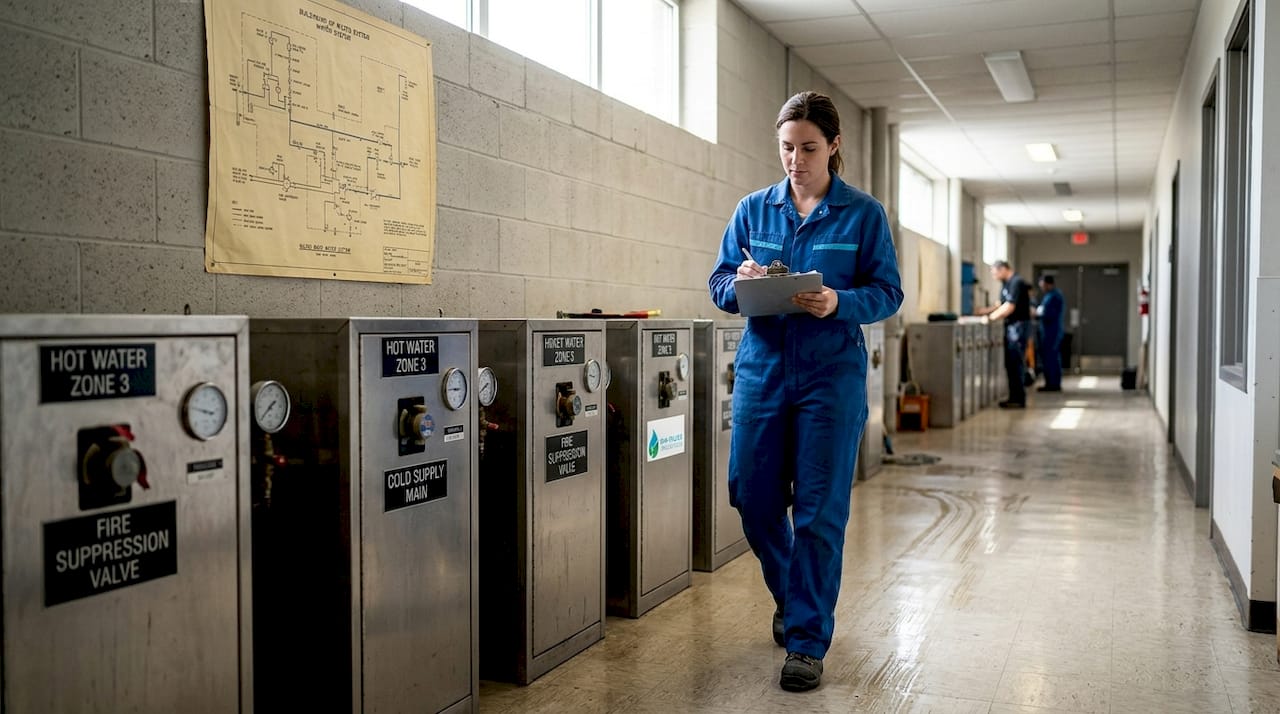
Start by inventorying every water point in your facility: main supply lines, branch circuits, cooling towers, irrigation systems, restrooms, and process equipment. Map each point against its risk profile. A cooling tower leak carries far greater financial and operational risk than a garden tap, so prioritize accordingly.
For retrofit scenarios, non-intrusive ultrasonic sensors are the preferred choice. They clamp onto existing pipes without cutting or shutting down flow, which means zero operational disruption during installation. In harsh industrial environments, sensor encapsulation is critical to combat biofouling, the buildup of biological material on sensor surfaces that degrades accuracy over time.
Connectivity is the next consideration. Your options include:
- LoRaWAN: Long-range, low-power, ideal for large campuses or outdoor assets
- NB-IoT: Cellular-based, suited for facilities with existing mobile infrastructure
- MQTT protocol: Lightweight messaging layer that works well for real-time data streaming to cloud platforms
Battery life is a practical concern that often gets underestimated. With standard configurations, battery life reaches 45 days using duty cycling, but with deeper optimizations that figure can extend to up to 8 years. Plan your maintenance schedule and calibration cycles around these realities from day one.
Here is a quick reference table for sensor selection:
| Sensor type | Best use case | Installation disruption | Typical battery life |
|---|---|---|---|
| Ultrasonic clamp-on | Retrofit pipework | None | 2 to 5 years |
| Inline flow meter | New installations | Moderate | Hardwired |
| Pressure transducer | Leak zone detection | Low | 1 to 3 years |
| Water quality sensor | Process/cooling water | Low | 6 to 18 months |
Pro Tip: Before finalizing your sensor platform, confirm it offers native integration with your existing Computerized Maintenance Management System (CMMS). When anomaly alerts automatically generate work orders, repair timelines shrink dramatically and accountability is built into the process rather than bolted on afterward.
For facilities building a broader sustainability case, aligning sensor deployment with water reuse for ESG goals from the start makes reporting far simpler down the line. Review sensor reliability challenges to anticipate the technical hurdles your team will face in industrial settings.
Step-by-step process for monitoring and managing water consumption
With preparation complete, follow these steps for a robust workflow that delivers measurable results from day one.
-
Deploy sensors at key water endpoints. Install sensors at the main supply entry point, each major branch line, and high-risk equipment such as cooling towers and boilers. This layered approach, often called sub-metering, gives you granular visibility. Facilities using sub-metering best practices consistently achieve 15 to 25% consumption reductions within 18 months.
-
Establish your data transmission pipeline. Configure sensors to transmit readings to an edge gateway or directly to your cloud platform. Edge processing reduces latency for time-critical alerts, while cloud storage enables long-term trend analysis. Ensure your platform supports real-time dashboards accessible to both operations staff and sustainability officers.
-
Configure AI and ML anomaly detection. Set baseline consumption profiles for each monitored zone during normal operating hours. Your AI layer then flags deviations, whether a sudden flow spike at 2 a.m. or a slow pressure decline that signals a developing leak. This is where IoT workflows earn their keep: automated pattern recognition catches what human review misses.
-
Set up automated alerting and work order integration. Define alert thresholds for each zone and map them to the right responders. A minor anomaly might trigger an email to the maintenance team; a major leak should escalate immediately to the facility manager and auto-generate a CMMS work order. Speed of response directly determines damage severity.
-
Generate structured reports for optimization and compliance. Use your platform's analytics to produce weekly efficiency summaries, monthly consumption benchmarks, and annual ESG documentation. Zone-level data simplifies LEED credit applications and supports transparent carbon accounting.
Key stat: Facilities that implement IoT leak detection achieve 20% annual reduction in water use, and those with automated alerting report 93% less damage severity from water-related incidents.
Pro Tip: Schedule a monthly workflow audit where you review alert logs, work order completion rates, and consumption trends together. This single habit catches configuration drift before it erodes your savings.
Troubleshooting and optimizing your monitoring workflow
After setup, long-term value depends on ongoing vigilance and refinement. A monitoring system that runs without maintenance gradually loses the accuracy you depend on.
The most common issues that erode system performance include:
- Sensor drift: Gradual calibration shift that causes readings to deviate from true values over time
- Biofouling: Biological buildup on sensor surfaces, particularly in warm or nutrient-rich water environments
- Supply interruptions: Pressure fluctuations or shutoffs that create false anomaly alerts and erode staff confidence in the system
- Cybersecurity gaps: Unpatched firmware or weak network segmentation that exposes IoT devices to intrusion
Sensor drift and biofouling are the leading accuracy threats in industrial deployments. Hybrid ML models that combine rule-based logic with adaptive learning outperform single-method approaches because they adjust to seasonal and operational changes without requiring constant manual reconfiguration.
Set a calibration schedule based on your environment. High-fouling environments like cooling towers or wastewater systems may need quarterly calibration, while clean water supply lines can often run for 12 months between checks. Document every calibration event in your CMMS so you have an auditable maintenance trail.
Use your dashboard data actively, not just reactively. Trend lines showing gradual consumption increases in a specific zone often indicate slow leaks or equipment inefficiency that hasn't yet triggered an alert threshold. Catching these early is where the real savings compound over time.
"Facilities report ROI benchmarks of 20%+ savings within the first year when closed-loop workflows are properly maintained and staff are trained to act on alerts consistently."
Review long-term system calibration guidance to build a maintenance schedule that keeps your sensors accurate through years of operation, not just the first few months.
Why most water monitoring initiatives fail (and how to beat the odds)
Here is what most implementation guides won't tell you: the technology is rarely the reason water monitoring programs underdeliver. The real culprits are cultural adoption gaps and broken integration loops.
Facilities invest in sensors and dashboards, then watch savings plateau because nobody owns the follow-through. Alerts fire, but work orders stall. Data accumulates, but nobody reviews the monthly trends. The system becomes background noise rather than an operational driver. Closed-loop workflows with automated work orders are what separate facilities that sustain 20% savings from those that see a brief improvement and then drift back.
The fix is organizational, not technical. Assign dedicated "water stewards" within each facility or department. These are staff members with explicit responsibility for reviewing alerts, confirming work order completion, and reporting consumption trends upward. This single structural change creates accountability that no software feature can replicate.
Pro Tip: Pair your water steward program with monthly team briefings where consumption data is shared openly. Visibility creates ownership, and ownership drives behavior change that compounds over years.
True efficiency also requires connecting water data to broader ESG documentation workflows. When water savings feed directly into carbon accounting and stakeholder reporting, the business case for sustained investment becomes self-reinforcing.
Ready to transform your water management?
If the workflow steps above resonate with where your facility needs to go, Simpeller's platform is built to get you there faster. Our plug-and-play smartsink IoT sensors deploy without operational disruption, while our AI-driven dashboard makes anomaly detection and ESG reporting automatic rather than manual. We connect verified water savings to tokenized efficiency credits, so every liter you save generates measurable value beyond the utility bill. Whether you are starting with a single building or scaling across an industrial campus, Simpeller water solutions give your team the visibility, accountability, and reporting tools to sustain savings year after year.
Frequently asked questions
How quickly can I see savings after deploying a water monitoring workflow?
Most facilities see measurable reductions, often up to 20% within the first year, particularly when IoT-enabled leak detection and sub-metering are both in place.
Do I need to shut down operations to retrofit IoT water sensors?
No. Non-intrusive ultrasonic sensors for retrofits clamp directly onto existing pipes without cutting flow or halting operations, making them the practical choice for active facilities.
What are common pitfalls when scaling water monitoring systems?
Sensor drift and biofouling degrade accuracy over time, while missing CMMS integration leaves alerts without follow-through. Regular calibration schedules and automated work order generation address both risks effectively.
How does water consumption monitoring contribute to ESG or LEED certification?
Zone-level consumption tracking produces the granular, auditable data that ESG and LEED credits require, simplifying compliance reporting and strengthening your sustainability disclosures.