

TL;DR:
- ESRS2 provides a structured blueprint for sustainability data, revealing operational efficiencies.
- Facility managers can turn ESRS2 compliance into measurable performance and cost savings.
- Integrating real-time data and strategic planning enhances sustainability reporting and building performance.
Sustainability reporting often gets dismissed as a compliance checkbox, something legal hands off to operations at the last minute. But facility managers who treat ESRS2 that way are leaving serious value on the table. The European Sustainability Reporting Standard 2 is not just a disclosure framework. It is a structured blueprint for identifying where your building wastes water and energy, where operational risk hides, and where efficiency investments pay off fastest. This article breaks down what ESRS2 actually requires, how its four core areas map to real facility decisions, and how leading teams are turning mandatory reporting into measurable performance gains.
Table of Contents
- What is ESRS2 and why does it matter for commercial buildings?
- Understanding ESRS2 disclosure requirements: The four core areas
- How ESRS2 connects to water and energy efficiency metrics
- Best practices: Using ESRS2 to drive innovative efficiency and sustainability
- Why ESRS2 can be your facility's performance advantage, not just a compliance burden
- Take the next step: Enhance your ESRS2 strategy with expert solutions
- Frequently asked questions
Key Takeaways
| Point | Details |
|---|---|
| ESRS2 broadens reporting | Facility managers must report on governance, strategy, risks, and precise energy/water metrics—beyond just financial data. |
| Operational gains possible | Using ESRS2 can unlock real cost cuts and efficiency boosts, especially by using building retrofit and water reuse best practices. |
| Double materiality matters | Reporting now spans the building’s value chain, including tenants and suppliers, to capture a full sustainability profile. |
| Data drives improvement | Accurate site-level metrics are crucial for both compliance and operational upgrades in commercial buildings. |
What is ESRS2 and why does it matter for commercial buildings?
ESRS2 is the general disclosures standard within the European Sustainability Reporting Standards (ESRS) framework, adopted under the EU Corporate Sustainability Reporting Directive (CSRD). Unlike topical standards that cover specific environmental or social issues, ESRS2 sets the foundational reporting architecture that every company in scope must follow. It defines how organizations explain their governance structures, strategic approach to sustainability, material impacts and risks, and the metrics and targets they use to track progress.
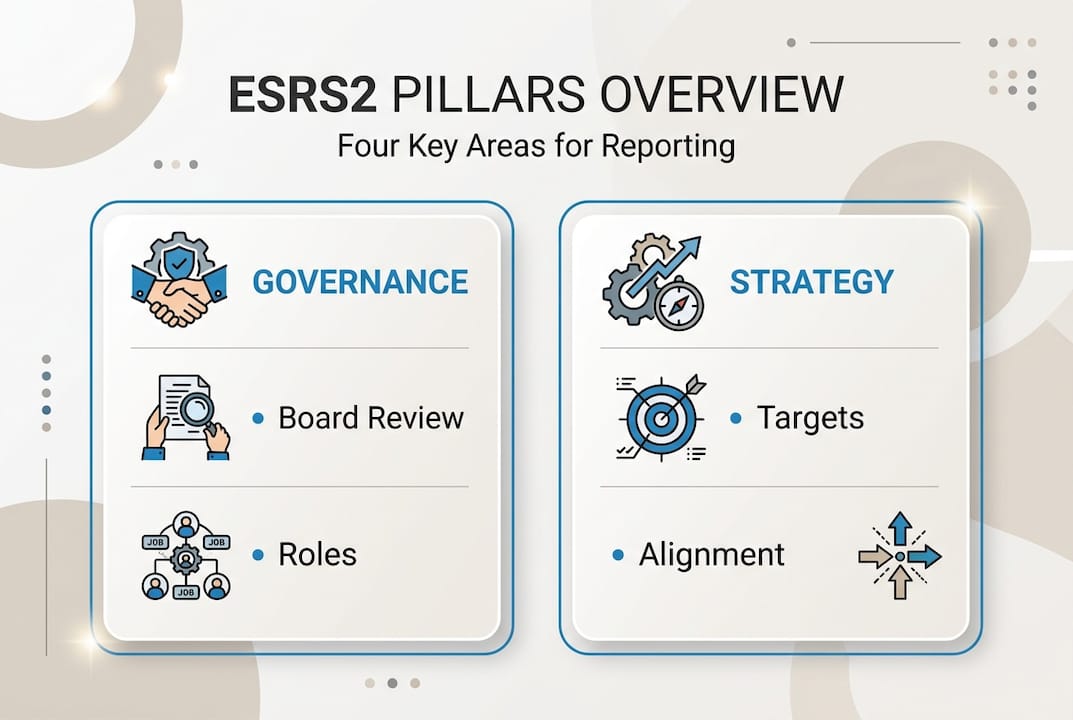
For facility managers, the significance is direct. ESRS2 requires disclosures across four core areas: Governance, Strategy, Impacts/Risks/Opportunities (IROs), and Metrics/Targets. Each of these areas touches something you already manage daily, from board-level oversight of energy budgets to the water consumption data your building management system collects.
What makes ESRS2 different from financial standards or older sustainability frameworks is the concept of double materiality. Traditional financial reporting asks: what sustainability issues affect the company's financial performance? Double materiality asks two questions at once. First, how does sustainability affect the business? Second, how does the business affect the environment and society? For commercial buildings, this means you are not just reporting energy costs. You are also disclosing the environmental impact of your building's consumption on surrounding communities and ecosystems.
Here is a snapshot of what each ESRS2 pillar means for a typical commercial building:
| ESRS2 Pillar | What it covers | Facility relevance |
|---|---|---|
| Governance | Board oversight, accountability structures | Who owns energy/water targets? |
| Strategy | Transition plans, risk integration | How does the building adapt to climate risk? |
| IROs | Physical and transition risks, opportunities | Flood risk, energy price volatility, retrofit ROI |
| Metrics/Targets | Quantified performance indicators | kWh/m², liters/occupant, emissions intensity |
Key implications for commercial building operations include:
- Facilities must document who has governance responsibility for sustainability outcomes
- Strategy disclosures require evidence of how buildings are adapting to physical climate risks
- IRO assessments must cover the full value chain, including tenants and contractors
- Metrics must be quantified, tracked over time, and aligned with ESRS topical standards like E1 (energy) and E3 (water)
"The shift from financial-only reporting to double materiality is not just a regulatory change. It is a fundamental reframing of what a building's performance actually means."
For facility managers, this reframing is an opportunity. The data you already collect, utility bills, sensor readings, maintenance logs, becomes the evidence base for a credible, high-quality ESRS2 disclosure.
Understanding ESRS2 disclosure requirements: The four core areas
With the big picture in place, it is time to drill down into each ESRS2 area for facility reporting. The four pillars are not abstract concepts. Each one has specific data requirements and governance actions that translate directly into facility management practice.
ESRS2 mandates reporting on governance of energy and water efficiency, strategy alignment with sustainability through transition plans, IROs like physical risks to buildings, and metrics like total energy and water use per ESRS E1 and E3. Here is how each pillar breaks down for a commercial building operator:
| Pillar | Required disclosures | Key data sources |
|---|---|---|
| Governance | Board oversight of sustainability, roles and responsibilities | Org charts, board minutes, policy documents |
| Strategy | Transition plans, climate scenario analysis | Capital plans, retrofit schedules, risk registers |
| IROs | Material impacts, risks, and opportunities identified | Asset surveys, tenant data, supply chain audits |
| Metrics/Targets | Energy use (kWh), water withdrawal (m³), emissions (tCO₂e) | BMS data, utility invoices, IoT sensor outputs |
High-impact sectors and facilities in water-stressed locations face additional requirements. Site-level granularity is expected, meaning building-by-building data rather than portfolio averages. This is where many facility teams hit a wall. Aggregated data from a central finance system simply does not meet the standard.
The four steps below outline a practical sequence for building your ESRS2 disclosure capability:
- Map governance accountability: Identify who in your organization has formal responsibility for energy and water performance. Document this clearly.
- Develop a transition plan: Outline how your facilities will reduce energy intensity and water consumption over a defined timeline, aligned with science-based targets.
- Conduct an IRO assessment: Identify physical risks (flooding, heat stress) and transition risks (carbon pricing, regulation) that affect your building portfolio. Include onsite water recycling as a potential opportunity.
- Establish granular metrics: Move from annual utility totals to monthly or weekly data by building, system, and occupancy zone.
Pro Tip: The fastest way to streamline ESRS2 data collection is to connect your building management system (BMS) directly to a centralized reporting platform. IoT-enabled water monitoring for sustainability gives you audit-ready, timestamped data that satisfies both E1 and E3 disclosure requirements without manual extraction.
Document sources to prioritize for each pillar: utility invoices and smart meter exports for metrics, board-approved sustainability policies for governance, capital expenditure plans for strategy, and third-party risk assessments for IROs.
How ESRS2 connects to water and energy efficiency metrics
Once you know the required disclosures, the next step is understanding the metrics that drive operational and sustainability gains. ESRS E1 covers climate change and energy, while ESRS E3 covers water and marine resources. Both are triggered by ESRS2's metrics and targets pillar and require specific, quantified data from your facilities.
For energy, building performance benchmarks show that commercial buildings average an electricity energy use intensity (EUI) of 148 kWh per square meter per year. Through targeted retrofits, including HVAC upgrades, improved insulation, and smart controls, that figure is reducible to approximately 119 kWh per square meter per year, a reduction of roughly 20%. Cooling alone accounts for an EUI of around 36 kWh per square meter per year, making it one of the highest-leverage targets for efficiency investment.
For water, ESRS E3 requires disclosure of total water withdrawal by source, consumption volumes, and specific data for facilities in water-stressed areas. This is not just about metering your mains supply. It includes tracking greywater reuse, rainwater harvesting, and any process water recycling your building operates.
Here is a practical benchmark table for commercial building operators:
| Metric | Baseline (typical) | Post-retrofit target | Improvement potential |
|---|---|---|---|
| Electricity EUI | 148 kWh/m²/yr | 119 kWh/m²/yr | ~20% reduction |
| Cooling EUI | 36 kWh/m²/yr | 27 kWh/m²/yr | ~25% reduction |
| Water withdrawal | Varies by use type | Site-specific target | Up to 50% with reuse |
| Water in stressed areas | Full disclosure required | Granular site data | Compliance + savings |
Projects that directly improve your ESRS2 metrics include:
- HVAC system upgrades and variable speed drives on pumps and fans
- LED lighting retrofits with occupancy-based controls
- Greywater recycling systems for toilet flushing and irrigation
- Rainwater harvesting integrated with building water management
- Sub-metering by floor, zone, or tenant to identify waste hotspots
- Smart leak detection to eliminate invisible losses
When you boost water savings through reuse systems and real-time monitoring, you are not just cutting utility bills. You are generating the verified, granular data that ESRS E3 demands. That data becomes your disclosure, your evidence of progress, and your basis for setting credible future targets.
Best practices: Using ESRS2 to drive innovative efficiency and sustainability
Having mapped out what is required and how metrics tie to building operations, we now explore best practices for maximizing value from ESRS2 implementation. The facility teams getting the most from ESRS2 are not treating it as an annual reporting exercise. They are embedding it into their operational rhythm.
Innovative solutions for water and energy efficiency in buildings, including retrofits, renewables, and smart monitoring, directly support ESRS2 strategy and IRO disclosures and strengthen ESRS E1 and E3 metrics. Leading organizations integrate these improvements into formal transition plans and measurable targets, creating a continuous feedback loop between operations and reporting.
Here are the four actions that separate high-performing facility teams from those simply filing disclosures:
- Run energy and water retrofits on a planned cycle: Do not wait for equipment failure. Use ESRS2 targets to justify proactive investment in insulation, HVAC upgrades, and water reuse systems. The 20% EUI reduction benchmark gives you a credible business case.
- Engage tenants as data partners: Your tenants consume a significant share of your building's energy and water. ESRS2's value chain scope means their consumption is part of your disclosure. Build data-sharing agreements and provide sub-metering access to make tenant data audit-ready.
- Integrate supply chain sustainability: Contractors, cleaning services, and fit-out suppliers all contribute to your building's environmental footprint. ESRS2 IRO assessments require you to consider these relationships. Prefer suppliers with verified sustainability credentials and documented practices.
- Collect granular water data continuously: Monthly utility bills are not enough. Real-time IoT monitoring of water flows, combined with water reuse and ESG gains, gives you the site-level granularity that ESRS E3 demands and the operational insight to act on waste before it becomes a cost.
Pro Tip: Align your facility improvement plan directly with your ESRS2 targets. For each efficiency project, document the expected metric improvement (e.g., reduce water withdrawal by 15% in year one) and track actual performance monthly. This creates a live audit trail that makes year-end ESRS2 reporting straightforward and defensible.
"Double materiality is not a reporting technicality. It is a lens that reveals how your building's resource use affects both your balance sheet and the communities around you. Facility managers who use it as a diagnostic tool find efficiency opportunities that purely financial analysis misses entirely."
Connecting smart water management strategies to your ESRS2 framework ensures that every operational improvement is captured, quantified, and reported with the credibility that regulators and investors expect.
Why ESRS2 can be your facility's performance advantage, not just a compliance burden
Most facility managers encounter ESRS2 as a request from the sustainability or legal team: fill in these fields, provide these numbers, sign off by this date. That framing is a missed opportunity. ESRS double materiality prioritizes impact reporting, which is potentially demanding but genuinely comprehensive for sustainability management.
Here is the uncomfortable truth: most facility teams analyze their own energy and water consumption but stop there. They overlook the value chain, the tenants who drive 40 to 60 percent of a building's actual consumption, the contractors whose practices affect waste streams, and the suppliers whose embedded carbon sits in every renovation. ESRS2 forces you to look at all of it. That wider view is where the real efficiency opportunities live.
The double materiality mindset also changes how you prioritize capital. When you assess both financial risk and environmental impact, water-stressed locations jump to the top of the list for reuse investment. Buildings with high tenant turnover become candidates for sub-metering and engagement programs. Facilities near flood plains get resilience upgrades that reduce insurance costs and improve asset value simultaneously.
Facility managers who embrace this framing find that ESRS2 becomes a living management tool, not an annual document. Exploring innovative water solutions through this lens reveals projects that pay back in both operational savings and reporting credibility. The standard does not just ask what you have done. It asks what you plan to do, and holds you accountable for the gap.
Take the next step: Enhance your ESRS2 strategy with expert solutions
ESRS2 compliance is achievable, but turning it into a genuine performance advantage requires the right data infrastructure and implementation support. Simpeller helps facility teams move from manual reporting to real-time, verified efficiency tracking. Our IoT-enabled smartsink devices and AI-driven platform make water and energy waste visible at the asset level, generating the granular, audit-ready data that ESRS E1 and E3 require. From verified savings to tokenized efficiency gains, we help you connect operational improvements directly to ESG reporting outcomes. Explore sustainable water and energy solutions designed for commercial buildings, and see how measurable efficiency gains can reduce costs, strengthen your ESRS2 disclosures, and support the communities that depend on the same resources you manage.
Frequently asked questions
What specific metrics must facility managers report under ESRS2?
Facility managers must report disaggregated energy and water metrics under ESRS E1 and E3, including total consumption, energy mix by source, and water withdrawal with specific detail for water-stressed locations.
How does ESRS2 differ from other sustainability standards like ISSB?
ESRS double materiality requires reporting on both financial impacts and environmental or social impacts, unlike ISSB, which focuses primarily on what sustainability issues affect the company's financial performance.
Does ESRS2 require site-level data for all buildings?
Site-level granularity is required for high climate-impact sectors and facilities in water-stressed locations, where portfolio-level averages do not meet the standard's disclosure expectations.
Can ESRS2 reporting lead to measurable cost savings?
Yes. Aligning ESRS2 reporting with operational efficiency actions like retrofits and smart water management can reduce energy EUI by 20% and cut water costs by up to 50% through reuse and monitoring programs.