

TL;DR:
- Resource efficiency maximizes output from every resource unit rather than just cutting use.
- Measuring, benchmarking, optimizing, and continuous repetition are key principles for sustained gains.
- Overcoming organizational barriers and embedding accountability drive long-term resource efficiency success.
Commercial and industrial facilities are quietly hemorrhaging money every day. 20 to 30% of commercial building energy is wasted before it ever contributes to productive output. That figure represents millions in avoidable operating costs across portfolios of any size, yet many facility managers and sustainability officers still conflate resource efficiency with basic cost-cutting or environmental compliance. It is neither. This guide cuts through that confusion, delivers clear definitions, actionable measurement frameworks, proven methodologies, and honest advice on the obstacles that separate high-performing facilities from those that flatline after early wins.
Table of Contents
- What is resource efficiency: Definitions and core principles
- How resource efficiency is measured and benchmarked
- Methodologies for achieving resource efficiency
- Common obstacles and what separates leaders from laggards
- Quick wins and advanced strategies for facility managers
- Resource efficiency: What most experts miss
- Next steps: Put resource efficiency into action
- Frequently asked questions
Key Takeaways
| Point | Details |
|---|---|
| Efficiency is measurable | Real benchmarks and EnMS standards ensure resource efficiency means quantifiable improvement, not vague goals. |
| Start with big wins | Focusing on energy-intensive systems like HVAC or pumps delivers the fastest and largest savings. |
| Use proven frameworks | Adopt methodologies like ISO 50001, PDCA, and LCCA to structure and sustain resource optimization. |
| Benchmarks drive improvement | Comparing your facility to industry peers ensures transparency, credibility, and ongoing gains. |
| Leadership sustains progress | Performance-based incentives and integrated strategies keep resource efficiency advancing after easy wins. |
What is resource efficiency: Definitions and core principles
Resource efficiency is not simply using less energy or water. It is about maximizing the value or output you extract from every unit of resource consumed, whether that unit is a kilowatt-hour, a gallon of water, or a ton of raw material. A facility that reduces energy use by shutting down production lines has not improved resource efficiency. A facility that maintains or grows output while consuming less has.
The distinction matters enormously for facility managers and sustainability officers because the wrong framing leads to the wrong decisions. Cost-cutting looks for the cheapest option. Environmental compliance sets a floor and stops there. Resource efficiency, by contrast, treats every input as an opportunity to generate more value, which is why it connects directly to operational resilience, ESG reporting, and long-term asset performance.
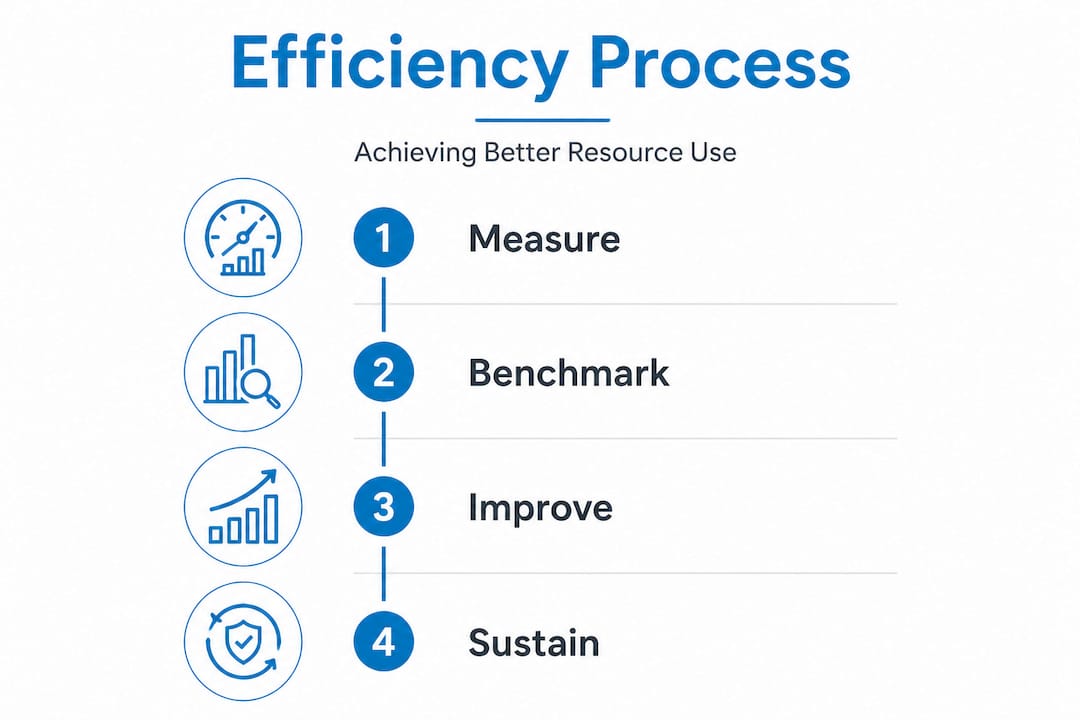
The core principles that drive resource efficiency can be grouped into four repeating actions:
- Measure: Establish what you are actually consuming at a granular level, by system, by zone, by process.
- Benchmark: Compare your consumption intensity against credible peers, standards, or your own historical baseline.
- Optimize: Identify and close the gap between current performance and the benchmark through targeted interventions.
- Repeat: Treat efficiency as a continuous cycle, not a one-time project.
Understanding resource management trends shows that the facilities pulling ahead in 2026 are those that have institutionalized this cycle rather than treating it as a periodic audit.
"Resource efficiency is not a destination. It is a discipline. Organizations that treat it as a project will always be outpaced by those that treat it as a system."
ISO 50001 EnMS provides the gold standard for structured resource optimization, giving facility teams a formal framework to establish energy policies, set measurable objectives, and drive continual improvement. If your organization has not yet adopted an Energy Management System (EnMS), that is the single most impactful structural decision you can make.
Pro Tip: Ground every resource efficiency conversation in a measurable baseline before proposing any intervention. Without a credible starting point, you cannot demonstrate savings, justify capital spend, or hold vendors accountable.
How resource efficiency is measured and benchmarked
Once you understand what resource efficiency means in principle, the next step is being able to quantify and compare it in practice. Measurement without benchmarking tells you what you consume. Benchmarking tells you whether that consumption is acceptable, competitive, or wasteful.
The most widely used metrics in commercial and industrial settings include:
- Energy intensity: kWh per square meter per year, which normalizes energy use across buildings of different sizes.
- Water intensity: Gallons per occupant per day or gallons per unit of production output, depending on your sector.
- Energy per output unit: For industrial facilities, this might be kWh per ton of product manufactured, giving a direct link between resource use and productive value.
The tools that make benchmarking credible and defensible include:
| Tool | What it measures | Best used for |
|---|---|---|
| ENERGY STAR Portfolio Manager | Energy and water use vs. peer buildings | Commercial real estate, offices, hospitals |
| DOE reference buildings | Modeled baseline for energy performance | New construction and retrofit planning |
| EPA water/energy calculators | Water and energy intensity vs. sector norms | Industrial and utility applications |
| ISO 50001 EnPIs | Custom energy performance indicators | Any facility with formal EnMS |
A simple three-step process makes this practical for any facility team:
- Establish a baseline: Collect at least 12 months of utility data, normalized for weather and occupancy. This is your starting point.
- Benchmark against peers: Use ENERGY STAR Portfolio Manager or DOE reference buildings to see where you stand relative to comparable facilities.
- Track progress with EnPIs: Set Energy Performance Indicators (EnPIs) that reflect your specific operations, then monitor them monthly or quarterly.
Facilities that follow this process consistently report 15 to 30% energy cost savings through systematic measurement alone, before any significant capital investment. The act of making consumption visible changes behavior at every level of an organization. Managers make better procurement decisions. Operations teams spot anomalies faster. Finance teams can model efficiency scenarios with real data rather than assumptions.
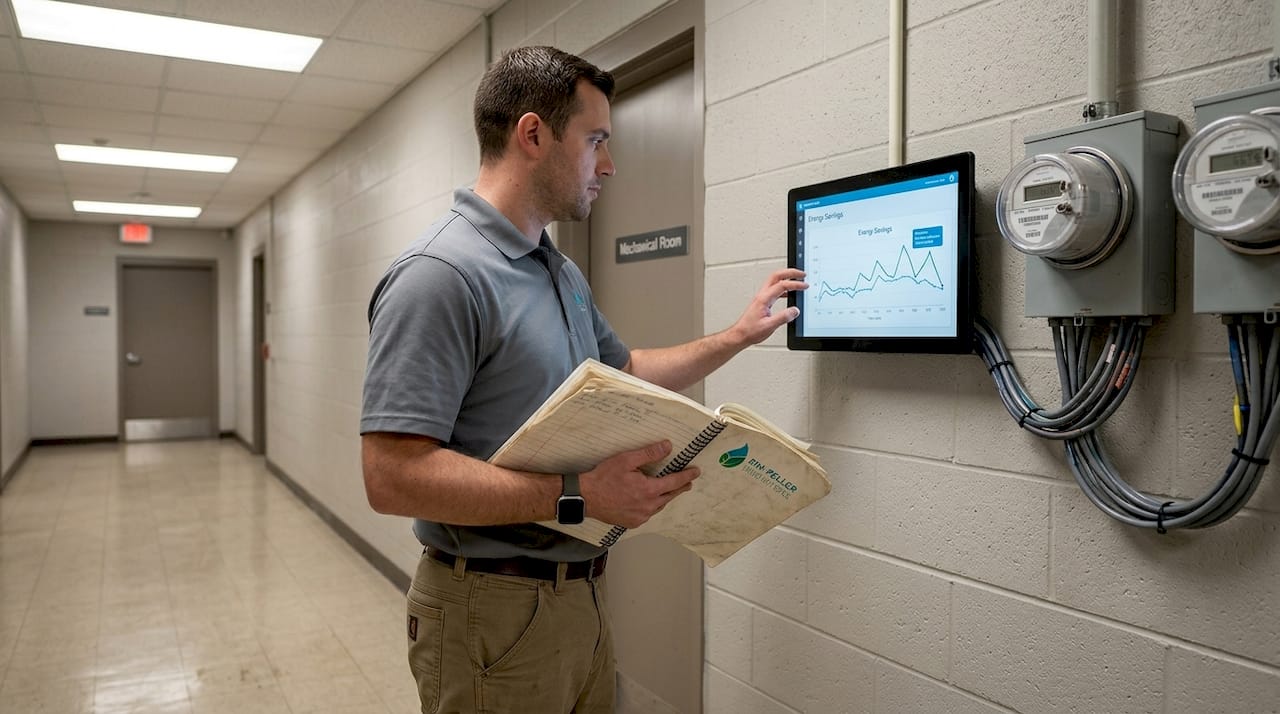
Monitoring energy waste is not a passive activity. It requires IoT-enabled metering, sub-metering by system or zone, and a platform that surfaces anomalies in near real time. The difference between a facility that catches a pump running continuously at night and one that does not is often just the presence or absence of granular monitoring.
Methodologies for achieving resource efficiency
Measuring efficiency is essential, but driving sustained improvement requires structured methodologies. Three frameworks dominate best practice in commercial and industrial facility management.
Energy Management System (EnMS) per ISO 50001 is the most rigorous. It requires an energy review to identify significant energy uses, establishment of baselines and EnPIs, a documented energy policy, and a formal PDCA cycle to drive continual improvement. ISO 50001 EnMS is not just a certification exercise. It is a management discipline that embeds efficiency into operational culture.
PDCA (Plan-Do-Check-Act) is the engine inside EnMS, but it can also be applied independently to specific systems or projects. Plan the intervention, implement it, check the measured outcome against the expected outcome, and act to standardize what worked or revise what did not. This cycle prevents efficiency gains from eroding over time, which is one of the most common failure modes in facility management.
Life-Cycle Cost Analysis (LCCA) is the financial methodology that justifies efficiency investments to stakeholders. Rather than evaluating equipment on purchase price alone, LCCA accounts for energy costs, maintenance costs, water costs, and end-of-life disposal over the full asset life. LCCA for water projects consistently shows that higher upfront investment in efficient pumps, chillers, and water treatment systems pays back within three to seven years and generates substantial net savings over a 20-year asset life.
Here is how these three methodologies compare in practice:
| Methodology | Strengths | Weaknesses | Best use case |
|---|---|---|---|
| EnMS (ISO 50001) | Systematic, auditable, drives culture | Requires significant setup and commitment | Large facilities, multi-site portfolios |
| PDCA | Flexible, fast to apply, iterative | Can lack rigor without formal structure | Project-level improvements, quick wins |
| LCCA | Financially rigorous, stakeholder-ready | Time-intensive, requires good data | Capital investment decisions |
Practical integration of these methodologies with water and energy actions includes:
- Retrofitting HVAC controls with variable frequency drives (VFDs) to cut pumping and fan energy by 20 to 40%.
- Installing sub-meters on cooling towers, boilers, and compressed air systems to identify the largest waste streams.
- Applying LCCA before replacing any major water-using equipment to quantify full lifecycle savings.
- Running quarterly PDCA reviews on the top three energy and water consuming systems.
- Using EnMS energy reviews to prioritize capital spend based on verified performance data rather than vendor claims.
Exploring practical energy-saving devices gives facility teams a concrete starting list for the equipment interventions that deliver the fastest verified returns.
Pro Tip: Always start with HVAC and pumping systems. These two categories typically account for 50 to 70% of a commercial facility's energy consumption, and efficiency improvements of 10 to 30% are achievable with controls upgrades alone, often without major capital expenditure.
Common obstacles and what separates leaders from laggards
Having the right methodologies is necessary but not sufficient. Facility teams encounter real structural and organizational barriers that slow or stall efficiency programs. Understanding these obstacles is the first step to overcoming them.
Split incentives in leased buildings are one of the most persistent barriers. When tenants pay utility bills and landlords control building systems, neither party has a strong financial incentive to invest in efficiency. The landlord does not benefit from lower bills. The tenant cannot modify the building envelope or major systems. This structural misalignment delays adoption of even straightforward efficiency measures for years.
Baseline disputes undermine performance contracts and demand response payouts. If the baseline is set too high, the facility appears to save more than it actually does. If it is set too low, legitimate savings go unrecognized and uncompensated. Non-linear improvement curves make this worse: early gains are large and easy to verify, but later improvements are smaller and harder to attribute, which creates disputes with energy service companies and demand response program administrators.
Diminishing returns are mathematically inevitable. The first 15 to 20% of efficiency gains typically come from low-cost behavioral changes and controls optimization. The next 15% requires capital investment. Beyond that, improvements demand system redesign, process innovation, or technology integration. Facilities that plan only for the first wave are blindsided when progress stalls.
"The facilities that sustain efficiency gains over a decade are not the ones with the best technology. They are the ones with the clearest accountability structures and the most consistent measurement discipline."
How do leaders consistently outperform? Several behaviors distinguish top performers:
- They assign named accountability for energy and water performance at the operations level, not just the sustainability team.
- They tie efficiency outcomes to financial incentives for facility managers, creating alignment between operational behavior and organizational goals.
- They invest in continuous monitoring rather than periodic audits, so anomalies are caught in days rather than quarters.
- They use verified, third-party data to settle baseline disputes before they become contractual problems.
- They build cross-functional teams that include finance, operations, and facilities, ensuring that efficiency decisions are evaluated on full business impact, not just technical merit.
Quick wins and advanced strategies for facility managers
With the challenges clearly mapped, it is time to focus on what you can actually do. Here are three quick wins any commercial or industrial facility can target this quarter:
- Audit your top five energy and water consuming systems using existing utility data and sub-meter readings. Identify the largest gaps between current performance and your benchmark. This costs nothing and typically reveals 10 to 15% of recoverable waste within the first review.
- Install smart controls on HVAC scheduling and setpoints. Many commercial buildings run at full conditioning loads during unoccupied hours. Correcting scheduling alone can reduce HVAC energy use by 15 to 25% with no capital expenditure beyond controls software.
- Conduct a water balance audit. Compare metered water input against known process and sanitary uses. Any unexplained gap represents leakage or waste that can be eliminated quickly once located.
For organizations ready to move beyond quick wins, the advanced strategy is to combine technical, service, and material efficiency into an integrated program. Industrial sectors that integrate these three dimensions can cut energy consumption by 25 to 45% even as output grows, a result that fundamentally changes the economics of sustainability investment.
Applying circular economy logic to water and materials extends this further. Reusing treated process water, recovering heat from wastewater streams, and optimizing asset life through predictive maintenance all generate persistent efficiency gains that compound over time. Detailed guidance on facility water savings, onsite water recycling, and water reuse strategies gives facility teams the specific implementation steps to make these gains real and measurable.
Pro Tip: Use circular economy logic as a filter for every capital decision. Before replacing a system, ask whether the resource it consumes can be recovered, reused, or redirected. This mindset consistently surfaces efficiency opportunities that a purely technical analysis misses.
Resource efficiency: What most experts miss
Most resource efficiency programs follow the same arc. A facility commits to improvement, captures 10 to 20% savings in the first 18 months through controls optimization and behavioral change, celebrates the win, and then quietly plateaus. Leadership moves on. The monitoring cadence slips. Baselines go stale. Within three years, much of the gain has eroded.
The conventional explanation is that diminishing returns are inevitable. That is partially true, but it misses the deeper problem: most programs are designed to produce a result, not to sustain a capability. When the result is achieved, the program winds down. The capability disappears with it.
What genuinely separates transformative efficiency programs from average ones is the alignment of financial, technical, and cultural drivers. Technical systems can measure and optimize. But without financial incentives tied to verified outcomes, the human behavior that drives ongoing improvement does not materialize. Without cultural embedding, the discipline of measurement and accountability fades when priorities shift.
Performance-based water rewards represent one of the most promising mechanisms for sustaining this alignment. When verified efficiency gains translate directly into financial rewards, renewable energy credits, or ESG-reportable outcomes, the incentive to maintain and improve performance persists beyond the initial project phase. Facilities that gamify efficiency tracking, tie team incentives to measured outcomes, and make performance data visible to all stakeholders consistently outperform those that treat efficiency as a back-office function.
The uncomfortable truth is that most organizations underinvest in the measurement and accountability infrastructure that sustains efficiency gains, and overinvest in the technology that generates the first wave of savings. Reversing that ratio is what separates the leaders from the rest.
Next steps: Put resource efficiency into action
If this guide has clarified what resource efficiency actually means and where your facility stands, the logical next step is to make your consumption visible and start generating verified, reportable savings. Simpeller's facility water and energy solutions are built specifically for commercial and industrial facilities that want to move from periodic audits to continuous, IoT-enabled performance tracking. Our smartsink devices and AI-driven platform surface leakages, waste streams, and optimization opportunities in near real time, turning invisible losses into measurable gains. Explore smart water management strategies to see how leading facilities are combining monitoring, benchmarking, and performance-based rewards into programs that sustain efficiency gains year over year.
Frequently asked questions
How is resource efficiency different from just reducing resource use?
Resource efficiency is maximizing desired outputs per unit of energy, water, or materials consumed, not simply using less. A facility can reduce consumption by cutting production, but that is not efficiency. True efficiency means doing more, or the same, with less input.
What are the fastest ways to improve resource efficiency in a commercial building?
Target HVAC optimization, monitor energy waste continuously, and track performance against credible baselines for the fastest cost and efficiency gains. HVAC accounts for roughly 40% of commercial building energy use, making it the highest-leverage starting point for any facility team.
Why do some resource efficiency projects stall after early improvements?
Early gains are often the easiest to capture through behavioral change and controls optimization, but plateauing happens without ongoing leadership, updated baselines, and performance-linked incentives. The non-linear improvement curve means later gains require more investment and stronger accountability structures to sustain.
Is there a single best benchmark or standard for resource efficiency?
No single benchmark covers every situation. Use ENERGY STAR Portfolio Manager for peer comparison and ISO 50001 EnMS for structured internal management, combining both for the most defensible and actionable performance picture.
How can I justify resource efficiency investments to stakeholders?
Use strong baselines, credible peer benchmarks, and LCCA for water and energy projects to demonstrate long-term cost savings and ROI. Stakeholders respond to lifecycle financial data far more than to environmental arguments alone, so anchor every proposal in verified numbers.