

TL;DR:
- Hidden energy waste in commercial and industrial facilities significantly impacts costs and sustainability targets.
- Monitoring methods like BEMS, IoT sensors, and audits help identify and address specific inefficiencies.
- Effective programs depend on data quality, internal accountability, and linking verified savings to measurable outcomes.
Commercial buildings waste up to 30% of energy consumed, and manufacturing facilities lose a similar share during non-productive time. That's not a rounding error. It's a direct hit to your operating budget, your sustainability targets, and your regulatory standing. Most of that waste stays invisible until something breaks or a bill spikes. Facilities managers who wait for that moment are already behind. This guide breaks down exactly how energy waste hides inside your operations, which monitoring methods actually work, what the research says about program outcomes, and how to turn verified savings into measurable value.
Table of Contents
- Uncovering hidden energy waste: Why it matters
- How monitoring works: Methods and technologies
- Advanced analysis and standards: Beyond basic monitoring
- Real-world challenges and program outcomes
- The uncomfortable truth most experts won't tell you about monitoring energy waste
- Ready to maximize savings and sustainability?
- Frequently asked questions
Key Takeaways
| Point | Details |
|---|---|
| Hidden energy waste costs | Even minor leaks and inefficiencies can cost thousands each year if left undetected. |
| Real-time monitoring methods | BEMS, IoT sensors, and audits provide actionable insights to cut waste and improve operations. |
| Compliance and standards | Regulatory requirements and ISO certifications are driving broader adoption and deeper savings. |
| Program pitfalls | Many programs miss savings targets without careful management of incentives and data quality. |
| Actionable next steps | Using the right tools and timing audits before budgeting ensures maximum results. |
Uncovering hidden energy waste: Why it matters
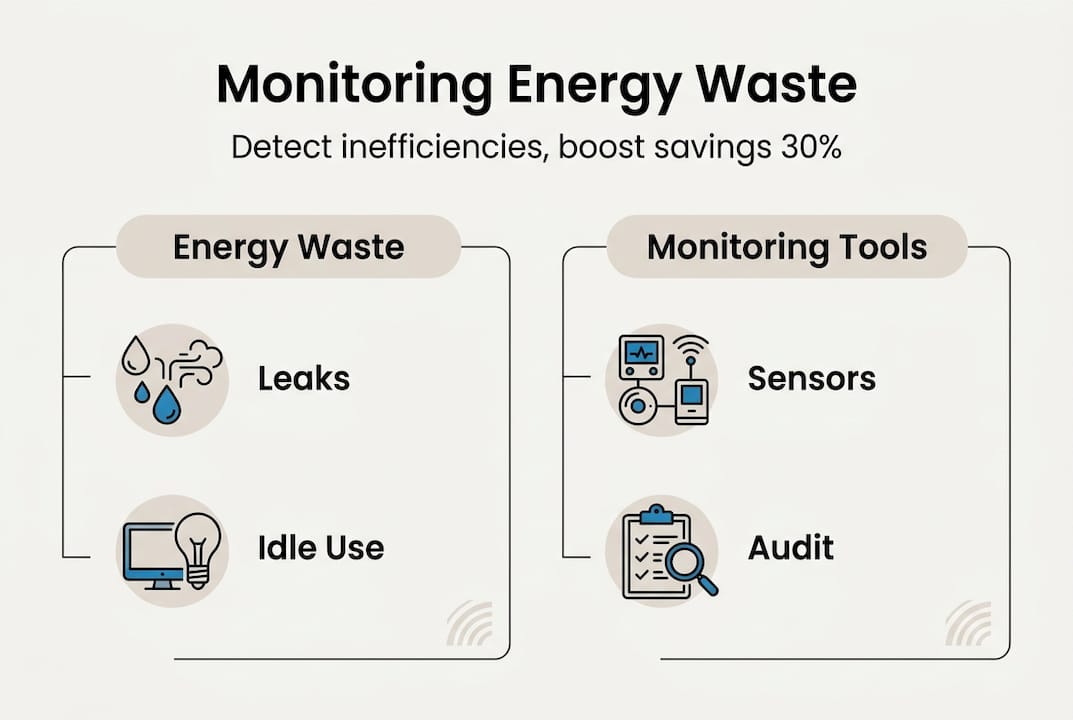
Energy waste isn't always dramatic. It rarely announces itself. Instead, it hides inside compressed air systems running at night, HVAC units cycling too often, lighting left on in unoccupied zones, and equipment idling between production runs. These aren't edge cases. They're the daily reality of most commercial and industrial facilities.
The financial impact is real and significant. A single compressed air leak can cost $2,500 per year, and most facilities have multiple leaks running simultaneously. Multiply that across a mid-sized manufacturing plant, and you're looking at tens of thousands in avoidable losses annually. The problem is that these costs don't show up as line items. They blend into your utility bill and get written off as normal operating expense.
The most common sources of hidden energy waste include:
- Idle equipment: Motors, compressors, and conveyors left running during shift changes or breaks
- Compressed air leaks: Often audible only with ultrasonic detectors, yet costly year-round
- Inefficient HVAC controls: Poorly calibrated setpoints that heat or cool unoccupied spaces
- Lighting in low-traffic areas: Fixtures running on fixed schedules rather than occupancy
- Power factor inefficiency: Reactive power drawing capacity without doing useful work
Beyond cost, there's a growing regulatory dimension. Mandatory monitoring requirements are expanding across jurisdictions, particularly for large commercial buildings and industrial operators. Compliance is no longer optional for many sectors, and the penalties for non-reporting are rising.
The good news is that identifying waste is the first step toward eliminating it. Facilities that cut costs and boost efficiency consistently do so by making the invisible visible first. And with the right monitoring infrastructure, that visibility is achievable without a major capital overhaul. Understanding ESRS2 sustainability and efficiency frameworks also helps facilities align their monitoring programs with reporting obligations from the start.
The shift from reactive to proactive energy management starts with accepting that waste is already happening. The question is whether you're measuring it.
How monitoring works: Methods and technologies
Knowing that waste exists is one thing. Pinpointing it with enough precision to act is another. Modern energy monitoring draws on several overlapping methodologies, each suited to different scales and goals.
Building Energy Management Systems (BEMS) form the backbone of most commercial monitoring programs. These platforms aggregate data from submeters installed at the utility, process, and equipment levels, giving you a layered view of consumption across your entire facility. Real-time BEMS with submetering combined with IoT sensors and edge computing for low-latency anomaly detection represent the current standard for serious energy management.

Here's how the main monitoring approaches compare:
| Method | Best for | Data granularity | Cost range |
|---|---|---|---|
| Utility-level metering | Baseline tracking | Low | Low |
| Submetering | Process and circuit-level | Medium | Medium |
| IoT sensors + edge computing | Real-time anomaly detection | High | Medium-High |
| Energy audits (Level 1-3) | Comprehensive assessment | Very high | Variable |
A structured approach to monitoring typically follows these steps:
- Establish a utility-level baseline using existing meter data
- Install submeters at key process and equipment nodes
- Deploy IoT sensors where real-time feedback is critical
- Conduct a Level 1 or Level 2 energy audit to validate findings
- Use edge computing to filter and prioritize anomalies before they escalate
Understanding the IoT workflow for monitoring is essential before deploying sensors at scale. Without a clear data architecture, you end up with noise instead of insight. The same principle applies to IoT and AI for facility efficiency, where integration between sensor data and analytical platforms determines whether you get actionable outputs or just dashboards.
Pro Tip: Schedule energy audits before your annual budget cycle, not after. Audit findings directly inform capital allocation decisions, and timing them post-budget means waiting another year to fund the fixes.
Data quality is the silent killer of monitoring programs. Sensors drift. Meters get miscalibrated. Timestamps misalign across systems. Building in regular data validation checks is not optional. It's what separates monitoring programs that deliver savings from those that generate reports nobody acts on.
Advanced analysis and standards: Beyond basic monitoring
Once your monitoring infrastructure is in place, the real work begins. Raw consumption data tells you what happened. Advanced analysis tells you why, and what to do next.
Two approaches dominate the technical conversation around load disaggregation. Non-Intrusive Load Monitoring (NILM) analyzes whole-building power signals to identify individual appliance signatures without additional submetering. Intrusive Load Monitoring (ILM) installs dedicated meters at each load point for precise, granular data. NILM vs ILM for load disaggregation each carry tradeoffs: NILM is lower cost but less precise; ILM is accurate but expensive to scale.
AI and machine learning are changing what's possible in fault detection. Predictive models can flag equipment degradation weeks before failure, using weather-normalized Energy Use Intensity (EUI) as a benchmark to separate operational inefficiency from climate-driven variation. This matters because a facility that looks efficient in mild weather may be bleeding energy during peak demand periods.
Here's how key standards and analytical approaches compare:
| Approach | Primary benefit | Limitation |
|---|---|---|
| ISO 50001 | Systematic energy management framework | Requires ongoing internal commitment |
| ISO 14001 | Lowers energy intensity (per GMM research) | Symbolic adoption yields limited real gains |
| AI/ML fault detection | Predictive, reduces downtime | Depends heavily on data quality |
| NILM | Low-cost disaggregation | Less precise than ILM |
Key considerations when advancing your monitoring program:
- ISO 50001 provides a systematic management structure, not just a certification checkbox
- ISO standard compliance combined with operational monitoring delivers deeper savings than either approach alone
- Dynamic GMM modeling shows that ISO 14001 adoption genuinely lowers energy intensity when implemented substantively
- Weather normalization is essential for fair benchmarking across seasons and sites
Pro Tip: Combine regulatory compliance requirements with ISO 50001 implementation. The overlap between mandatory reporting and standard-based management creates efficiency in your compliance workflow and surfaces savings opportunities that neither approach finds alone.
Facilities exploring how monitoring shapes sustainable architecture will find that advanced analytics also support capital planning decisions. And for those working within ESRS2 for commercial efficiency reporting frameworks, AI-driven EUI benchmarking provides the verified performance data that ESG disclosures require.
Real-world challenges and program outcomes
The research on energy monitoring programs is encouraging but honest. Audits work. They drive adoption rates up by 10 to 20 percentage points in participating facilities. But the outcomes aren't always what program designers promise.
"Programs often miss savings goals, with low total resource cost ratios below 1, and ISO 14001 benefits can be symbolic rather than substantive when adoption is surface-level." Nature Energy, 2025
One of the more counterintuitive findings from recent research: unit costs dropped 8% in some audit programs without a corresponding reduction in energy use. Price corrections and operational adjustments drove the savings, not behavioral change. That's useful, but it's not the same as actually using less energy.
Common pitfalls facilities managers encounter in practice:
- Free-ridership in incentive programs: Facilities claiming rebates for efficiency upgrades they would have made anyway
- Missed savings goals: Programs designed around optimistic baselines that don't reflect actual operating conditions
- Low adoption of audit recommendations: Findings sit in reports while equipment keeps running inefficiently
- Incentive misalignment: Rebates tied to equipment purchase rather than verified performance outcomes
Steps to maximize real savings from your monitoring program:
- Tie incentives to verified performance data, not equipment installation
- Set baselines using actual metered data, not industry averages
- Track performance-based rewards against real consumption reductions over time
- Build internal accountability by assigning energy KPIs to department managers
- Review audit recommendations quarterly, not annually
Facilities that connect monitoring outcomes to savings and sustainability goals consistently outperform those treating monitoring as a compliance exercise. And for managers exploring how tokenisation for facility managers can convert verified savings into tangible value, the key is starting with clean, auditable data from the monitoring layer.
The uncomfortable truth most experts won't tell you about monitoring energy waste
Here's what the technical literature glosses over: most energy monitoring programs fail not because of bad technology, but because of bad data and cultural resistance. You can deploy the most sophisticated BEMS on the market, and it will still underperform if your team doesn't trust the data or know what to do with it.
AI and edge computing enhance monitoring significantly, but only when the underlying data quality is sound. Garbage in, garbage out applies here more than anywhere else in facilities management. Sensors need calibration schedules. Data pipelines need validation. Benchmarks need to be set before budget season, not after.
The free-ridership problem in incentive programs is also underreported. Many facilities collect rebates for efficiency upgrades that were already planned. The program gets credit for savings that would have happened anyway. This distorts program evaluations and diverts funding from facilities that genuinely need support.
What actually works is simpler than most vendors suggest. Audit early. Benchmark honestly. Assign accountability. Track performance rewards against verified outcomes, not projected ones. The facilities that consistently reduce energy waste treat monitoring as an operational discipline, not a reporting obligation.
Ready to maximize savings and sustainability?
If this article has made one thing clear, it's that energy waste is measurable, manageable, and directly tied to your bottom line. At Simpeller, we make that measurement simple. Our plug-and-play IoT sensor devices and AI-driven platform surface the waste that's hiding in your facility right now, from compressed air leaks to HVAC inefficiencies, and convert verified savings into rewards you can actually use. Whether that means renewable energy credits, material-exchange vouchers, or ESG-ready carbon accounting, the path from monitoring to value is shorter than you think. Explore business water savings tools and see how Simpeller turns efficiency gains into measurable outcomes for your facility.
Frequently asked questions
How much money can businesses save by monitoring energy waste?
Businesses can recover thousands per year by identifying and fixing inefficiencies. A single compressed air leak costs $2,500 annually, and most facilities have multiple leaks running undetected.
What are the most effective tools for monitoring energy waste?
Energy audits, real-time BEMS with submetering, and IoT sensors with edge computing are the most effective combination for detecting and addressing waste at scale.
Do energy monitoring programs always deliver promised savings?
Programs often miss savings targets due to adoption gaps, free-ridership in incentives, and optimistic baselines, but well-structured programs still lower unit costs and improve operational efficiency.
Is monitoring energy waste required by regulations?
Increasingly yes. Regulatory monitoring requirements are expanding for large facilities and ISO 50001-compliant businesses, making structured monitoring both a compliance necessity and a financial opportunity.