

TL;DR:
- Up to 30% of energy in commercial buildings is wasted but often goophly unaddressed.
- Technology like predictive analytics and digital twins enables real-time efficiency improvements and cost savings.
- Behavioral strategies and leadership support are critical for transforming data into lasting resource management gains.
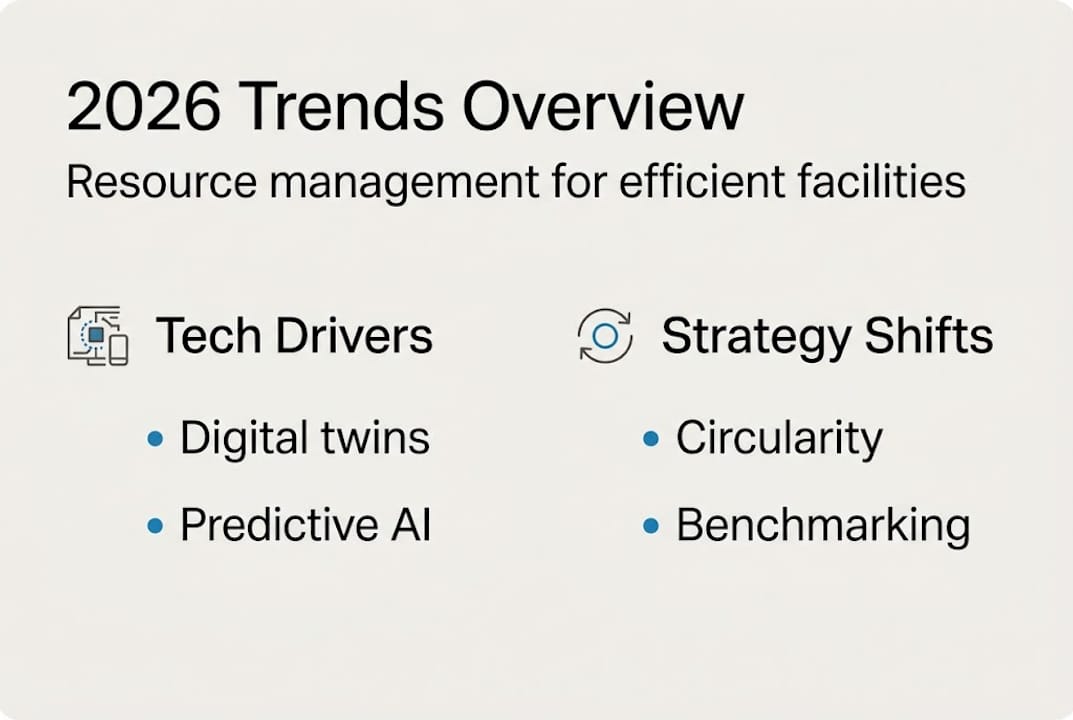
Many facilities are sitting on recoverable savings they haven't touched yet. 30% of energy in commercial buildings is wasted and potentially recoverable, yet most operations continue running on reactive instincts rather than data-driven strategy. 2026 is not a year for incremental tweaks. Climate mandates are tightening, operational costs are climbing, and the gap between high-performing facilities and the rest is widening fast. This guide maps the key resource management trends shaping the year, from predictive analytics and digital twins to behavioral strategy and regional resilience, so you can move from awareness to action with confidence.
Table of Contents
- The evolution of resource management: 2026 landscape
- Tech-powered efficiency: Predictive maintenance and digital twins
- Closing the waste gap: High-resolution benchmarking and KPIs
- Regional and behavioral factors: Beyond technology for lasting impact
- Our perspective: Why efficiency isn't the whole story
- Take the next step in resource management
- Frequently asked questions
Key Takeaways
| Point | Details |
|---|---|
| Digital twins and AI | Predictive maintenance and digital twins can slash energy and maintenance costs by up to 25%. |
| Benchmarking exposes waste | High-resolution data reveals up to 30% of commercial building energy is recoverable with the right KPIs. |
| Regional strategies matter | Success depends not just on technology, but on tailoring approaches to market maturity and local culture. |
| Mind the rebound effect | Efficiency alone risks increased consumption; resilience and engagement are key for sustainable impact. |
The evolution of resource management: 2026 landscape
Resource management has shifted from a cost-control function to a strategic priority. Three forces are driving this change simultaneously: regulatory pressure, rising energy and water costs, and mounting reputational risk for organizations that cannot demonstrate measurable sustainability progress. Facility managers are no longer just maintaining buildings. They are managing climate exposure.
Technology is the engine behind this shift. Digital twins, predictive analytics, and real-time monitoring now give operations teams visibility they never had before. You can model an entire facility's energy and water flows, simulate the impact of a system change before spending a dollar, and catch inefficiencies before they become failures. The resource management impact of these tools is measurable and growing year over year.
But technology alone does not explain the full picture. Global facility trends show that circular economy practices vary sharply by market maturity. Northern Europe has standardized reuse as a baseline expectation, while emerging markets are prioritizing resilience over optimization. Both approaches are valid, but they require very different implementation strategies.
| Market type | Primary focus | Key strategy | Maturity indicator |
|---|---|---|---|
| Northern Europe | Circular reuse | Standardized systems | High |
| North America | Efficiency gains | Digital integration | Medium-high |
| Emerging markets | Resilience | Community-based models | Developing |
| Asia-Pacific | Hybrid growth | Scalable infrastructure | Variable |
The new principles shaping facility resource management in 2026 include:
- Data ownership: Facilities that control their own consumption data make faster, better decisions.
- Lifecycle thinking: Procurement, operations, and disposal are now evaluated as one continuous cost.
- Interoperability: Systems that don't communicate with each other are a liability, not an asset.
- Verified performance: ESG reporting now demands proof, not estimates.
- Resilience by design: Efficiency gains that cannot survive disruption are fragile.
The facilities winning in 2026 are not necessarily the ones with the newest equipment. They are the ones with the clearest picture of where resources go and the systems to act on that picture in real time.
Tech-powered efficiency: Predictive maintenance and digital twins
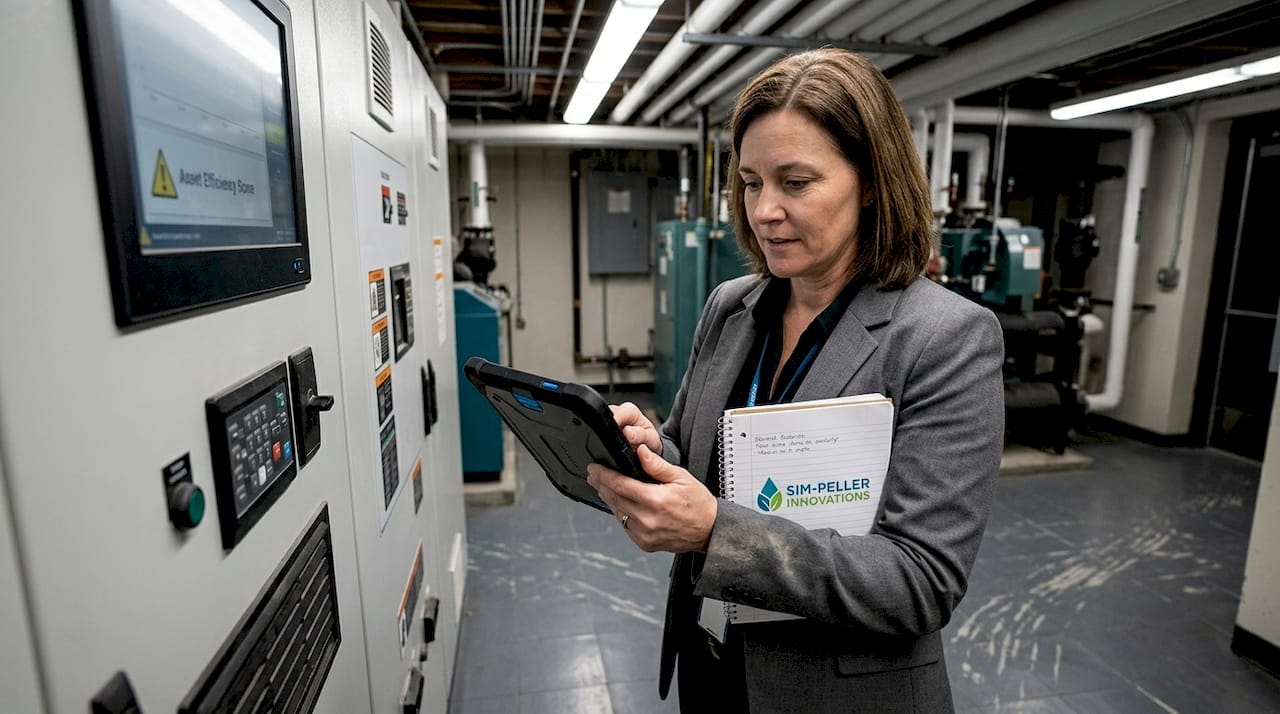
Traditional maintenance runs on a fixed schedule or waits for something to break. Both approaches waste money. Scheduled maintenance replaces parts that still have useful life. Reactive maintenance creates unplanned downtime that costs far more than the repair itself. Predictive maintenance changes the equation entirely by using sensor data and AI to flag issues before they escalate.
Predictive maintenance and digital twins cut energy use by 20% and maintenance costs by 25% in documented facility deployments. Those are not marginal improvements. For a mid-sized industrial facility, that translates to hundreds of thousands of dollars in annual savings and a significantly smaller carbon footprint.
| Factor | Traditional maintenance | Predictive maintenance |
|---|---|---|
| Trigger | Schedule or failure | Real-time sensor data |
| Downtime | Planned or unplanned | Minimized |
| Cost efficiency | Low to moderate | High |
| Energy impact | Neutral | 20% reduction potential |
| Data dependency | Low | High |
A digital twin takes this further by creating a live virtual model of your facility's physical systems. Every pump, chiller, and water circuit has a digital counterpart that reflects real conditions. When the model detects a pattern that precedes failure, your team gets an alert with enough lead time to act. When you want to test a new operating schedule, you run it in the twin first.
To implement predictive systems effectively, follow this sequence:
- Conduct a baseline audit of all major energy and water-consuming assets, documenting current performance and failure history.
- Prioritize high-impact assets where failure is costly or where consumption data shows anomalies.
- Deploy IoT sensors on priority assets and connect them to an analytics platform, as covered in our IoT and AI efficiency guide.
- Run a pilot on a contained system, validate the predictions against actual outcomes, and refine the model.
- Expand systematically to remaining assets once the pilot proves ROI.
Pro Tip: Use your digital twin to rank assets by their efficiency rebound potential. The fastest wins are usually assets running at partial load for extended periods, where small adjustments deliver outsized savings. Pair this with AI-driven water analytics to catch water-side inefficiencies that energy monitoring alone will miss.
Closing the waste gap: High-resolution benchmarking and KPIs
Knowing you have a waste problem is not the same as knowing where it lives. High-resolution benchmarking closes that gap. Sub-5-second energy datasets capture consumption patterns at a granularity that standard monthly utility bills simply cannot provide. When you analyze data at that resolution, patterns emerge: a compressor cycling irregularly at 3 a.m., a pump running at full load when demand is a fraction of capacity, a heat exchanger losing efficiency over weeks.
"74 billion data points analyzed across industrial facilities revealed that the majority of recoverable waste is concentrated in a small number of high-frequency loss events, most of which are invisible to conventional monitoring."
This is why 30% of energy in commercial buildings remains wasted and recoverable. It is not because facility managers aren't trying. It is because the resolution of their data is too low to see the losses clearly. High-resolution benchmarking makes the invisible visible.
| Facility type | Typical energy intensity | Savings potential | Priority KPI |
|---|---|---|---|
| Commercial office | 180-220 kWh/m²/yr | 15-30% | Energy intensity per occupant |
| Industrial plant | 350-600 kWh/m²/yr | 20-35% | Unplanned downtime rate |
| Healthcare facility | 400-500 kWh/m²/yr | 10-20% | Water reuse ratio |
| Retail complex | 200-280 kWh/m²/yr | 18-28% | Peak demand reduction |
The KPIs that matter most for facility managers focused on resource efficiency are:
- Energy intensity per square meter: Tracks consumption relative to floor area, enabling meaningful cross-facility comparison.
- Water reuse ratio: Measures what percentage of water is recaptured and reused rather than discharged, a metric that is growing in ESG importance.
- Unplanned downtime rate: Directly tied to predictive maintenance effectiveness and hidden energy waste during restart cycles.
- Carbon intensity per unit of output: Bridges operational data with climate accountability.
Start monitoring energy waste at the asset level before aggregating to facility-wide dashboards. The detail is where the savings are. Use a water savings guide to set realistic reduction targets once your baseline is established.
Regional and behavioral factors: Beyond technology for lasting impact
Technology sets the ceiling for what is possible. Behavior determines how close you get to it. This is the part of resource management that most implementation plans underestimate, and it is often the reason well-funded projects underperform.
Resilience and community learning underpin success in emerging markets where resources are constrained and redundancy is not an option. In these contexts, standardized reuse systems are less relevant than adaptive strategies that can function under variable conditions. In mature markets, the challenge is different: overcoming institutional inertia and getting staff to change habits that have worked well enough for years.
A phased roadmap that combines audits, quick wins, lifecycle assessment tools, and behavioral change programs consistently outperforms technology-only approaches. The behavioral component is not soft. It is structural.
The non-technical factors that determine real-world resource management success include:
- Leadership commitment: Visible, consistent support from senior management signals that resource efficiency is a real priority, not a reporting exercise.
- Staff training and ownership: Teams who understand why a system exists and how their actions affect outcomes perform better than teams who follow procedures without context.
- Community and peer learning: Facilities that share performance data with peers, whether within a portfolio or across an industry network, improve faster.
- Behavioral nudges: Visible meters, performance dashboards, and recognition programs create feedback loops that sustain change after the initial project energy fades.
- Cultural fit: A strategy that works in a high-autonomy Scandinavian facility may need significant adaptation for a hierarchical manufacturing environment.
Pro Tip: Install visible consumption displays in common areas and team spaces. When staff can see real-time water and energy use, consumption drops without any additional intervention. Pair this with smart water management tools that give your team actionable data, not just numbers. For facilities managing multiple sites, CRE water reuse savings strategies can cut water costs by up to 50% while strengthening ESG positioning.
Our perspective: Why efficiency isn't the whole story
Here is something the efficiency conversation rarely acknowledges: doing more with less can lead to doing more overall. This is the Jevons Paradox, and it is a real risk for facilities that treat efficiency as the finish line rather than one part of a larger strategy. When a building cuts its energy cost per square meter, the economic pressure to expand or intensify use often increases. The net result can be higher total consumption, not lower.
This does not mean efficiency is the wrong goal. It means efficiency without a cap on total demand, without resilience planning, and without staff engagement is incomplete. The facilities that will genuinely reduce their climate footprint over the next decade are the ones building strategies that are robust to growth, disruption, and behavioral drift. Efficiency is the foundation. Tokenisation and sustainability tools that convert verified savings into accountable outcomes are what make that foundation durable. Look past the percentage reductions on your dashboard and ask whether your strategy holds when conditions change.
Take the next step in resource management
The gap between knowing what to do and having the systems to do it is where most facilities stall. Simpeller bridges that gap with plug-and-play IoT sensor devices, AI-driven analytics, and a platform that converts verified water and energy savings into measurable ESG value. Whether your priority is closing the waste gap with high-resolution benchmarking, building a predictive maintenance program, or turning efficiency gains into tokenized credits that support underserved communities, the tools are ready. Explore advanced resource management solutions or connect with our team to design an implementation roadmap built for your facility's specific context and climate commitments.
Frequently asked questions
What are the top resource management trends for facility managers in 2026?
Key trends include predictive maintenance, digital twins, high-resolution benchmarking, circular economy strategies, and a shift toward regional resilience and behavioral change. Core 2026 strategies focus on cutting facility costs and energy use through data-driven tools.
How can digital twins and predictive maintenance improve efficiency?
They enable real-time monitoring and AI optimization, lowering energy use by up to 20% and maintenance costs by 25%. Full implementation of both tools delivers the strongest combined results.
What is the Jevons Paradox and why does it matter for sustainability?
The Jevons Paradox states that efficiency gains can sometimes increase total resource use, highlighting the need for resilience and broader demand-management strategies. Rebound risk is a documented consequence of efficiency-only approaches.
How much energy savings can high-resolution benchmarking data reveal?
High-resolution benchmarking shows that up to 30% of commercial energy is wasted and recoverable through targeted facility interventions.
How can I start implementing advanced resource management solutions?
Begin with a baseline audit, identify quick wins, invest in lifecycle assessment tools, and promote staff engagement for lasting change. A phased implementation roadmap consistently outperforms single-technology deployments.