
TL;DR:
- Energy upgrades typically pay for themselves within 1.7 years through substantial cost savings.
- Upgrading HVAC, lighting, and water systems maximizes efficiency and boosts property value.
- Continuous monitoring and integrated strategies are essential for sustained energy savings and ESG performance.
Many property managers assume energy upgrades drain budgets faster than they return value. The data tells a different story. Commissioning studies across more than 224 buildings show a median energy savings of 16% with a payback period of just 1.7 years. That means most upgrades pay for themselves before a typical lease renewal. This guide walks you through the proven, measurable benefits of energy efficiency for commercial buildings, from slashing operational costs and boosting asset value to strengthening sustainability credentials and ESG positioning. If you manage or own a commercial property, this is where the numbers start working in your favor.
Table of Contents
- How energy efficiency improves operational costs
- Boosting asset value and market perception
- Key areas to target: HVAC, lighting, and water systems
- Sustainability gains: Beyond just savings
- Why most commercial energy upgrades miss their true potential
- Connect with proven energy solutions today
- Frequently asked questions
Key Takeaways
| Point | Details |
|---|---|
| Rapid cost payback | Energy efficiency upgrades typically recoup costs in less than two years, offering fast financial returns. |
| Market value boost | Efficient commercial buildings command higher asset transaction prices and stronger tenant demand. |
| Target major systems | Focusing on HVAC, lighting, and water delivers the greatest operational and environmental impact. |
| Sustainability benefits | Energy efficiency supports compliance and improves ESG and sustainability scores, attracting investment. |
| Strategic integration wins | You maximize long-term value by embedding efficiency upgrades into broader operations and management culture. |
How energy efficiency improves operational costs
With payback confirmed in the data, it helps to understand exactly how energy efficiency converts into day-to-day cost savings. The answer lies in targeting the right systems with the right approach.
Commissioning is the process of verifying that building systems operate as intended. Retro-commissioning applies that same process to existing buildings, tuning up HVAC controls, lighting schedules, and mechanical systems that have drifted from optimal performance over time. Retro-commissioning achieves a median 16% energy savings at just $0.26 per square foot with a 1.7-year payback. For a 100,000-square-foot office, that is a $26,000 investment returning substantial annual savings.
HVAC and lighting account for the majority of energy spend in most commercial properties. Together, they represent the clearest opportunity for fast, measurable returns. Common upgrades that deliver strong results include:
- Retro-commissioning HVAC controls and variable frequency drives
- Replacing fluorescent fixtures with LED systems
- Installing occupancy sensors and daylight harvesting controls
- Upgrading building automation systems for real-time monitoring
- Sealing duct leaks and recalibrating thermostatic zones
Here is a quick comparison of typical upgrade options and their financial profile:
| Upgrade type | Avg. cost per sq ft | Payback period | Energy savings |
|---|---|---|---|
| Retro-commissioning | $0.26 | 1.7 years | ~16% |
| LED lighting retrofit | $1.00 to $3.00 | 2 to 4 years | Up to 90% lighting cost |
| HVAC controls upgrade | $0.50 to $1.50 | 2 to 5 years | 10 to 20% |
| Building automation system | $2.00 to $5.00 | 3 to 7 years | 15 to 30% |
For managers exploring broader efficiency frameworks, sustainable property management practices provide a structured starting point. And pairing upgrades with the right hardware matters: energy-saving devices for managers can close the gap between potential savings and realized results.
Pro Tip: If your building is more than 10 years old, retro-commissioning should be your first move. It costs the least, pays back fastest, and reveals where more targeted investments will have the greatest impact.
Boosting asset value and market perception
Lower operating costs are just the start. Energy efficiency also elevates the value and reputation of your property in ways that show up directly in transaction data.
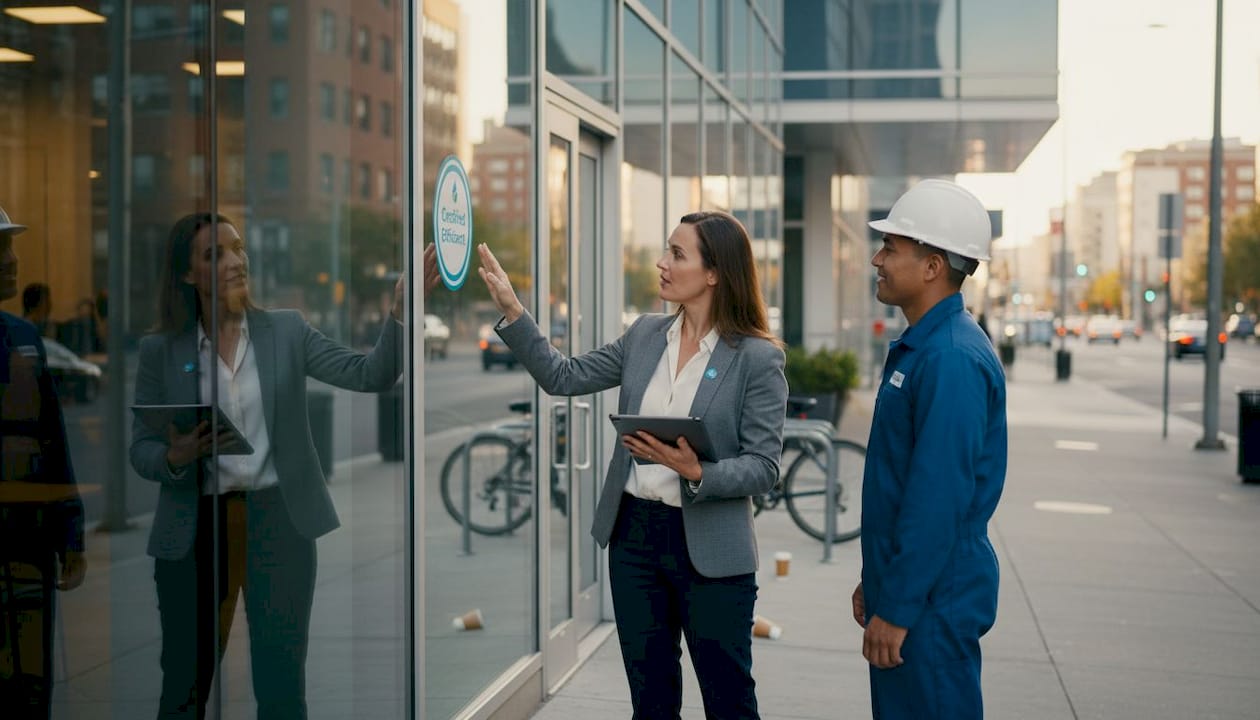
A major Netherlands study found that minimum energy performance standards increase transaction prices by 21.8% for compliant office buildings. That is not a marginal gain. For a building valued at $5 million, energy compliance could add over $1 million to its market price. That kind of return reshapes how you think about the cost of an upgrade.
Beyond price premiums, energy-efficient buildings attract a different caliber of tenant. Corporate occupiers, especially those with their own ESG commitments, actively seek spaces that align with their sustainability targets. The benefits stack up quickly:
- Higher lease rates due to lower total occupancy costs for tenants
- Reduced vacancy risk as demand for green-certified space grows
- Stronger ESG scores that attract institutional investors and sustainability-focused buyers
- Improved brand perception for the building owner in competitive markets
- Easier access to green financing instruments and favorable loan terms
"Energy performance compliance is no longer just a regulatory checkbox. It is a documented financial asset that separates high-performing properties from the rest of the market."
Managers who want to align their properties with current standards should review sustainability and ESRS2 standards, which lay out what compliance looks like in practice for 2026. The market is moving toward mandatory disclosure and performance benchmarking, and early movers capture the premium before compliance becomes the floor rather than a differentiator.
The data is clear: energy efficiency is not just an operational decision. It is a capital strategy.
Key areas to target: HVAC, lighting, and water systems
With higher asset values on the table, the next question is where to focus first. Three core building systems consistently deliver the greatest efficiency gains.
-
HVAC systems. HVAC accounts for 40 to 60% of commercial building energy use, making it the single largest driver of utility costs. Retro-commissioning HVAC alone yields an average of 15% savings. Start here. Modern controls, variable speed drives, and demand-controlled ventilation can shrink energy consumption without sacrificing occupant comfort.
-
LED lighting. LED lighting cuts energy use by up to 90% compared to incandescent systems and lasts 50 times longer. In commercial settings, that translates to lower replacement labor costs and fewer maintenance interruptions. Pairing LEDs with occupancy sensors and daylight controls amplifies savings further, especially in large open-plan offices or warehouses with variable occupancy.
-
Water systems. Water is often the last system managers consider, but the savings can be significant. Hot water heating, cooling towers, and irrigation all carry hidden energy loads. Leaks in water supply lines increase both water costs and the energy needed to pump and heat that water. Connecting energy waste monitoring to water systems gives you visibility into inefficiencies that are otherwise invisible.
Key stat: A building spending $500,000 annually on energy could reduce costs by $75,000 to $200,000 per year by targeting just these three systems in sequence.
For a deeper look at water-side savings, the water efficiency guide breaks down specific measures and their expected returns. Managers interested in the intersection of water reuse and energy performance will also find value in exploring blue-carbon innovation strategies emerging for 2026.
Pro Tip: Sequence your upgrades strategically. Start with HVAC retro-commissioning to establish your new energy baseline, then layer in LED lighting, then address water systems. Each phase informs the next and compounds your total savings.
Sustainability gains: Beyond just savings
Efficient upgrades do more than lower bills. They fuel sustainability, strengthen compliance, and shift your competitive positioning in ways that directly affect long-term risk and return.
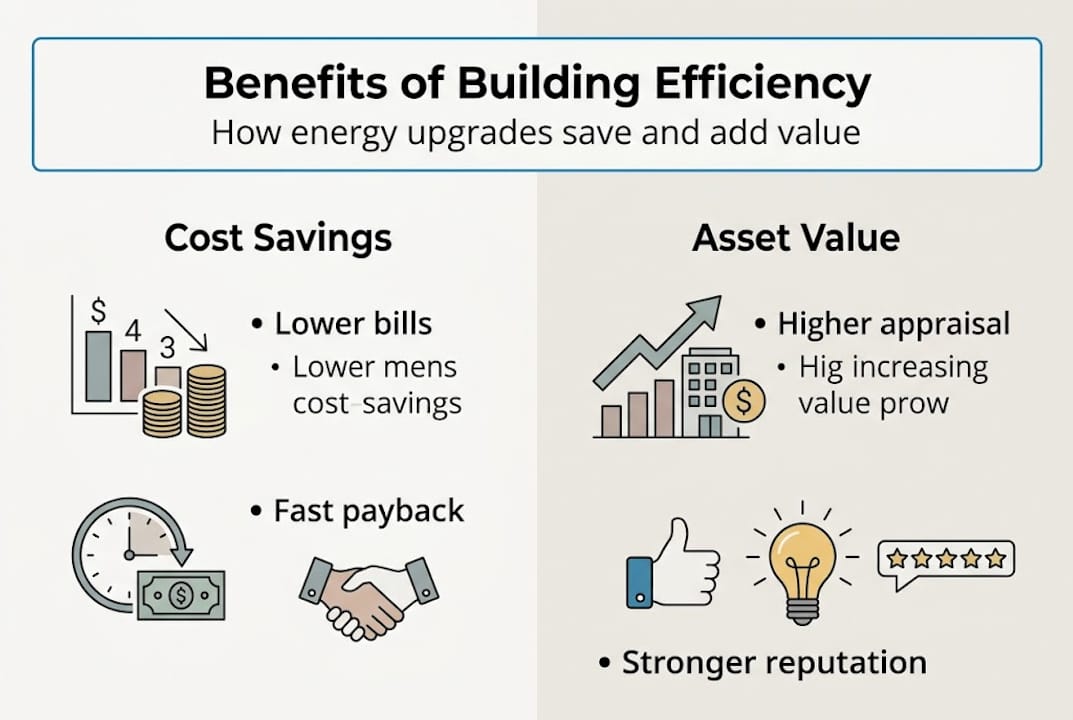
Energy efficiency is now central to how regulators, investors, and tenants evaluate commercial properties. Energy efficiency initiatives stimulate investments and enhance compliance-driven sustainability credentials, according to research on energy standards across European markets. The same dynamic is accelerating in North American markets as disclosure mandates tighten.
For building owners, the sustainability benefits break down into three distinct layers:
- Regulatory compliance: Meeting energy performance standards ahead of deadlines protects against fines and forced retrofit costs. Early compliance is always cheaper than reactive compliance.
- ESG positioning: Strong energy performance data supports transparent ESG reporting, which is increasingly required by institutional investors and large corporate tenants.
- Risk reduction: Buildings with poor energy performance face growing exposure to stranded asset risk as standards tighten. Upgrading now protects long-term capital value.
"Sustainability is not a cost center. For commercial buildings, it is a documented risk management tool that strengthens investor confidence and tenant retention simultaneously."
Managers tracking where the market is heading should review resource management trends shaping facility operations in 2026. For those exploring how to convert efficiency gains into measurable financial instruments, tokenisation sustainability benefits offer a forward-looking perspective. And for properties with water-intensive operations, CRE ESG water reuse strategies can cut water costs by up to 50% while strengthening ESG scores.
The bottom line is that sustainability gains are tangible, trackable, and increasingly tied to the financial health of commercial real estate portfolios.
Why most commercial energy upgrades miss their true potential
Here is the reality most upgrade programs never confront: the biggest ROI from energy efficiency does not come from the equipment. It comes from how upgrades are managed after installation.
The most common mistake we see is treating efficiency projects as isolated one-time events. A building gets a new HVAC controller, LED fixtures go in, and then everyone moves on. Six months later, settings drift, occupancy patterns change, and half the savings evaporate because no one is watching the systems anymore.
Real, lasting value comes from integrating efficiency into your facility's operating culture. That means ongoing monitoring, regular performance reviews, and connecting energy data to operational decisions. It also means thinking beyond a single system. When HVAC savings are linked to water system performance and both feed into your ESG reporting, you are building something defensible and scalable.
Onsite water recycling is a strong example of this principle in practice. When water reuse is paired with energy monitoring, the combined savings exceed what either system achieves independently. That is the integration advantage most buildings never capture because they treat each upgrade as a standalone project rather than part of a coordinated efficiency strategy.
Pro Tip: Build a culture of monitoring and continuous improvement. Assign ownership of energy performance data to a specific role, set quarterly review targets, and treat efficiency as an ongoing operational priority, not a capital project you complete and forget.
Connect with proven energy solutions today
For those ready to apply these strategies, specialized tools and expert guidance can make all the difference between marginal gains and transformational results. At Simpeller, we help commercial building owners and managers track, manage, and offset water and energy consumption using plug-and-play IoT sensors and an AI-driven platform that makes waste visible and savings measurable. Whether your focus is HVAC optimization, LED transitions, water system monitoring, or ESG-aligned sustainability reporting, Simpeller's solutions connect operational performance to real financial value. Take the next step toward turning your building's efficiency potential into documented, verifiable savings.
Frequently asked questions
What is the typical payback period for energy efficiency upgrades in commercial buildings?
Most efficiency projects pay back within 1.7 years, based on commissioning data covering over 224 buildings. Retro-commissioning of existing systems delivers the fastest returns at the lowest upfront cost.
How much can an office building's asset value increase after energy-efficient upgrades?
Compliant upgrades can raise transaction prices by around 21.8% for offices meeting energy performance standards, based on recent European market data.
Which systems should commercial managers focus on first for energy savings?
Prioritize HVAC first since it accounts for 40 to 60% of energy use, then layer in LED lighting upgrades, which can cut lighting costs by up to 90%.
How does energy efficiency improve sustainability credentials and ESG scores?
Efficiency upgrades align buildings with energy performance standards, which directly boost ESG profiles, strengthen investor confidence, and support transparent carbon accounting and compliance reporting.