
TL;DR:
- Water leaks in commercial buildings are often hidden and cause significant damage and costs.
- Effective detection relies on advanced sensors, strategic zone monitoring, and real-time alert systems.
- Integrating leak management with building systems reduces response times, operational costs, and supports sustainability.
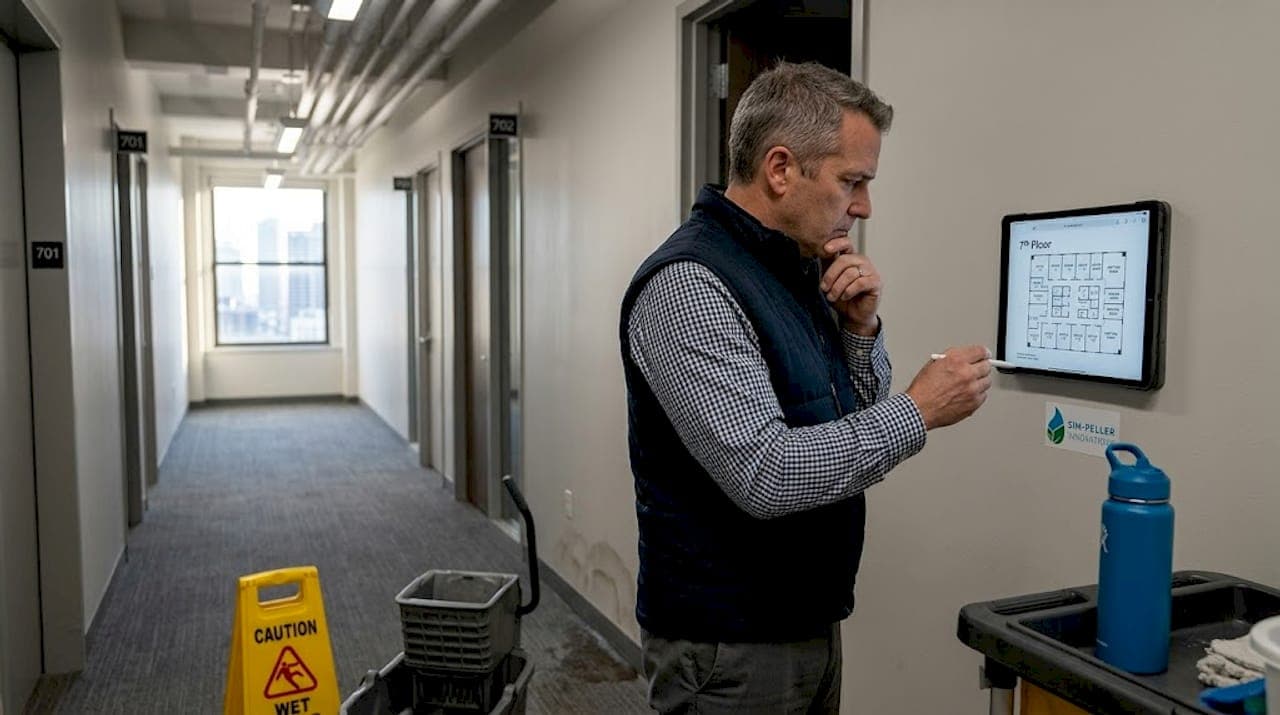
Water leaks in commercial buildings rarely announce themselves. They hide inside walls, run undetected through mechanical rooms, and silently inflate utility bills for months before anyone notices the damage. For property owners and facility managers, that invisibility is the real problem. Water leakage is the unintended escape of water from plumbing, HVAC, roofs, or other systems, and it costs far more than most teams budget for. This guide breaks down what water leakage actually is, where it comes from, how to detect it, and what you can do right now to stop it from draining your operating budget.
Table of Contents
- Understanding water leakage in commercial environments
- Detection technologies and methodologies for water leakage
- Mitigation and prevention strategies for facility managers
- Integrating leak management for cost savings and resource efficiency
- Why most water leakage management advice is incomplete
- Solutions for property owners and facility managers
- Frequently asked questions
Key Takeaways
| Point | Details |
|---|---|
| Hidden leaks cause damage | Most commercial water leaks go undetected until property damage and costly disruptions occur. |
| Advanced detection saves money | Using sensor and AI-based leak detection can cut operational costs by up to 90%. |
| Integration drives efficiency | Integrating leak monitoring with building systems accelerates response and boosts resource efficiency. |
| Routine mitigation prevents issues | Proactive inspections and auto-shutoff valves are essential for preventing large-scale water loss. |
Understanding water leakage in commercial environments
Water leakage in commercial buildings is not a single problem. It is a category of failures that spans dozens of systems, materials, and conditions. Understanding the full picture is the first step toward controlling it.
What counts as water leakage?
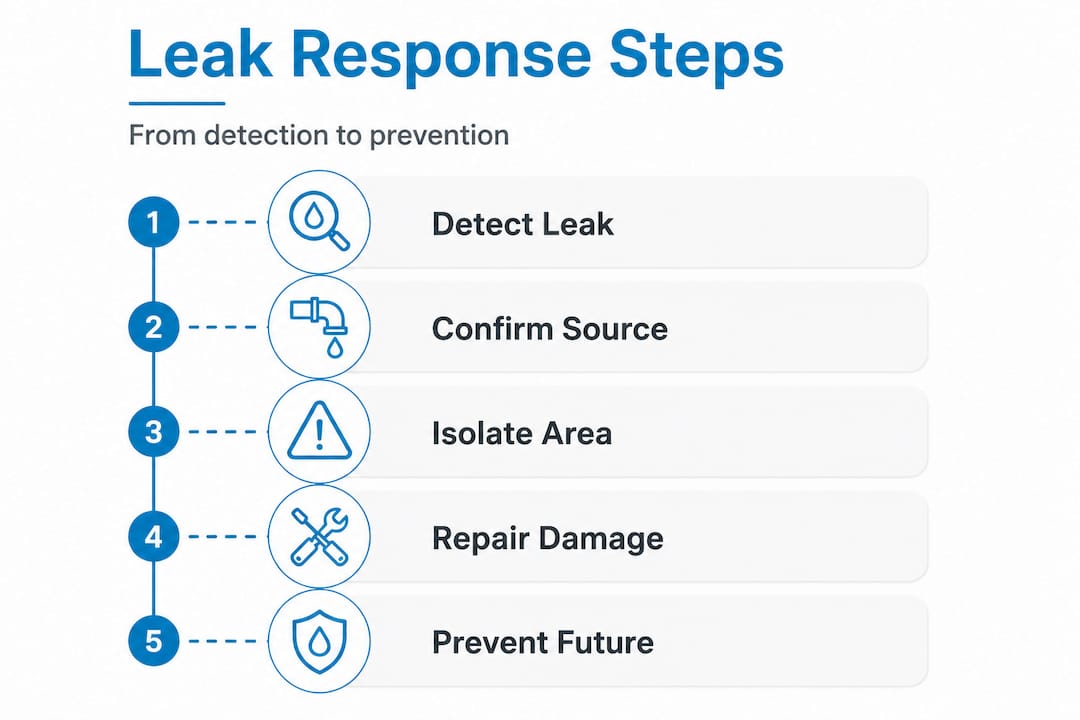
Water leakage management defines the issue clearly: it is the unintended escape of water from plumbing, HVAC, roofs, or other systems, leading to water loss, property damage, and operational disruptions. That covers everything from a slow drip under a kitchen sink to a pressurized pipe failure in a basement mechanical room. In commercial settings, the scale and complexity multiply fast.
Common sources in commercial buildings
The most frequent leak zones vary by building type, but these appear consistently across office buildings, warehouses, and retail spaces:
- Aging plumbing infrastructure: Pipes installed more than 20 years ago, particularly galvanized steel or early PVC, degrade over time. Corrosion, joint failure, and material fatigue are leading contributors.
- HVAC condensate lines: Air handling units produce significant condensate. Blocked or disconnected drain lines overflow into ceiling cavities and wall assemblies, often going undetected for weeks.
- Roof and facade penetrations: Flat roofs common in commercial construction are vulnerable at seams, drains, and mechanical penetrations. A single failed flashing can introduce hundreds of liters of water per rain event.
- Improper installation: Rushed fit-outs, incorrect pipe sizing, and missed pressure testing create weak points that fail under normal operating conditions.
- Lack of scheduled maintenance: Without regular inspection cycles, small issues compound. A minor valve weep becomes a joint failure within a season.
The real cost of commercial leaks
The consequences go well beyond a repair bill. Consider this breakdown of typical impact categories:
| Impact category | Example in commercial setting | Estimated cost range |
|---|---|---|
| Direct water loss | Undetected pipe drip, 1 liter/hour | $500–$2,000/year per leak |
| Structural damage | Ceiling collapse, mold remediation | $10,000–$100,000+ |
| Business disruption | Tenant evacuation, lost trading days | $5,000–$50,000/incident |
| Insurance premiums | Claims history affecting renewal | 10–30% premium increase |
| Regulatory exposure | Water waste violations, ESG reporting gaps | Variable by jurisdiction |
Effective building water monitoring is not a luxury. It is a core operational requirement for any facility managing significant water infrastructure.
"Undetected leaks are not maintenance failures. They are system design failures. If your building cannot tell you when water is escaping, the problem is not the pipe. It is the absence of visibility."
With the basics defined, let's explore how leaks are actually detected.
Detection technologies and methodologies for water leakage
Detection is where most facilities either win or lose the battle against water waste. The right technology, deployed in the right zones, can catch a leak within minutes. The wrong approach leaves you discovering damage during a routine walk-through, weeks too late.
The detection technology landscape
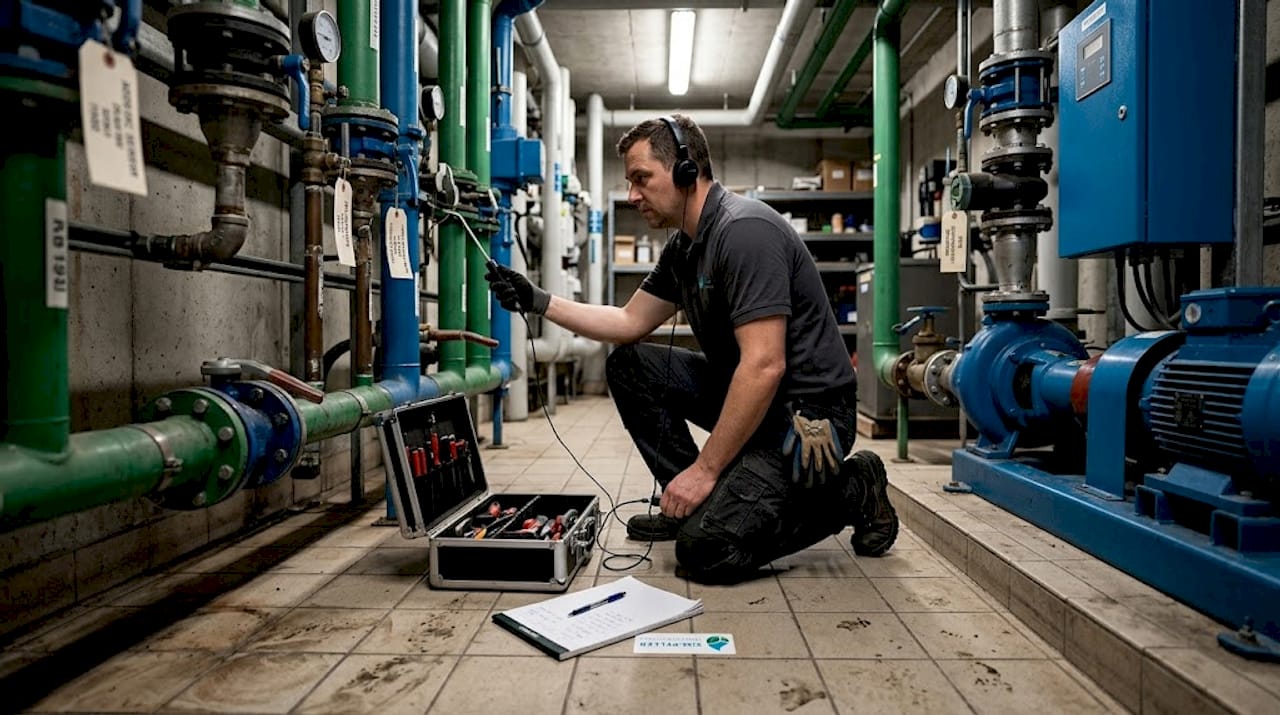
Detection methodologies include acoustic sensors, flow and pressure monitoring, thermal imaging, spot and rope sensors, noise loggers, tracer gas, and advanced AI-powered flow analysis for system-wide anomalies. Each method has a specific use case, cost profile, and reliability ceiling.
Here is a practical comparison for commercial facility decision-making:
| Technology | Best use case | Relative cost | Scalability | Detection speed |
|---|---|---|---|---|
| Acoustic sensors | Buried pipes, mains | Medium | High | Hours to days |
| Flow/pressure monitoring | Distribution systems, mains | Medium | Very high | Minutes |
| Thermal imaging | Walls, floors, roofs | High (labor) | Low | Immediate |
| Spot sensors | Plant rooms, server rooms | Low | Medium | Seconds |
| Rope/cable sensors | Under raised floors, data centers | Low | Medium | Seconds |
| Tracer gas | Buried or concealed pipes | High | Low | Hours |
| AI-driven flow analysis | System-wide anomaly detection | Medium/SaaS | Very high | Minutes |
How to implement detection in practice
Deploying detection technology effectively follows a logical sequence:
- Map your risk zones. Identify every water-bearing system in the building. Prioritize by consequence: mechanical rooms, server rooms, and tenant spaces with high-value fit-outs come first.
- Select technology by zone type. Spot sensors work well in plant rooms. Acoustic loggers suit buried supply mains. AI-driven flow monitoring covers the entire distribution network continuously.
- Connect sensors to your monitoring platform. Whether you use a Building Management System (BMS) or a Computerized Maintenance Management System (CMMS), sensors should push real-time alerts rather than requiring manual log checks.
- Set anomaly baselines. Normal flow profiles vary by building type and occupancy schedule. Establish what normal looks like so deviations trigger alerts automatically.
- Test your response chain. Detection only matters if the right person receives the alert and acts on it within a defined time window. Simulate a leak event and measure your actual response time.
IoT water management platforms now make this integration accessible without major capital investment. Plug-and-play sensor devices can connect to existing infrastructure and begin generating data within hours of installation.
Pro Tip: Submeter every critical zone separately, and configure after-hours flow alerts. Most significant commercial leaks occur overnight or on weekends when building occupancy is zero. Any measurable flow during unoccupied periods is an immediate red flag that warrants investigation.
AI water detection platforms go further by learning your building's consumption patterns and flagging statistical anomalies that human operators would never catch manually. A 2% increase in overnight baseline flow sounds minor. Over 90 days, it can represent thousands of liters of unaccounted water loss.
After identifying leaks, facilities must act fast to mitigate their impact.
Mitigation and prevention strategies for facility managers
Detection without a mitigation plan is incomplete. Knowing a leak exists and being able to stop it quickly are two separate capabilities. Both are essential.
Building a robust mitigation framework
Effective mitigation combines regular inspections, pressure management, automated shutoff valves, real-time alerts, and integration with building management systems, supported by a maintenance culture that treats prevention as a budget priority rather than an afterthought.
The core mitigation toolkit for commercial facilities includes:
- Pressure regulation: Excessive water pressure accelerates joint wear and increases leak frequency. Install pressure reducing valves (PRVs) on supply mains and maintain operating pressure within manufacturer specifications for all fixtures and fittings.
- Automated shutoff valves: These are non-negotiable for server rooms, electrical substations, archive storage, and any space where water contact causes catastrophic damage. When a sensor detects flow anomalies, the valve closes automatically, isolating the zone within seconds.
- Real-time alert routing: Alerts must reach the right person immediately. Configure tiered notifications: first to the on-call facilities technician, then to the facilities manager, then to senior management if the issue is not acknowledged within a set time window.
- Integration with BMS: A standalone sensor that beeps in an empty plant room helps no one. Connecting leak detection to your BMS means alerts appear on the same dashboard your team monitors for HVAC, lighting, and security.
- Scheduled inspection protocols: Monthly visual inspections of accessible pipework, quarterly pressure testing of critical zones, and annual thermographic surveys of roofs and facades create a layered defense that catches degradation before it becomes failure.
- Material selection in refits: When replacing pipework or fixtures, specify corrosion-resistant materials such as cross-linked polyethylene (PEX) or copper for high-pressure zones. Avoid galvanized steel in new installations.
Statistic callout
Commercial buildings that integrate leak detection with automated shutoff and BMS alerting report response times under 10 minutes for active leak events, compared to an industry average of 4 to 8 hours for facilities relying on manual detection.
Strategies to cut water costs consistently point to prevention as the highest-return investment. Fixing a leak before it causes structural damage costs a fraction of post-damage remediation.
Pro Tip: Auto-shutoff valves are essential for high-criticality spaces, but they carry one operational risk: if triggered during a legitimate high-flow event such as fire suppression testing, they can interrupt critical systems. Configure your BMS to cross-reference shutoff triggers with scheduled maintenance windows to avoid false isolations.
Smart water management platforms allow facility managers to set consumption thresholds, schedule maintenance reminders, and generate compliance reports, all from a single interface. The operational overhead of managing water infrastructure drops significantly when the system does the monitoring for you.
To maximize value, facility managers can leverage technology integration for even greater efficiency and rapid response.
Integrating leak management for cost savings and resource efficiency
The most forward-thinking facility managers are not treating leak detection as a standalone maintenance task. They are embedding it into a broader resource efficiency strategy that connects to ESG reporting, water reuse, and operational cost reduction.
The financial case for integrated leak management
Integrating flow-based sensors with BMS and CMMS for 24/7 coverage, establishing consumption baselines, and enabling rapid response can cut water-related operational costs by 70 to 90%. That is not a marginal improvement. It is a structural shift in how a building performs financially.
The savings materialize across several channels:
- Reduced utility bills: Every liter of water that does not escape through a leak is a liter you do not pay for twice (once to buy, once to treat and discharge).
- Lower insurance costs: A documented leak detection and response program is a material risk reduction that insurers recognize in commercial property premiums.
- Extended asset life: Reducing moisture intrusion protects structural elements, finishes, and mechanical equipment, pushing replacement cycles further out.
- ESG and sustainability reporting: Water consumption data from integrated monitoring feeds directly into ESG frameworks such as GRESB, GRI, and LEED certification requirements.
| Integration level | Annual water savings potential | ESG reporting benefit | Response time |
|---|---|---|---|
| No detection | 0% | None | Days to weeks |
| Spot sensors only | 15–25% | Limited | Hours |
| Flow monitoring + BMS | 40–60% | Moderate | Minutes |
| AI platform + full integration | 70–90% | Full audit trail | Seconds to minutes |
Connecting leak management to water reuse
Water reuse in commercial real estate is the logical next step after leak elimination. Once you have stopped losing water through leaks, you can start capturing and reusing water that would otherwise go to drain. Greywater from sinks and cooling towers, for example, can be treated and redirected to irrigation or toilet flushing, cutting potable water demand by 30 to 50%.
Onsite water recycling systems work best when paired with accurate consumption data. Leak detection infrastructure provides exactly that: a real-time picture of where water goes, how much is used, and where recovery opportunities exist.
For facility managers building a business case for capital investment in water infrastructure, the combination of leak reduction and reuse creates a compelling ROI narrative. Verified savings can be tracked, reported, and in some frameworks, converted into measurable sustainability credits.
Now that you know how to integrate best practices, let's look at what most articles miss about water leakage management.
Why most water leakage management advice is incomplete
Most guides on commercial water leakage focus on the obvious: fix the pipe, install a sensor, call a plumber. That advice is not wrong. It is just insufficient for the complexity of modern commercial infrastructure.
The gap shows up most clearly in three areas that standard guidance consistently underemphasizes.
After-hours submetering is not optional
Standard advice says "monitor your water use." What it rarely specifies is that submetering individual zones and tracking consumption during unoccupied hours is where the real intelligence lives. A building consuming water at 2 a.m. on a Sunday is telling you something critical. Without zone-level submetering, you cannot isolate which system or floor is responsible. After-hours monitoring and zone submetering are described by detection specialists as critical, not supplementary, capabilities for commercial properties.
Tracer gas and acoustic methods for hidden leaks
Surface-mounted spot sensors and visual inspections miss buried pipes entirely. For underground supply mains, pipes within concrete slabs, and concealed risers, tracer gas and acoustic leak detection are the only reliable options. Tracer gas involves pressurizing the pipe with a harmless gas mixture and using a surface detector to locate where it escapes. Acoustic loggers identify the characteristic sound signature of pressurized water escaping through a crack or joint. These methods are more expensive and require specialist contractors, but for a large commercial campus or a multi-story building with aging infrastructure, they are essential diagnostic tools.
Auto-shutoff valves require careful configuration
The advice to install auto-shutoff valves is correct. But the configuration detail is almost always missing from standard guidance. An incorrectly configured shutoff valve in a hospital, data center, or manufacturing facility can cause more damage than the leak it was meant to stop. The solution is not to avoid auto-shutoff. It is to configure it with zone-specific logic, cross-reference triggers with operational schedules, and test the system regularly. Monitoring workflow optimization through IoT platforms makes this level of configuration manageable without requiring dedicated engineering resources.
The facilities that get water leakage management right are the ones that treat it as an intelligence problem, not just a maintenance problem. The data exists. The technology exists. The gap is in how systematically that intelligence is collected, interpreted, and acted upon.
Solutions for property owners and facility managers
Simpeller's water-saving solutions are built specifically for the operational realities that property owners and facility managers face every day. The smartsink IoT sensor platform makes invisible water waste visible, delivering real-time leak alerts, consumption baselines, and zone-level monitoring through a single AI-driven dashboard. You get the detection intelligence, the response tools, and the verified performance data needed to support ESG reporting and cost reduction goals, without a complex installation process or a large capital outlay. For facilities ready to move from reactive maintenance to proactive water management, Simpeller provides the infrastructure to track every liter, identify every anomaly, and convert verified savings into measurable operational value. The next step is straightforward: connect your building's water systems to a platform that works for you around the clock.
Frequently asked questions
What is the main cause of water leakage in commercial buildings?
Aging infrastructure, poor installation, and lack of routine maintenance are the most common causes. Water leakage in commercial buildings is the unintended escape of water from plumbing, HVAC, roofs, or other systems.
What are the best sensors for detecting water leaks?
Acoustic sensors and AI-powered flow and pressure monitors are recommended for system-wide coverage and rapid detection. Detection methodologies including acoustic sensors, flow monitoring, and AI-based analysis provide the broadest coverage for commercial environments.
How do auto-shutoff valves help mitigate water leakage?
Auto-shutoff valves quickly isolate leaks and prevent major damage, especially in mission-critical areas. Automated shutoff valves are a core component of any integrated mitigation strategy alongside real-time alerts and BMS integration.
Can integrating leak detection with BMS actually cut costs?
Yes, integrating leak management with building systems can reduce costs by 70 to 90% through rapid response and resource monitoring. Flow-based sensor hybrids combined with CMMS and BMS integration deliver the fastest response times and the highest cost reduction potential.
Why is after-hours monitoring vital for leak detection?
Leaks often occur unnoticed outside business hours, so monitoring submeter zones at night is critical to catch issues early. After-hours submetering allows facilities to detect anomalous flow during unoccupied periods when leaks would otherwise go unnoticed for days.