

TL;DR:
- Water and energy use are closely linked in facility operations, influencing costs and sustainability.
- Efficiency efforts can unintentionally increase total resource consumption due to behavioral and systemic responses.
- Combining real-time monitoring, lifecycle analysis, and integrated strategies optimizes water and energy efficiency simultaneously.
Water and energy are two sides of the same operational coin in commercial facilities, yet most managers still track them in separate silos. Drinking water and wastewater plants account for 30 to 40% of local government energy use, a figure that should stop any facility manager in their tracks. When water costs rise, energy bills follow. When energy prices spike, water operations get more expensive. Understanding this relationship is not optional anymore. This article breaks down the water-energy nexus, shows where it shows up in your facility every day, and gives you the frameworks and tools to act on it.
Table of Contents
- The fundamentals of the water-energy nexus
- How water and energy flows manifest in commercial facilities
- Real-world challenges and paradoxes
- Optimizing your facility: methodologies and tools
- A fresh take: What most guides miss about the water-energy nexus
- Discover solutions to maximize water and energy efficiency
- Frequently asked questions
Key Takeaways
| Point | Details |
|---|---|
| Water and energy are inseparable | Optimizing one always impacts the other, so both must be tracked and managed together in facilities. |
| Efficiency starts with data | Measuring water and energy flows is the foundation for identifying high-impact improvements. |
| Smart tools drive results | Intelligent monitoring and life-cycle analysis achieve step-change sustainability gains and cost savings. |
| Avoid simple trade-offs | Short-term upgrades can backfire unless full lifecycle impacts are assessed in water-energy decisions. |
The fundamentals of the water-energy nexus
Now that you've glimpsed the scale of water's impact on energy costs, let's break down what the water-energy nexus means for facilities.
The water-energy nexus describes the tight, two-way dependency between water and energy systems. Simply put, energy is necessary for every stage of water supply, treatment, and distribution, and water is vital for various energy production methods. You cannot optimize one without affecting the other.
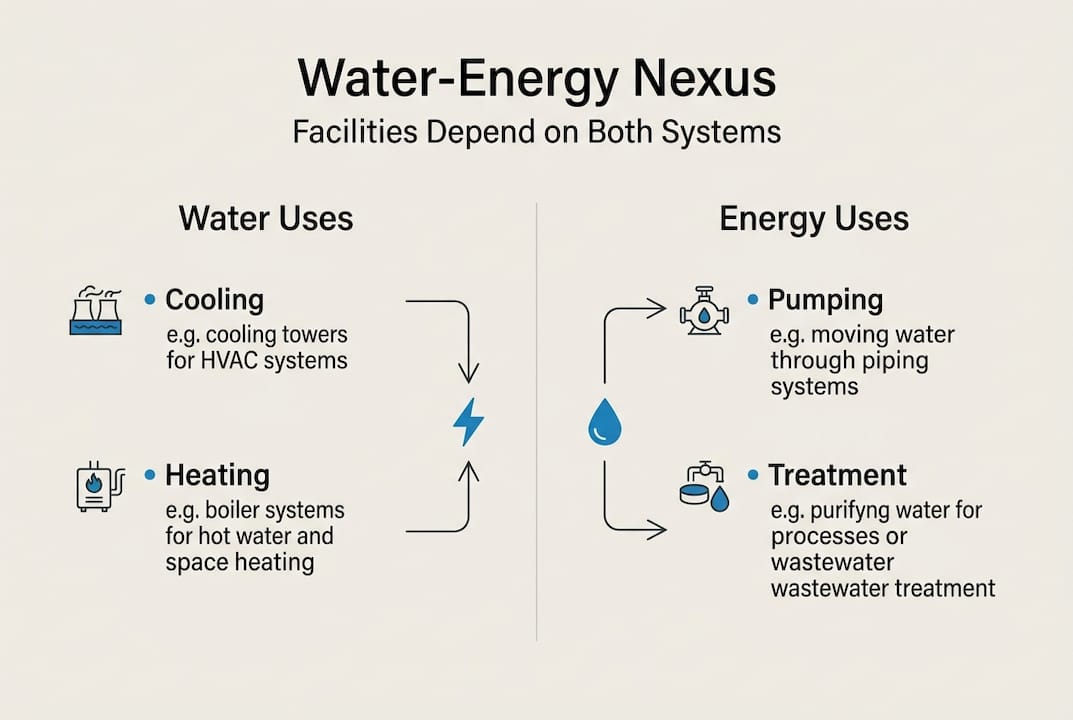
For facility managers, this means every decision about water use carries an energy cost, and every energy choice carries a water footprint. Ignoring this connection leaves real money on the table.
Here is where the nexus shows up most clearly in facility operations:
- Water treatment and pumping require significant electricity to move and clean water before it reaches your building
- Cooling towers and HVAC systems consume both water and energy simultaneously, often in ways that are hard to separate
- Thermoelectric power generation relies heavily on water withdrawal for cooling, meaning the electricity powering your facility already has a hidden water cost
- Wastewater treatment demands energy to process and discharge water safely, adding to the downstream burden
- Steam and boiler systems use water as a working fluid, linking thermal energy output directly to water consumption
Thermoelectric power plants, which generate most of the electricity on the US grid, withdraw enormous volumes of water for cooling. While much of that water is returned to the source, the energy used to pump, treat, and manage it is not recovered. This is the hidden water cost embedded in every kilowatt-hour your facility consumes.
A critical distinction worth understanding is withdrawal versus consumption. Withdrawal refers to total water taken from a source, while consumption refers to water that is not returned, typically lost to evaporation or incorporated into a product. Cooling towers, for example, withdraw large volumes but consume a smaller fraction through evaporation. Knowing this difference helps you set smarter reduction targets.
"The water-energy nexus is not a niche environmental concept. It is a core operational reality for any facility that wants to control costs and manage risk in a resource-constrained world."
How water and energy flows manifest in commercial facilities
After grasping the definition of the nexus, it's vital to see its everyday impact through data.
The US urban average water and wastewater flows and their embedded energy amounts reveal just how significant this relationship is at the building level. Water does not arrive at your facility for free, and it does not leave without cost either.
Consider this breakdown of typical embedded energy in urban water systems:
| Water system stage | Energy intensity (kWh per million gallons) |
|---|---|
| Drinking water treatment | 370 to 480 |
| Water distribution (pumping) | 1,000 to 1,800 |
| Wastewater collection | 100 to 200 |
| Wastewater treatment | 1,100 to 2,100 |
| Wastewater discharge/reuse | 200 to 400 |
These numbers add up fast in a large commercial facility. A building consuming 500,000 gallons per month is carrying a substantial embedded energy load before a single light is switched on.
Here are the key touchpoints where water and energy interact in a typical commercial facility:
- Incoming water supply carries embedded energy from municipal pumping and treatment
- HVAC and cooling systems consume water for heat rejection and electricity for compression
- Domestic hot water systems use energy to heat water and water to distribute thermal energy
- Irrigation and landscaping draw from potable supply, adding to both water and energy bills
- Wastewater discharge incurs treatment energy costs at the municipal level, often passed back through utility rates
- On-site water reuse reduces both incoming water demand and the energy cost of treating new supply
For a practical starting point, our water savings guide outlines the fastest ways to shrink consumption across these touchpoints. For a broader operational view, the facility water management guide covers how IoT and AI tools are reshaping how managers track these flows in real time.
The takeaway is straightforward: every gallon saved is also an energy saving, and every unit of energy saved reduces the demand placed on water systems. The two are inseparable.
Real-world challenges and paradoxes
The numbers don't always tell the full story; let's explore what can go wrong and how to spot hidden trade-offs.
One of the most counterintuitive findings in water-energy research is that efficiency improvements do not always reduce total consumption. Known as the Jevons paradox, efficiency improvements can sometimes increase total water withdrawal because lower costs encourage greater use. A facility that cuts water costs through efficiency may simply expand operations, erasing the gains.
Another trade-off that catches managers off guard involves HVAC optimization. HVAC water savings may increase air conditioning energy use in certain climates, meaning a strategy that looks good on the water bill can quietly inflate the electricity bill. This is especially relevant in hot, dry regions where water-efficient cooling systems shift load to energy-intensive alternatives.
Consider these real-world scenarios:
| Facility type | Primary water use | Primary energy interaction | Key risk |
|---|---|---|---|
| Data center | Cooling tower makeup water | High electricity for servers and cooling | Dual consumption spike during heat events |
| Office building | HVAC, domestic use | Chiller and pump energy | Inefficient cooling design |
| Hospital | Sterilization, HVAC, domestic | Steam, hot water, chiller systems | Regulatory compliance adds complexity |
| Manufacturing plant | Process water, cooling | Compressed air, boilers | Reuse opportunities often overlooked |
Data centers illustrate the dual consumption challenge sharply. They require massive electricity for computing, and that electricity generates heat, which requires water-cooled systems to manage. During a drought, water restrictions can force a shift to air-cooled systems, which consume more energy. California's drought-driven hydropower shutoffs showed exactly this dynamic at a grid scale, where water scarcity directly reduced electricity supply.
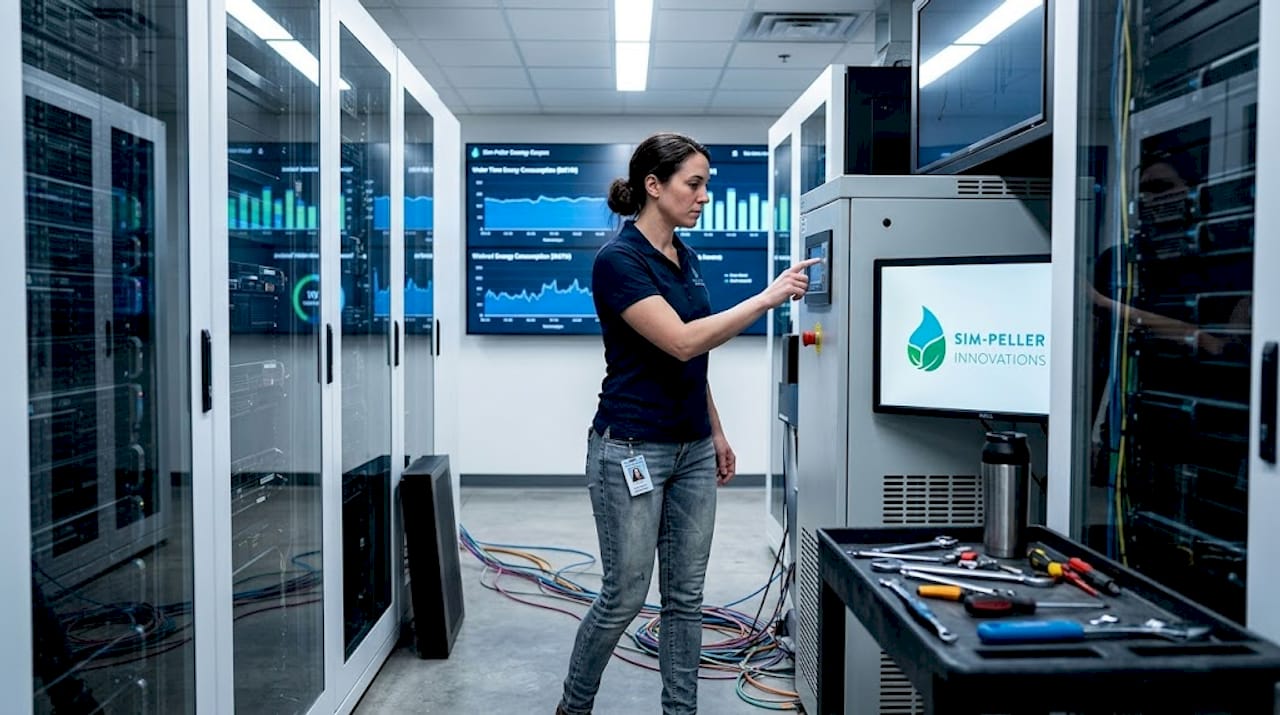
Pro Tip: Before committing to any single efficiency measure, model its lifecycle impact on both water and energy. A quick win on one side of the ledger can create a slow loss on the other. Tools for smart water management and monitoring energy waste help you see both dimensions before making decisions.
The path forward is not to avoid efficiency investments. It is to measure them honestly across both resources and over time.
Optimizing your facility: methodologies and tools
The real win comes from applying tested strategies and tools. Here's how to get started.
Life-cycle cost analysis (LCCA) is the gold standard for evaluating water efficiency investments. Rather than looking at upfront cost alone, LCCA accounts for the present value of energy savings, water savings, wastewater cost reductions, and ongoing operations and maintenance over the full life of a system. Variable speed pumps, leak detection, pressure management, and water reuse are all proven measures that perform well under LCCA when modeled correctly.
Building energy modeling tools such as IESVE allow facility teams to simulate water and energy interactions before committing capital. This removes guesswork from major decisions.
Here is a practical framework for building your optimization program:
- Audit first: Establish baseline water and energy consumption across all systems before targeting reductions
- Identify high-impact zones: Focus on cooling, hot water, and irrigation, which typically account for the largest share of combined water and energy use
- Deploy sub-metering: Install water monitoring tools at key points to isolate consumption by system or zone
- Apply pressure management: Reducing distribution pressure can cut both leakage and the energy needed to pump water
- Implement leak detection: Even small, undetected leaks waste water continuously and inflate energy use for pumping
- Introduce water reuse: Greywater recycling and condensate recovery reduce incoming water demand and the embedded energy it carries. Our water recycling guide covers the options available in 2026, and water reuse solutions show how commercial real estate operators are cutting costs by up to 50%
- Track and report: Use integrated dashboards to connect water and energy data for ESG reporting and continuous improvement
Intelligent water management systems like Nexa deliver ROI within one year and proactively detect issues before they become costly failures. That kind of payback timeline makes the business case straightforward.
Pro Tip: Integrate your water and energy data streams into a single dashboard. Benchmarking both together reveals correlations that separate reports will always miss, and those correlations are where the biggest savings hide.
A fresh take: What most guides miss about the water-energy nexus
While practical steps matter, strategy needs honest perspective. Let's rethink some conventional approaches.
Most guides focus on individual efficiency measures and call it a day. Swap the fixtures, install the meters, reduce the bill. That framing is not wrong, but it is incomplete. The Jevons paradox is real, and it shows up in commercial facilities more often than managers admit. Efficiency gains that lower per-unit costs frequently enable expansion, and total consumption climbs back up.
The deeper issue is data scarcity. Integrated utility data and holistic planning are still rare, and without them, benchmarking and policy decisions rest on incomplete information. Most facilities track water or energy, rarely both together, and almost never in a way that reveals the relationship between them.
The managers who consistently outperform their peers are the ones who treat water and energy as a single resource system. They use lifecycle thinking, not just monthly bill comparisons. They look for performance-based water rewards that convert verified efficiency gains into measurable value, not just cost avoidance. That shift in mindset, from reducing waste to generating verified value, is what separates reactive management from genuine optimization.
Discover solutions to maximize water and energy efficiency
Ready to turn insight into action? Here's where you find hands-on solutions.
At Simpeller, we built our platform specifically for the challenge this article describes. Our plug-and-play IoT smartsink devices make invisible water and energy waste visible in real time, giving your team the data needed to act fast and measure results accurately. We track verified performance improvements and convert efficiency gains into measurable value, whether that means renewable PV credits, material-exchange vouchers, or ESG-ready carbon accounting. If you are serious about cutting operational costs and building a credible sustainability record, explore our water-energy solutions to see how tokenized efficiency works in practice.
Frequently asked questions
What is the water-energy nexus and why does it matter to facility managers?
It is the interdependent relationship where energy is required for water supply and water is essential for energy production, meaning decisions about one resource directly affect the cost and availability of the other in your facility.
How much energy does water treatment and distribution consume?
Drinking water and wastewater plants represent 30 to 40% of local government energy use, making them among the largest single energy consumers in municipal operations and a major cost driver for facilities connected to those systems.
Are renewables always the better choice for water and energy savings?
Renewables like wind and solar PV use very little operational water, but their full supply chain still carries a water footprint through manufacturing and infrastructure, so lifecycle assessment matters before drawing conclusions.
What tools help optimize the water-energy nexus in commercial buildings?
Life-cycle cost analysis and intelligent management systems like Nexa are proven starting points, combining financial modeling with real-time detection to support cost-effective efficiency improvements across water and energy systems.