

TL;DR:
- Water conservation strategies must be evaluated using clear criteria including ROI, maintenance, code approval, and user experience.
- Indoor water use can be significantly reduced through low-flow fixtures, greywater recycling, IoT monitoring, and performance verification.
- Outdoor water savings are achievable via rainwater harvesting, native planting, smart irrigation, and permeable surfaces, supporting net zero water goals.
Architects specifying commercial buildings in 2026 face a tightening vice of water-related pressure: stricter codes, ESG reporting obligations, and owners who want verified savings, not just projections. Every fixture schedule, mechanical coordination meeting, and specification decision carries a measurable water consequence, and the margin for guesswork is shrinking fast. The good news is that the tools available today, from certified low-flow fixtures to IoT-enabled leak detection, have never been more capable or cost-competitive. This guide lays out a clear, criteria-driven framework for evaluating water conservation strategies, so your next commercial project delivers real, documentable results from day one.
Table of Contents
- Key criteria for effective water conservation in design
- Maximize indoor efficiency: Fixtures, recycling, and monitoring
- Outdoor strategies: Rainwater harvesting and drought-ready landscaping
- Comparing whole-building strategies: Net zero water and integrated management
- Why most architects underuse water-saving tech—and how to get ahead
- Elevate your project's water performance now
- Frequently asked questions
Key Takeaways
| Point | Details |
|---|---|
| Set clear criteria | Start water conservation planning by prioritizing ROI, code compliance, and measurable results. |
| Layer solutions | Combine low-flow fixtures, monitoring, and recycling for maximum impact indoors and out. |
| Adapt to context | Choose strategies like rainwater harvesting or native landscapes based on local climate and project needs. |
| Go net zero | Pursue net zero water by integrating green infrastructure, reuse, and data-driven management. |
Key criteria for effective water conservation in design
Before specifying a single fixture or system, you need a structured way to compare options. Water conservation solutions range from low-cost fixture swaps to complex greywater recycling installations, and treating them as interchangeable is a common, expensive mistake. A clear criteria framework keeps your team aligned and your clients confident.
Start with these four evaluation pillars:
- Return on investment (ROI) and payback period. A strategy that saves water but takes 25 years to pay back is hard to sell to a building owner. Push for third-party lifecycle cost data before committing to any system.
- Maintenance requirements. Low-flow aerators need minimal O&M. Membrane bioreactor greywater systems need skilled maintenance contracts. Be realistic about what the building's facilities team can actually manage.
- Local code approvals. Greywater reuse, rainwater harvesting, and dual plumbing systems face wildly different regulatory landscapes depending on jurisdiction. Confirm code compliance before schematic design, not during construction documents.
- User experience. Occupant behavior can make or break a conservation strategy. Pressure-compensating fixtures that feel comfortable maintain user buy-in; systems that frustrate occupants get bypassed or disabled.
The sequencing of strategies matters as much as the strategies themselves. Cut costs and boost efficiency by starting with quick wins that deliver immediate, measurable savings before layering more complex systems on top. Low-flow fixtures, for example, can be specified with virtually no additional design effort, yet low-flow fixtures reduce indoor water use by up to 50 to 70% compared to standard models. That is a significant baseline reduction before any advanced system is added.
Post-occupancy performance verification is non-negotiable. Specify submetering at fixture groups or zones so building managers can confirm actual savings against design projections. This data also feeds ESG reporting, which is increasingly a client requirement rather than a nice-to-have.
Pro Tip: Look for WaterSense certification from the EPA and WELL Building Standard water feature credits when shortlisting fixtures. These third-party benchmarks cut specification time and provide defensible performance claims for both code submissions and owner presentations.
For high-health environments like hospitals and laboratories, add a risk management layer to your criteria. Greywater systems in these settings carry heightened contamination concerns and may face outright prohibition. Identify these constraints early so you can redirect budget toward alternative strategies like advanced metering or fixture upgrades without losing design momentum.
Maximize indoor efficiency: Fixtures, recycling, and monitoring
With a solid criteria framework in place, the next step is translating that framework into specific indoor water conservation decisions. Indoor use typically accounts for the majority of a commercial building's water consumption, which means this is where the highest-impact reductions are achievable.
A practical, sequenced approach for indoor efficiency:
- Specify low-flow fixtures across all fixture types. This means aerating faucets rated at 0.5 gallons per minute (GPM) for restroom lavatories, WaterSense-labeled toilets using 1.28 gallons per flush (GPF) or less, and low-flow showerheads for any hospitality or gym component. Do not treat fixture selection as a value engineering target; the lifecycle savings far outweigh the marginal cost difference.
- Evaluate greywater recycling feasibility. Where local codes allow, onsite water recycling from sinks, showers, and laundry can reduce potable water demand by 25 to 50%, with recovered water redirected to toilet flushing, irrigation supply, and cooling tower makeup. The key feasibility factors are available floor area for treatment equipment, proximity of collection and reuse points, and the building's maintenance staffing capability.
- Assess contamination risk and treatment requirements. Greywater from hand-washing sinks carries lower contamination loads than kitchen sink or laundry waste, making it suitable for simpler treatment trains. Higher-risk greywater sources require membrane bioreactor or UV disinfection systems. Specify accordingly, and coordinate with the mechanical engineer on sizing early.
- Integrate IoT sensors and smart management systems. Monitoring and leak detection platforms with embedded sensors can identify leak events, abnormal consumption spikes, and fixture failures in real time. Smart water management systems with sensors and leak detection can optimize usage and prevent waste, reducing overall consumption by up to 50%. That number reflects not just reduced flow rates but the elimination of silent leaks that often go undetected for months in large commercial buildings.
- Set up submetering and performance dashboards. Design the mechanical system to support zone-level metering from the outset. Retroactively adding submeters is expensive and often structurally impractical.
Pro Tip: Coordinate with your mechanical engineer at the 30% schematic design stage, not later. Greywater collection piping, treatment room allocation, and sensor infrastructure are far cheaper to design in than to retrofit. Missed coordination at this stage is one of the most common and costly errors in water-efficient commercial design.
The tradeoffs are real and worth naming honestly. Greywater systems carry higher capital cost, require maintenance contracts, and demand careful regulatory navigation. Smart metering platforms require integration with building management systems and ongoing software licensing. None of these are reasons to avoid the strategies; they are reasons to scope and budget for them correctly from the start.
Outdoor strategies: Rainwater harvesting and drought-ready landscaping
Once indoor efficiency strategies are locked in, shifting attention to the site and landscape level unlocks another major category of savings. Outdoor water use in commercial projects, primarily irrigation, can account for 30% or more of total site consumption, making it a legitimate target for meaningful reduction.
| Strategy | Key benefit | Estimated savings | Main constraints |
|---|---|---|---|
| Rainwater harvesting | Reduces potable irrigation and non-potable demand | Up to 34% of annual water needs | Requires precipitation analysis, cistern sizing, permitting |
| Native and drought-resistant planting | Cuts irrigation demand, lowers O&M | 50 to 75% outdoor use reduction | Site-specific plant selection, establishment period |
| Drip irrigation with smart controllers | Targets water precisely, avoids overwatering | Combined with native plants, up to 75% reduction | Controller programming, sensor calibration |
| Permeable paving and bioretention | Recharges groundwater, reduces runoff | Supports net zero water goals | Local stormwater regulations, soil permeability |
Rainwater harvesting systems are most effective when sized to local precipitation data. A cistern sized for Seattle's rainfall profile will dramatically underperform in Phoenix. Conduct a precipitation frequency analysis early, and design the collection area, typically the roof, and storage volume in tandem. Coordinate with civil engineers on overflow routing and first-flush diverters to protect water quality.
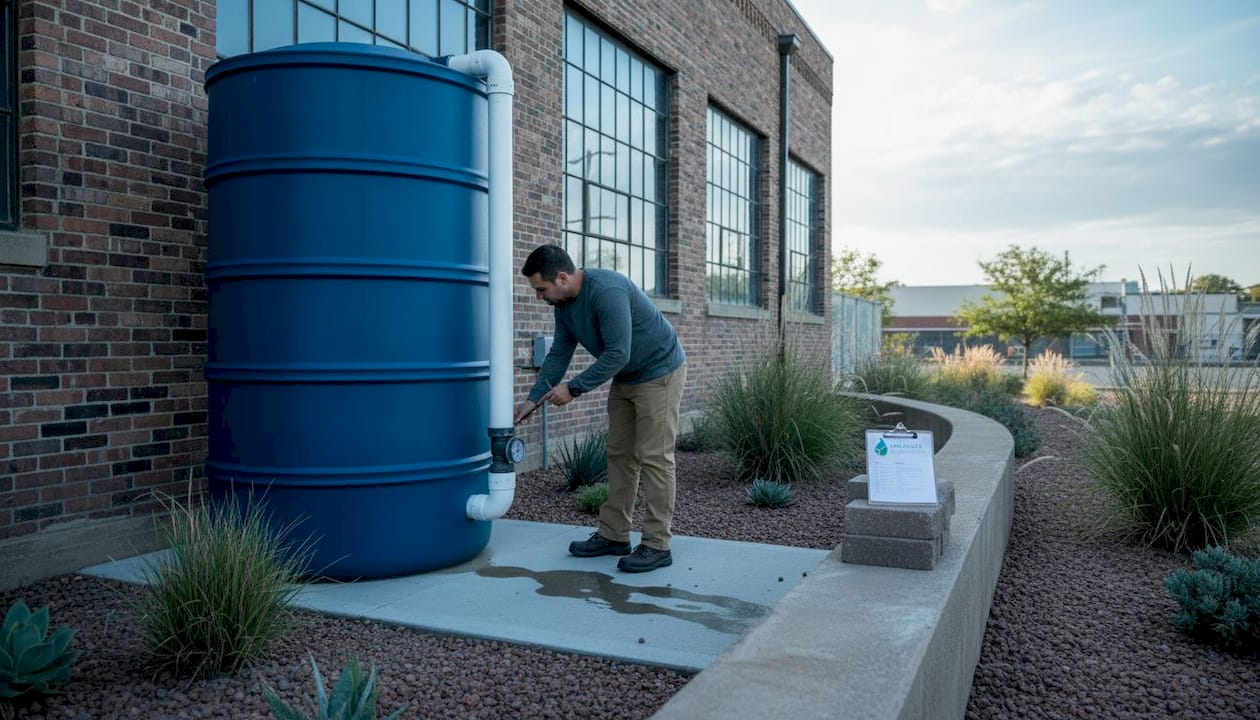
Native, drought-resistant landscaping is gaining traction well beyond arid climates. The logic is straightforward: plants that evolved in the local environment need far less supplemental irrigation to establish and thrive. Pair native plant selection with drip irrigation and soil-moisture-based smart controllers for genuinely responsive outdoor water management.
Water reuse in case studies from high-performing commercial projects consistently point to outdoor strategies as a strong complement to indoor efficiency gains.
"The Kendeda Building at Georgia Tech demonstrates what integrated outdoor water management can achieve at scale, capturing 1.11 million gallons of stormwater annually, meeting 100% of its irrigation demand with harvested water, and saving 158,000 gallons of potable water every year." (Landscape Performance)
The Kendeda example is instructive not just for the numbers but for the design philosophy. Outdoor water independence is achievable when rainwater capture, native planting, and smart irrigation control are treated as an integrated system rather than isolated add-ons.
Always verify local regulations before finalizing outdoor reuse strategies. Some jurisdictions restrict above-ground cisterns, limit the end uses permitted for harvested rainwater, or require specific treatment before non-potable reuse. These are not insurmountable obstacles, but they need to be identified before the landscape design is finalized.
Comparing whole-building strategies: Net zero water and integrated management
With both indoor and outdoor strategies defined, the next challenge is synthesizing them into a coherent whole-building approach. The options range from targeted conservation upgrades to fully integrated net zero water design, and choosing the right combination depends on the project type, budget, owner ambitions, and regulatory context.
| Approach | Description | Key benefits | Main challenges |
|---|---|---|---|
| Targeted conservation upgrades | Low-flow fixtures, smart meters, basic landscaping | Low cost, quick payback, easy to implement | Limited overall savings ceiling |
| Integrated water management | Fixtures plus greywater reuse plus IoT monitoring | Significant consumption reduction, ESG-reportable data | Higher capital cost, more complex O&M |
| Net zero water design | Full onsite capture, reuse, and replenishment | Eliminates net potable demand, maximum resilience | High design complexity, regulatory navigation, site constraints |
Net zero water buildings balance consumption with onsite replenishment via green infrastructure like permeable surfaces and bioretention systems. This is no longer a theoretical aspiration. The Kendeda Building case proves it works at the scale of a real academic facility.
Integrating water monitoring across all systems is the connective tissue that makes whole-building strategies function as designed. Without real-time consumption data, even the best-specified systems drift from their design intent over time.
A practical checklist for assessing which approach fits your next project:
- Confirm the owner's ESG reporting requirements and whether verified consumption data is needed for compliance.
- Identify local code constraints on greywater reuse, rainwater harvesting, and dual plumbing systems.
- Conduct a precipitation and site hydrology analysis to determine outdoor harvest potential.
- Assess the building type and occupancy pattern to size indoor fixture loads accurately.
- Evaluate the facilities team's maintenance capacity for advanced systems.
- Model lifecycle costs for each strategy tier and present ROI scenarios to the owner.
- Identify which blue-carbon innovation in water savings technologies may qualify for utility rebates or green finance incentives in the project's jurisdiction.
The integrated management approach is often the most practical entry point for commercial projects where full net zero water is not yet feasible. It delivers significant, verifiable savings while keeping capital cost and O&M complexity within reach of most project teams and building operators.
Why most architects underuse water-saving tech—and how to get ahead
Here is an uncomfortable truth worth naming directly: most design teams default to code-minimum water efficiency because they are waiting for someone else to push harder. Owners wait for codes to require action. Architects wait for owners to request it. And the most effective tools, from smart metering to integrated greywater systems, sit underutilized on project after project.
The common roadblock is not cost. It is uncertainty. Architects worry that advanced systems will create O&M headaches for facilities teams, that code interpretations will derail the permitting process, or that the performance data will not hold up to scrutiny. These are legitimate concerns, but they are manageable with the right approach.
The payback on performance-based water rewards and smart water management is consistently underestimated. Pilot projects that start with fixture upgrades and IoT monitoring routinely deliver savings data compelling enough to justify the next tier of investment. That pilot data is also your most powerful tool for steering client conversations toward integrated systems before mandates force the issue.
The mindset shift is straightforward: lead client conversations about water efficiency rather than responding to them. Frame water conservation as operational resilience, ESG value, and long-term cost reduction from the earliest project discussions. Architects who take that proactive stance are the ones building practices that clients return to for the next project.
Elevate your project's water performance now
Translating these strategies into verified, measurable outcomes is where Simpeller's platform becomes a genuine asset for commercial project teams. Simpeller's industry-leading solutions for water savings combine plug-and-play IoT sensor devices with an AI-driven platform that makes invisible water waste visible, giving architects, owners, and facilities managers the data they need to track, manage, and report consumption with confidence.
Whether you are specifying a new commercial build or retrofitting an existing facility, Simpeller's tools turn water efficiency from a design intention into a documented performance result. Explore practical guides, monitoring tools, and expert consultation to boost facility water efficiency and support your project's ESG reporting from day one. Visit Simpeller to connect with the team and access resources built specifically for commercial building professionals.
Frequently asked questions
How much water can low-flow fixtures save in a typical commercial project?
Low-flow fixtures can reduce indoor water use by 50 to 70% compared to standard models, making them the fastest and most cost-effective first step in any commercial water conservation strategy.
What are the main challenges with using greywater recycling?
Greywater recycling systems require advanced filtration and careful maintenance due to contamination risks, and greywater systems face stricter requirements in buildings with health-sensitive occupancies like hospitals or food service facilities.
Is rainwater harvesting always better than native landscaping for water savings?
Neither approach is universally superior. Rainwater harvesting suits sites with sufficient annual precipitation and non-potable demand, while native drought-resistant plants consistently reduce irrigation demand regardless of local rainfall patterns.
What is a net zero water building?
A net zero water building balances its total annual water consumption with onsite replenishment through green infrastructure such as permeable surfaces, bioretention systems, and stormwater capture.