
TL;DR:
- Water management effectiveness relies on baseline assessments, submetering, and quick-win initiatives.
- Automated controls and real-time data analytics significantly enhance water savings and operational efficiency.
- Sustained water savings depend on active management, accountability, and continuous performance monitoring.
Water costs are rising fast, and regulatory scrutiny around resource use is only intensifying. For facility managers and operations executives, water is no longer just a utility line item. It is a financial risk, an ESG reporting obligation, and a competitive differentiator. Facilities that still rely on manual oversight or outdated infrastructure are quietly bleeding money through undetected leaks, inefficient cooling towers, and irrigation systems running on guesswork. This guide walks you through a structured, evidence-backed approach to optimize water management, from baseline assessment and targeted upgrades to automation and continuous performance tracking.
Table of Contents
- Assess your facility's water use: Baseline and quick wins
- Implement targeted strategies: From behavioral to technical solutions
- Leverage data and automation: Advanced controls for efficiency
- Verify savings and refine strategies: Monitoring and continuous improvement
- Why smart water management is less about tech and more about focus
- Take your strategy further with Simpeller's water solutions
- Frequently asked questions
Key Takeaways
| Point | Details |
|---|---|
| Start with low-cost audits | Quick wins like audits, leak checks, and staff training yield immediate water and cost savings. |
| Target big water users | Focus on cooling towers and restrooms for major impact before investing in advanced tech. |
| Use data for decisions | BMS, submetering, and analytics help spot waste and prove savings to drive improvements. |
| Combine behavior and tech | Significant, lasting results come from aligning people, processes, and automation—not just one approach. |
| Measure and repeat | Continuous monitoring and staff engagement keep savings growing over time. |
Assess your facility's water use: Baseline and quick wins
With a clear view of the problem, the first step is to assess where your water is being used most and identify immediate improvements. You cannot manage what you cannot measure, and in most commercial facilities, the data gaps are significant.
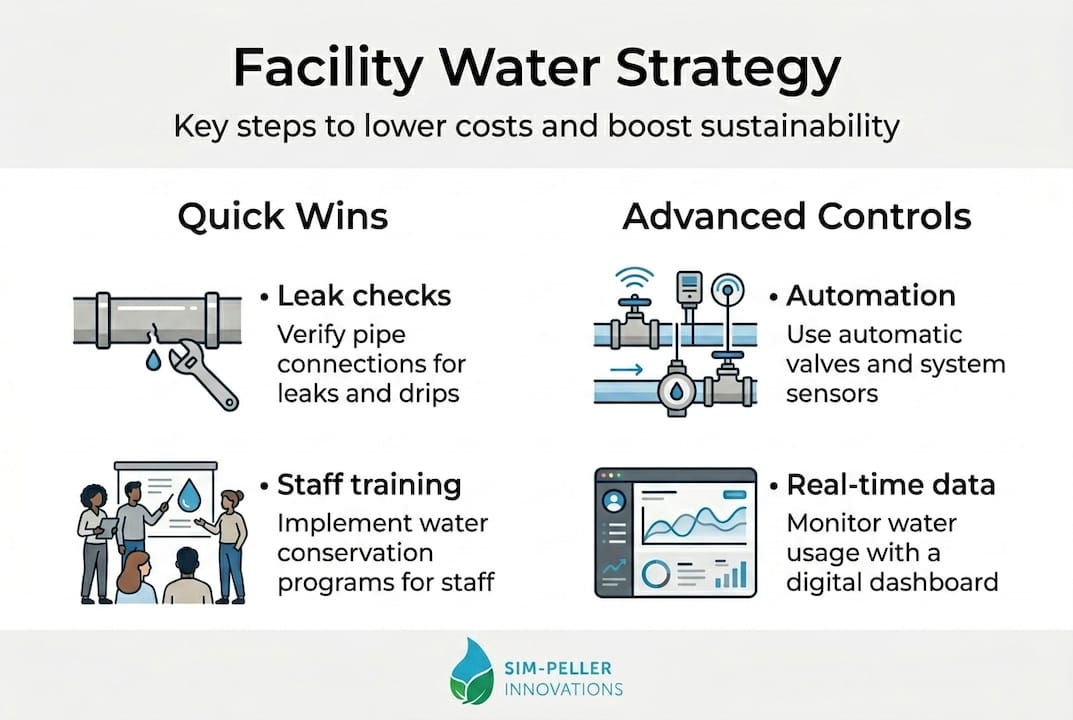
Conducting a water audit begins with pulling 12 to 24 months of utility bills and mapping usage against operational schedules. Look for spikes on weekends or overnight hours. These anomalies almost always point to leaks or equipment malfunctions, not legitimate operational demand. Document every point of use: cooling towers, restrooms, kitchen facilities, landscape irrigation, and process systems if applicable.
Facility managers should target cooling towers as the primary focus area, followed by restrooms and landscaping. Submetering these systems individually gives you the accountability and anomaly detection you need to act before problems become expensive. Without submetering, you are essentially flying blind between monthly utility statements.
High-priority areas to audit:
- Cooling towers: Often account for 30 to 50 percent of a commercial building's total water use
- Restrooms: Low-flow retrofit opportunities are frequently overlooked in older buildings
- Landscape irrigation: Timer-based systems waste enormous amounts of water regardless of weather conditions
- Water heating systems: Recirculation loops and heat exchangers are common sources of hidden waste
Before committing to capital-intensive retrofits, prioritize quick wins like audits, leak detection, and staff training. These low-cost actions routinely deliver 10 to 20 percent reductions in water use within the first three months. Integrating findings with your building management system (BMS) adds a layer of real-time visibility that compounds those early gains.
Example baseline metrics and tracking tools:
| Water use area | Typical share of total use | Recommended tracking tool |
|---|---|---|
| Cooling towers | 30 to 50% | Submeter with cycle counter |
| Restrooms | 20 to 30% | Individual floor submeters |
| Landscape irrigation | 10 to 25% | Smart controller with ET data |
| Domestic hot water | 5 to 15% | Inline flow meter |
| Process or lab use | Variable | Dedicated process meter |
A robust water savings guide will help you build the documentation framework for tracking these metrics consistently over time. Pairing that with facility water monitoring tools that integrate with your BMS creates a living dashboard rather than a static spreadsheet.
Pro Tip: When installing submeters, prioritize any single system that consumes more than 20 percent of your total water budget. The payback on that meter installation is almost always under six months.
Implement targeted strategies: From behavioral to technical solutions
Once your baseline is clear, it is time to move from assessment to action, combining people-driven changes with technology upgrades. The most successful facilities treat this as a parallel effort, not a sequential one.
Rolling out a water-saving program in commercial facilities requires a structured sequence:
- Communicate the business case to your team. Staff who understand the financial and environmental stakes are far more likely to report leaks, follow protocols, and suggest improvements. Share your baseline data openly.
- Establish water use policies. Define acceptable use, reporting procedures for detected leaks, and responsibilities for each department or building zone.
- Deploy low-flow fixtures in restrooms. Aerators, sensor faucets, and dual-flush toilets are inexpensive and reduce restroom water use by 30 to 50 percent without any behavioral change required.
- Install automated irrigation controls. Replace timer-based systems with ET (evapotranspiration) controllers that respond to weather data. These systems alone can cut landscape water use by 20 to 40 percent.
- Upgrade cooling tower controls. Automated blowdown controls and conductivity sensors prevent over-draining and maintain optimal cycles of concentration, a critical factor discussed in the next section.
- Introduce rainwater harvesting where feasible. Captured stormwater can be used for irrigation, toilet flushing, and in some cases, cooling tower makeup water, slashing your reliance on municipal supply.
On the technology side, smart water management platforms now make it straightforward to layer automated controls, leak alerts, and demand forecasting onto existing infrastructure without a full system replacement.
"Awareness and behavior changes are necessary starting points, but they remain insufficient without governance structures and the right infrastructure in place. When comparing sustainable water strategies, rainwater harvesting ranks highest in multi-criteria analysis over alternatives like desalination."
That finding carries a real lesson for facility teams. Behavioral initiatives are cost-effective and quick to launch, but they plateau without the governance and infrastructure investment to sustain them. Staff training alone does not fix a leaking cooling tower. And a new sensor system means very little if nobody has been designated to respond to its alerts.
Pro Tip: Pair every new technology deployment with a clear ownership assignment. Identify who receives the alert, what the expected response time is, and how resolution gets documented. Without this governance layer, even the best automation produces little sustained change.
The contrast between behavioral and infrastructure investment is worth holding clearly in mind. Behavioral programs cost little and can start tomorrow. They tend to generate early momentum and build the cultural foundation that makes technical upgrades stick. Infrastructure investments require capital and planning cycles, but they deliver compounding returns over the life of the asset.
Leverage data and automation: Advanced controls for efficiency
After covering operational changes, the next opportunity lies in leveraging data and advanced automation to multiply your results. This is where the trajectory of a water management program can shift from incremental to transformational.
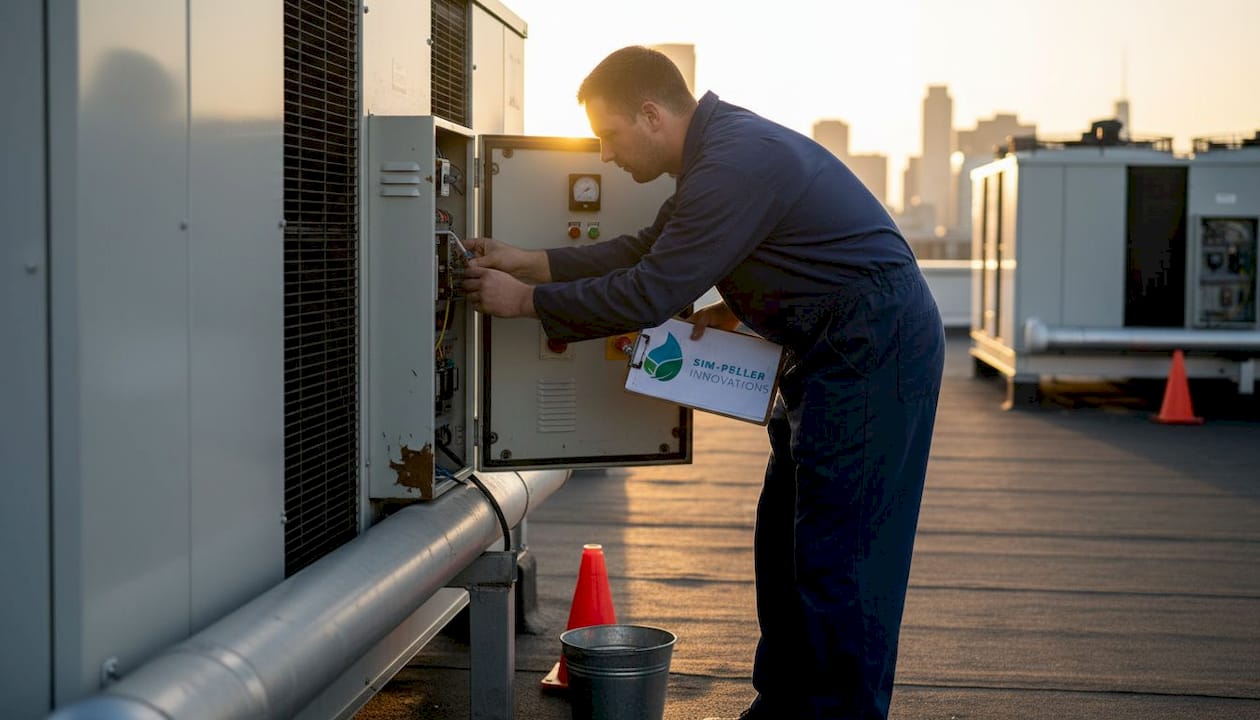
Real-time monitoring and predictive analytics close the gap between what a facility is using and what it should be using. Traditional monthly utility billing catches waste only after the fact. Submetering with hourly or real-time data resolution catches anomalies within minutes. That difference translates directly to dollars.
Cooling towers represent one of the clearest automation opportunities in any commercial facility. Maintaining 6 or more cycles of concentration reduces makeup water demand significantly. Automated blowdown controllers prevent over-bleeding, which wastes both water and the chemicals used to treat it. Without automation, most cooling towers operate at two to three cycles of concentration, far below their efficient potential.
Manual vs. automated water management: A direct comparison
| Management approach | Anomaly detection speed | Cooling tower efficiency | Typical water savings |
|---|---|---|---|
| Manual monitoring | Days to weeks | 2 to 3 cycles avg. | Baseline |
| BMS integration | Hours | 3 to 4 cycles avg. | 10 to 20% |
| Full IoT and AI automation | Minutes | 6 or more cycles | 25 to 40%+ |
The numbers behind AI-driven controls are striking. Melbourne Water's model predictive control implementation saved 2 billion liters per year in distribution management. In wastewater aeration, AI predictive controls achieved a 31 percent reduction in airflow, generating savings of 2,330 kWh per day and approximately $100,000 per year. These are not pilot project numbers. They reflect real operational outcomes from scaled deployments.
For facility managers building the case internally for automation investment, a facility IoT and AI water guide provides the framework for calculating ROI before committing capital. Separately, exploring AI-driven water analytics case studies can help you benchmark realistic savings expectations against your facility profile.
How to prioritize your automation investments:
- Start with cooling tower automation if towers are your largest water consumer. ROI is typically fastest here.
- Add smart irrigation controls as a second priority if landscaping is a significant cost driver.
- Deploy leak detection sensors on high-risk lines such as domestic supply, chilled water, and process water.
- Layer predictive analytics over your submeter network once the monitoring infrastructure is in place.
The pattern that emerges across high-performing facilities is consistent. They do not automate everything at once. They identify the highest-value opportunities, prove ROI on those first, and use the demonstrated savings to fund the next phase of investment.
Verify savings and refine strategies: Monitoring and continuous improvement
With technologies and strategies implemented, the final phase ensures results are validated, maintained, and built upon. Implementation without verification is, at best, an educated guess about your actual performance.
Validating savings through submetering and analytics means comparing post-implementation consumption data against your documented baseline, adjusted for weather, occupancy changes, and operational shifts. Raw consumption comparisons without these adjustments frequently undercount or overcount actual savings, which creates problems when reporting to stakeholders or board-level ESG committees.
Common trouble spots after upgrades include:
- Fixture regression: Low-flow aerators removed or bypassed by facilities staff for cleaning and never replaced
- Cooling tower drift: Automated blowdown controllers requiring recalibration after maintenance cycles
- Irrigation controller resets: Smart controllers reverting to factory defaults after power outages
- Submeter data gaps: Communication failures creating holes in monitoring data that mask anomalies
Addressing these issues requires scheduled verification routines, not just reactive responses to alerts. A quarterly physical walkthrough combined with monthly data review catches most of the drift before it compounds.
"Submetering creates the accountability structure that turns water efficiency from a project into a practice. Without it, savings erode quietly over time."
Submetering for accountability and anomaly detection gives you the evidence base for stakeholder reporting and the early warning system for performance degradation. Combine this with a commercial water management review cycle that includes leadership communication and you build a program that sustains its results year over year.
Key performance indicators to track monthly:
- Gallons per square foot per day by building zone
- Cooling tower cycles of concentration
- Irrigation use compared to ET benchmark
- Leak detection event frequency and response time
- Water cost per occupied unit or per production unit where applicable
Building a culture of continuous improvement means making performance data visible, celebrating wins, and treating performance gaps as learning opportunities rather than failure events. Regular recognition of team members who report issues or suggest improvements turns water management from a compliance obligation into a point of organizational pride.
Tracking performance-based water rewards and linking efficiency gains to visible outcomes creates tangible motivation. Exploring onsite water recycling as a next-level strategy allows facilities that have maximized efficiency to further reduce municipal dependence and demonstrate leadership on sustainability.
Why smart water management is less about tech and more about focus
Here is an uncomfortable truth that expensive software vendors will not tell you: the gap between average-performing and top-performing facilities is rarely about the sophistication of their technology. It is about the consistency of their attention.
Facilities that sustain 30 to 40 percent water savings year after year are not necessarily running the most advanced AI platforms. They are doing the fundamentals relentlessly. They review data weekly. They investigate every anomaly. They hold monthly conversations about performance with the teams responsible for operating equipment. They celebrate when cooling tower cycles improve by half a point.
The technology matters. Automation genuinely multiplies results. But technology deployed without active management attention drifts. Automated systems go out of calibration. Alerts get ignored. Dashboards stop being checked. The path to sustained performance is blocked not by a lack of sensors but by a lack of ownership.
The facilities that impress us most at Simpeller are not always the ones with the biggest IoT deployments. They are the ones where the facility manager can tell you, without looking it up, what their cooling tower ran at last Tuesday. That level of operational intimacy comes from culture, reporting rhythms, and leadership emphasis on fundamentals, which is something no software platform installs for you. Explore how boosting sustainability through structured accountability frameworks can anchor the human side of your water management program.
Take your strategy further with Simpeller's water solutions
Everything covered in this guide, from baseline auditing and submeter deployment to AI-driven controls and continuous improvement cycles, requires one foundational capability: the ability to see your water use in real time and trust that the data is accurate. That is exactly what Simpeller's IoT-enabled platform delivers for commercial facilities.
Simpeller combines plug-and-play smartsink sensor devices with an AI-driven analytics platform that makes hidden waste visible, tracks verified savings, and converts efficiency gains into measurable value. Whether your priority is slashing operational costs, meeting ESG reporting targets, or building the case for sustainability investment, our tools give you the verified performance data to act with confidence. Reach out today to explore how Simpeller's water management solutions can be tailored to your facility's specific profile and goals.
Frequently asked questions
What are the first steps in optimizing water use for large facilities?
Start with a water audit, leak detection, staff training, and submetering to set a measurable baseline and target quick wins first before committing to capital-intensive retrofits.
How do cooling towers impact overall facility water consumption?
Cooling towers are typically the largest water users in commercial facilities, and optimizing cycles of concentration to six or more through automated blowdown controls can significantly reduce makeup water demand.
Are AI and IoT really necessary for water savings?
Fundamentals like audits and fixture upgrades deliver the first wave of savings, but AI predictive controls enable anomaly detection and optimization at a scale that manual oversight simply cannot match.
What is a common mistake facility managers make in water management?
Relying solely on awareness campaigns without governance processes or monitoring in place is a frequent and costly mistake, since behavior changes alone are insufficient without the right infrastructure and accountability structures supporting them.