
TL;DR:
- Commercial buildings waste 30% of water through preventable inefficiencies, increasing costs.
- Regular water audits and fixture upgrades can save significant amounts of water quickly.
- Ongoing monitoring and building a culture of efficiency are crucial for sustaining water savings long-term.
Unexpected spikes in water bills have a way of forcing facility managers to pay attention. The truth is, commercial buildings waste 30% of their water through inefficiencies that are entirely preventable, from worn washers in restroom faucets to cooling systems running on outdated schedules. That waste translates directly into higher operating costs, bloated utility budgets, and missed sustainability targets. This guide walks you through a practical, step-by-step framework covering audits, fixture upgrades, alternative water sources, and ongoing monitoring so you can stop the waste, shrink costs, and build a stronger case for ESG reporting.
Table of Contents
- Assessing current water use: Audits and tools
- Quick wins: Fixtures, leaks, and operations
- Integrating alternative water sources
- Maintaining savings: Ongoing monitoring and management
- Why water savings in buildings succeed (or fail): Hard-won lessons
- Unlock more savings with Simpeller solutions
- Frequently asked questions
Key Takeaways
| Point | Details |
|---|---|
| Start with a water audit | Assess current use and find the biggest waste sources before investing in upgrades. |
| Fix leaks and upgrade fixtures | Quick repairs plus low-flow fixtures can dramatically reduce water and cost. |
| Explore alternative sources | Rainwater and greywater systems are powerful tools but work best in the right locations. |
| Monitor and engage staff | Ongoing tracking and staff involvement are key for long-term savings. |
Assessing current water use: Audits and tools
With the scale of water waste clear, the next step is to understand your building's baseline and spot the quickest wins. A water audit is the single most effective starting point for any facility manager serious about cutting consumption. Without knowing where water actually goes, improvements are guesswork.
A thorough audit maps every point of water use in the building: restrooms, kitchens, cooling towers, irrigation, and process water if applicable. It identifies meters that may be misread, fixtures that are outdated, and patterns in consumption that point to hidden leaks. The EPA offers free assessment tools specifically designed for commercial and institutional facilities, and using them is one of the fastest ways to benchmark your building against similar properties.
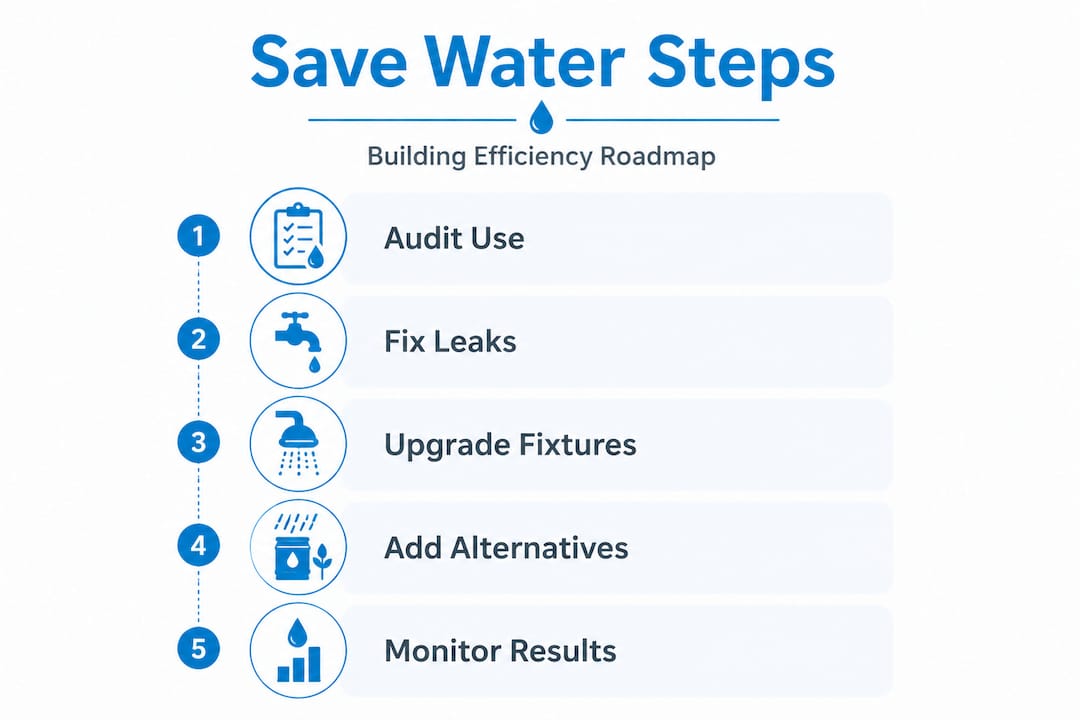
Here is a simple breakdown of what a standard water audit covers and what each step typically reveals:
| Audit step | What it examines | Common finding |
|---|---|---|
| Meter review | Total consumption vs. billing records | Billing errors, unmetered branches |
| Fixture inventory | Age, type, and flow rates of all fixtures | Outdated high-flow toilets and faucets |
| Leak detection walk | All supply lines, valves, and connections | Running toilets, dripping faucets |
| Operational review | Scheduling for irrigation and HVAC cooling | Off-hours usage spikes |
| End-use breakdown | Water volume allocated by use category | Restrooms often account for 35-45% of use |
Once you have baseline data, the audit prioritizes where intervention will deliver the highest return. Buildings with large restroom areas almost always find the most savings there first. Cooling towers and irrigation systems often rank second and third.
Conducting the audit itself follows a logical sequence:
- Pull 12 to 24 months of utility bills and plot consumption trends by month.
- Compare weekday versus weekend data to flag usage that continues when the building is empty.
- Walk every floor with a checklist and document fixture types, ages, and visible condition.
- Test toilets and urinals for phantom flushing using dye tablets or listening closely for tank refill cycles.
- Check all shut-off valves and isolation valves for drip or seepage.
- Review irrigation controller schedules and compare them with actual rainfall records.
- Prioritize findings by volume of waste and ease of fix.
Pro Tip: Set a calendar reminder to repeat the audit annually. Conditions change as fixtures age, occupancy patterns shift, and new systems are added. Consistent reassessment keeps you ahead of waste rather than reacting to it.
Water audits are not a one-time exercise. Buildings change, equipment wears, and usage patterns evolve with occupancy and season. Scheduling a formal review each year, combined with monthly meter checks, creates a rhythm of accountability that makes waste visible before it becomes expensive. Understanding how water monitoring can be a game changer for facilities architecture is a natural next step after your first audit. You can also explore how water rewards programs can turn documented savings into tangible value.
Quick wins: Fixtures, leaks, and operations
Once you spot the issues, you can see quick returns from targeted improvements. Restrooms, leaks, and aging fixtures are responsible for the overwhelming majority of water waste in commercial buildings. Addressing them first delivers the fastest payback and the clearest data for management reporting.
Restrooms alone account for a disproportionate share of building water consumption. In a typical office building with hundreds of occupants, toilets, urinals, and faucets run constantly throughout the workday. The EPA's WaterSense program sets clear targets: low-flow toilets at 1.28 gpf or less, urinals at 0.5 gpf or less, public faucets at 0.5 gpm, and showerheads at 2.0 gpm. These specifications are not aspirational. They are achievable with products that are widely available and competitively priced.
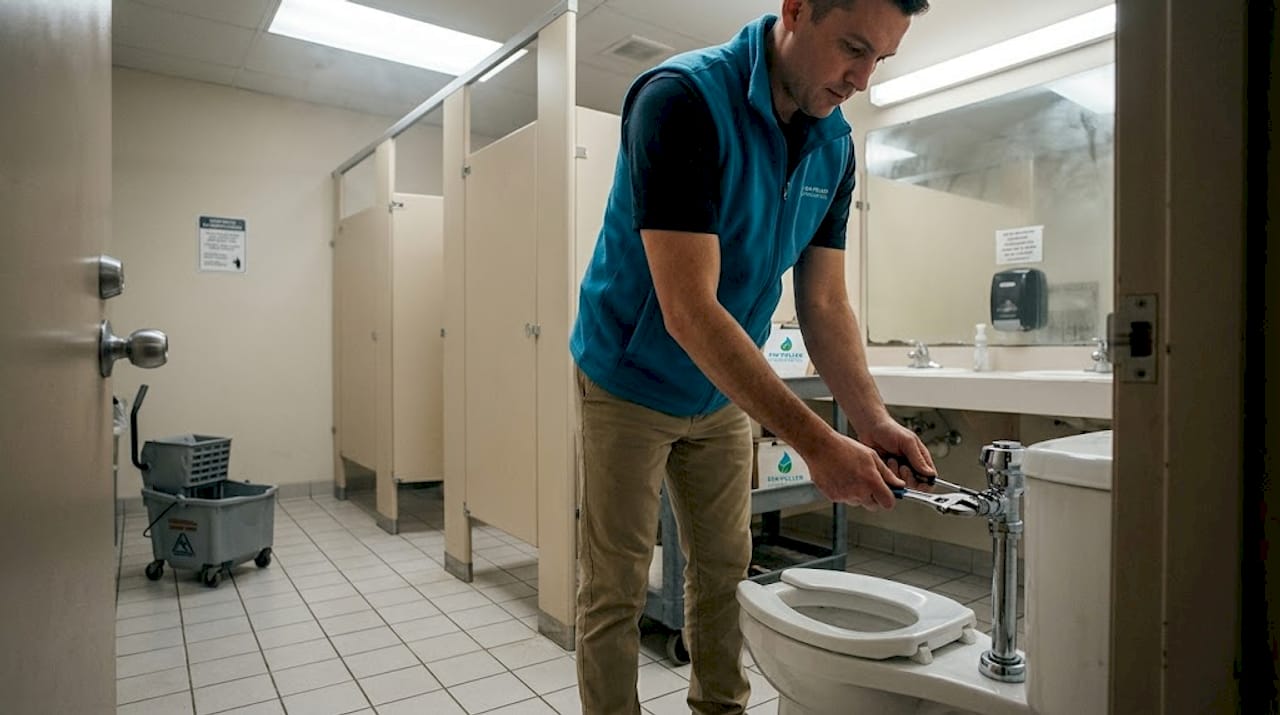
Here is how low-flow fixtures compare to standard ones in real-world performance:
| Fixture type | Standard flow rate | WaterSense target | Savings per unit per year |
|---|---|---|---|
| Toilet | 1.6 gpf | 1.28 gpf or less | Up to 4,000 gallons |
| Urinal | 1.0 gpf | 0.5 gpf or less | Up to 15,000 gallons |
| Public faucet | 2.2 gpm | 0.5 gpm | Up to 30% of faucet use |
| Showerhead | 2.5 gpm | 2.0 gpm | Up to 2,900 gallons |
The savings stack quickly across a multi-floor building. A ten-story office with four restrooms per floor and dozens of fixtures can expect to eliminate hundreds of thousands of gallons annually by swapping out one fixture type.
Leaks deserve equal attention. A running toilet can waste up to 200 gallons per day without making a sound that alerts anyone. A dripping faucet contributes thousands of gallons per year. The good news is that low and no-cost fixes like replacing flappers, tightening connections, and repairing running toilets can prevent as much as 30% of total water waste in some facilities.
Here are the most impactful operational practices to implement immediately:
- Replace toilet flappers on a scheduled basis, not just when a problem is reported.
- Install aerators on all non-kitchen faucets to cut flow without reducing perceived pressure.
- Add auto-shutoff sensors to public restroom faucets to eliminate the most common source of forgotten-tap waste.
- Inspect all supply line connections quarterly and log findings in your maintenance system.
- Check water meter readings at the start and end of weekend or holiday periods when the building is unoccupied. A meter that continues to tick confirms a leak.
- Audit cooling tower bleed-off rates and verify that conductivity controllers are calibrated correctly.
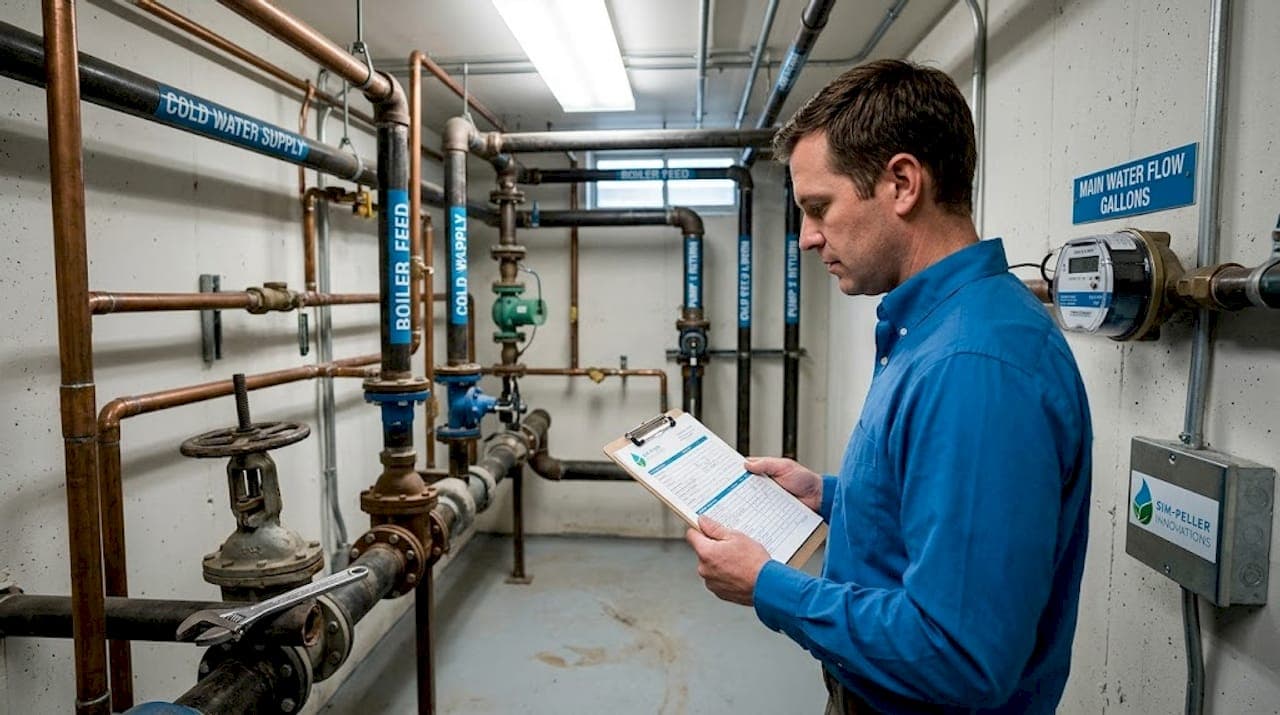
Pro Tip: Walk your mechanical room slowly and look at every pipe connection, valve, and fitting. Mineral deposits, rust stains, or moisture on concrete floors are reliable clues that something is losing water slowly. These low-cost visual checks often catch problems that sensor systems miss.
Upgrading fixtures and plugging leaks also opens the door to thinking about related energy-saving devices that compound the savings. And if your building is ready to go further, reviewing onsite water recycling options can dramatically reduce potable water demand for non-drinking uses.
Integrating alternative water sources
For even greater efficiency, buildings can benefit by supplementing potable water with site-adapted alternatives. Not every building can fully replace municipal supply, but most can offset a meaningful portion of demand by capturing and reusing water that would otherwise go down the drain.
The two most practical options for commercial buildings are rainwater harvesting and greywater reuse. Each has specific applications where it performs best, and choosing between them depends on your site's conditions, local regulations, and primary water end-uses.
Key factors that determine which system makes sense for your building:
- Roof area and material: Larger roofs with smooth, non-toxic surfaces collect more usable rainwater. A building with 20,000 square feet of roof can collect tens of thousands of gallons in a single moderate rain event.
- Local rainfall patterns: Buildings in regions with consistent annual rainfall benefit most from rainwater harvesting systems connected to cooling towers, toilet flushing, or irrigation.
- Occupancy and greywater volume: Buildings with showers, sinks, and laundry facilities produce large volumes of greywater that can be treated and reused for toilet flushing or landscape irrigation without significant treatment costs.
- Regulatory environment: Local codes vary widely. Some jurisdictions actively incentivize greywater reuse and rainwater collection; others impose restrictions. Always verify compliance before designing a system.
- Storage and treatment infrastructure: Both systems require tanks, filters, and in some cases UV treatment. Space for storage is often the binding constraint in dense urban buildings.
Research published in peer-reviewed environmental science journals confirms that greywater is more reliable in low-rainfall regions, while rainwater harvesting tends to perform better for cooling tower makeup water in areas with adequate precipitation. The choice is site-specific, and forcing either system onto an unsuitable building wastes capital without delivering meaningful results.
"Alternative water sources including rainwater and greywater are viable for large commercial rooftops, but performance is highly site-specific. Greywater systems demonstrate greater reliability in regions with low or variable annual precipitation, while rainwater harvesting shows stronger returns when used for cooling tower makeup water in higher-rainfall climates."
The practical path forward is to commission a feasibility study that models your building's actual rainfall data, greywater generation volumes, and target end-uses before specifying any equipment. Pairing that analysis with a clear understanding of water reuse strategies for commercial real estate helps set realistic expectations for cost recovery timelines and ESG reporting benefits.
Common pitfalls include oversizing storage tanks relative to collection capacity, underestimating treatment maintenance requirements, and failing to train staff on system operation. A greywater system that sits improperly maintained quickly becomes a liability rather than an asset.
Maintaining savings: Ongoing monitoring and management
Implementing changes is only the start. Keeping savings sustained calls for ongoing vigilance, consistent communication, and the right tools to make performance visible.
One of the most common patterns in commercial buildings is that water use improves sharply after a retrofit or audit, then gradually creeps back up over 18 to 24 months. Fixtures wear out. Staff turnover means new team members who were not part of the original initiative. Meters go unchecked. Leaks reappear. Without a system for continuous monitoring, the gains quietly evaporate.
Here is a proven framework for sustaining water savings long-term:
- Assign ownership: Designate a specific team member or role as the water efficiency lead. Savings that belong to everyone tend to belong to no one.
- Set monthly meter reading targets: Compare actual consumption to the baseline established in your initial audit and flag any month where consumption rises more than 5% without a corresponding change in occupancy.
- Schedule quarterly leak detection walks: Use the same checklist developed during the audit and log results consistently so trends are visible over time.
- Engage the whole team: Brief maintenance and janitorial staff on what to watch for. They are often first to notice a running toilet, a dripping pipe, or a malfunctioning sensor. Their observations are valuable intelligence.
- Review fixture performance annually: Aerators clog, flappers harden, and sensor batteries fail. Annual checks keep equipment performing at specification.
- Use smart technology to close the gap: IoT sensors and AI-driven platforms make continuous monitoring feasible without adding headcount. Anomalies in consumption appear in real time rather than at the end of a billing cycle.
The data makes a compelling case for this kind of structured approach. Holistic plans that combine assessment, fixture retrofits, and ongoing operations and maintenance consistently deliver 30 to 50% reductions in water use without compromising occupant experience or building performance. That range represents enormous cost savings across a portfolio of properties.
Smart technology is accelerating what is possible. Understanding how smart water management ties together data, alerts, and accountability is becoming a baseline competency for forward-looking facility managers. Platforms that combine IoT sensors with AI-driven analysis can detect micro-leaks, flag abnormal usage patterns, and generate the verified performance data that supports ESG disclosures and carbon accounting with real credibility.
The financial case for sustained monitoring is straightforward. Water rates in most U.S. cities have risen faster than general inflation for over a decade. Every gallon saved today is worth more tomorrow. Buildings that maintain their efficiency gains protect themselves against rate increases while those that backslide simply pay more.
Why water savings in buildings succeed (or fail): Hard-won lessons
With all the strategies outlined above, it is worth pausing to ask a harder question. Why do some buildings achieve lasting water savings while others stall after the initial retrofit?
The honest answer is rarely about technology. Facilities that backslide almost always share a common pattern: the initiative lived in one person's head, never became part of the operational culture, and faded when that person moved on or shifted priorities. The audit happened. Fixtures were upgraded. Then nothing was measured again.
Buildings that sustain real savings treat water efficiency the way they treat fire safety or security. It is built into schedules, responsibilities, and reporting. Maintenance teams know what to look for. Managers review consumption data the same way they review energy bills. Janitorial staff report issues instead of ignoring them.
New technology helps, but it does not substitute for culture. A building with engaged staff and basic monitoring consistently outperforms a building with expensive sensors and no follow-through. That insight might be uncomfortable, but it is actionable. If you want savings to last, invest in people and process first, then layer in smart technology to amplify what a motivated team can see and respond to.
Exploring sustainable property management practices that embed efficiency into everyday operations is the best way to make sure your water program survives beyond the initial excitement.
Unlock more savings with Simpeller solutions
Ready to put these strategies to work and amplify your results? Simpeller's plug-and-play IoT smartsink devices and AI-driven platform make water waste visible in real time, so facility managers can act on verified data rather than waiting for the next bill. Our water-saving solutions connect audit findings to continuous monitoring, turning efficiency gains into measurable value that supports ESG reporting, carbon accounting, and operational cost reduction. For a deeper look at the full savings potential, the comprehensive water savings guide covers advanced strategies across building types. Reach out to the Simpeller team to discuss a tailored approach for your portfolio.
Frequently asked questions
What are the most effective water-saving upgrades for buildings?
Upgrading to low-flow toilets, urinals, and faucets meeting WaterSense specifications delivers immediate, measurable savings without reducing performance or occupant satisfaction.
How often should water audits be performed in commercial buildings?
Annual water audits are the standard recommendation, giving facility managers a reliable cycle to detect new waste sources and measure the impact of previous improvements.
What is the potential ROI for water-saving initiatives?
Comprehensive programs combining audits, retrofits, and ongoing operations and maintenance regularly achieve 30 to 50% reductions in water use, with cost recovery often within one to three years depending on local water rates.
Are alternative water sources feasible for every building?
Not universally. Site-specific factors including roof size, local rainfall, storage capacity, and regulatory requirements determine whether rainwater harvesting or greywater reuse will deliver a positive return for a given property.