
TL;DR:
- Water waste poses significant operational risks but can be effectively managed with proven strategies.
- Sub-metering, benchmarking, and continuous monitoring are essential for identifying and reducing water loss.
- Advanced technologies like IoT sensors and AI analytics offer high-impact, verifiable water savings across industries.
Water waste is one of the most underestimated operational risks in commercial real estate, manufacturing, and hospitality today. A single leaking toilet can silently drain 275 liters every day, and across a large facility, that loss multiplies into thousands of dollars in utility overruns before anyone notices. For facility managers and operations specialists, the good news is that proven, scalable solutions exist right now. This guide walks through a structured, step-by-step approach to assessing water use, building a tailored management strategy, adopting high-impact technology, and achieving measurable savings that hold up quarter after quarter.
Table of Contents
- Assess and benchmark your water use
- Develop a facility-specific water management strategy
- Adopt high-impact fixtures and technologies
- Innovations for manufacturing and high-demand facilities
- What most guides get wrong about water waste reduction
- Explore water-saving solutions designed for your facility
- Frequently asked questions
Key Takeaways
| Point | Details |
|---|---|
| Data-driven audits | Regular audits and benchmarking expose the biggest opportunities for water waste reduction in facilities. |
| Tech-enabled solutions | IoT sensors and smart fixtures deliver fast ROI and consistent savings by preventing undetected leaks. |
| Strategy over quick fixes | Comprehensive water management strategies outperform reactive repairs and one-off changes. |
| Manufacturing innovations | Advanced process redesign in manufacturing can cut water use by up to 90 percent. |
Assess and benchmark your water use
Understanding your current water footprint is the critical first step before implementing any solutions. You cannot reduce what you have not measured, and in most facilities, the true picture is far worse than what the utility bills suggest.
The most effective starting point is sub-metering. Installing sub-meters at key endpoints, including restrooms, cooling towers, kitchens, and irrigation systems, gives you granular data on exactly where water is consumed. This is fundamentally different from reading a single master meter at the property boundary. Sub-metering isolates problem zones and makes invisible losses visible, which is precisely where the savings opportunity lives.
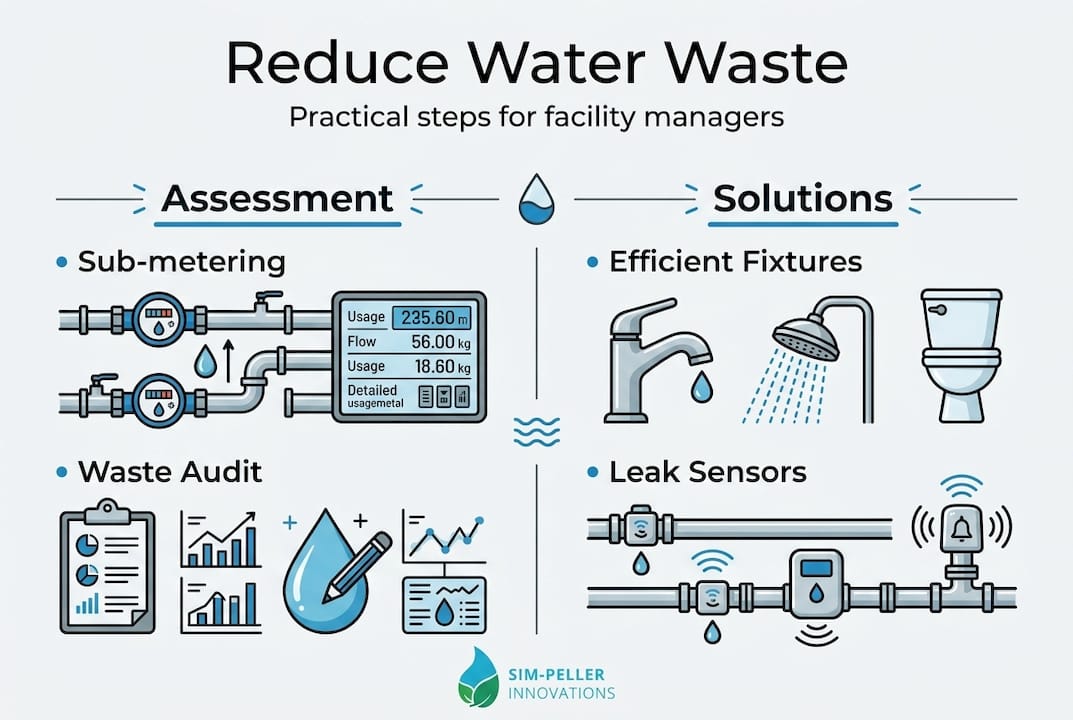
A structured waste audit complements sub-metering. Waste audits and tools like ENERGY STAR Portfolio Manager give facility managers a systematic framework to track water data over time, compare usage across billing cycles, and flag anomalies that signal leaks or operational inefficiencies. ENERGY STAR Portfolio Manager is particularly valuable because it allows you to enter real utility data and receive a normalized performance score based on your building type and climate zone.
Benchmarking against recognized indices takes the analysis one step further. Smart metering and benchmarking tools, including the Cornell Center for Hospitality and Sustainability Benchmarking (CHSB) Index, have demonstrated that facilities using these methods can identify and address up to 30% of total water waste. For hospitality properties, that figure translates directly into bottom-line savings that show up in every quarterly operations report.
Key benchmarks to track by facility type:
- Commercial offices: 30 to 50 gallons per occupant per day
- Hotels: 100 to 200 gallons per occupied room per night
- Manufacturing plants: varies widely by process, but cooling and cleaning account for the majority
- Restaurants: 5,000 to 7,000 gallons per day in high-volume operations
The goal of this assessment phase is to build a reliable baseline. Without a baseline, you cannot set realistic targets, justify capital investments, or demonstrate progress to stakeholders and ESG auditors. For a deeper look at how CRE water costs and ESG performance intersect, the data from this phase becomes the foundation of your reporting story.
Pro Tip: Schedule your water audit during a period of normal operations, not a holiday shutdown. Auditing during low-occupancy periods misrepresents your baseline and skews your benchmarks downward, making it harder to size upgrades correctly.
Once you have sub-meter data and audit results in hand, prioritize your findings by volume and frequency. A toilet that runs intermittently and wastes 50 liters per day gets fixed before you invest in a landscaping controller. Quick wins fund the larger capital projects. Review water monitoring best practices to understand how continuous monitoring platforms can sustain the gains your audit reveals.
Develop a facility-specific water management strategy
With data in hand, it is time to create a targeted strategy that matches your facility's unique needs, not a generic template borrowed from another sector.
A well-constructed water management strategy follows five core steps. A comprehensive strategy covers these stages in sequence: assess current use, identify operational and climate-related risks, set quantified reduction targets, implement solutions, and monitor performance continuously. Each step builds on the previous one, and skipping ahead typically results in expensive mismatches between problems and solutions.
The five steps, sequenced for facility managers:
- Assess current water consumption using sub-meters, utility bills, and audit tools
- Identify risks including aging infrastructure, drought exposure, regulatory requirements, and ESG commitments
- Set targets that are specific and time-bound, such as a 20% reduction in water intensity within 18 months
- Implement solutions in priority order, starting with highest-impact, lowest-cost fixes
- Monitor continuously using IoT sensors and platform dashboards, and adjust as needed
The sequencing matters. Hospitality facilities, for example, face a different risk profile than manufacturing plants. A hotel in a water-stressed region must factor in regulatory restrictions on outdoor irrigation and guest expectations around sustainability. A manufacturing plant may face discharge compliance requirements that make process water recycling not just economically attractive but legally necessary.
| Facility type | Top risk driver | Priority solution | Typical savings |
|---|---|---|---|
| Commercial real estate | Aging fixtures and leaks | Sub-metering and fixture upgrades | 15 to 25% |
| Hospitality | Guest use and laundry | Smart controls and greywater reuse | 20 to 30% |
| Manufacturing | Process and cooling water | Closed-loop systems and AI forecasting | 40 to 90% |
Setting targets also means connecting water reduction to your ESG reporting framework. Investors and tenants increasingly scrutinize water intensity metrics, and facilities that cannot demonstrate verified performance data are at a disadvantage in lease negotiations and asset valuations. IoT and AI for water management are making it significantly easier to generate the verified, auditable data that ESG reporting requires.
Pro Tip: Tie your water reduction targets directly to a dollar figure. A 20% reduction sounds compelling, but "saving $48,000 annually in utility costs" gets capital approved faster. Always translate volume savings into financial impact when presenting to decision-makers.
For facilities that manage multiple properties, a portfolio-level strategy lets you prioritize capital allocation across sites based on comparative water intensity scores. The properties with the highest intensity and the lowest cost-to-fix ratio move to the top of the investment queue. Smart water management platforms with portfolio dashboards make this kind of triage straightforward and defensible.
Adopt high-impact fixtures and technologies
Once the strategy is set, the next move is choosing technologies that maximize water reduction for your available resources and budget.
The technology landscape has matured considerably. Facility managers no longer face a binary choice between doing nothing and undertaking a full infrastructure overhaul. Today's solutions range from affordable fixture upgrades to AI-powered leak detection systems that operate continuously in the background. Low-flow fixtures, IoT leak sensors, greywater recycling, and drought-resistant landscaping each address different segments of your water footprint, and the best programs stack them for compound results.
High-impact technology options for facility managers:
- Low-flow fixtures: Aerators, dual-flush toilets, and sensor-activated faucets typically reduce restroom water use by 20 to 40% with payback periods under two years
- IoT leak sensors: Continuous monitoring devices placed at pipes, valves, and fixtures detect anomalies in real time and alert operations staff before small leaks become major losses
- Greywater recycling systems: Capturing and treating sink and shower water for reuse in toilets and irrigation can cut potable water demand by 20 to 30% in hospitality properties
- AI-driven leak detection platforms: Machine learning models trained on flow pattern data can identify leaks that are invisible to manual inspection, including slow seeps behind walls and under slabs
- Smart irrigation controllers: Weather-responsive systems that adjust watering schedules based on real-time evapotranspiration data routinely cut landscape water use by 30 to 50%
Statistic callout: Buildings account for 40% of global energy-related carbon emissions, and water heating is a significant contributor. Combining water reduction with energy efficiency upgrades delivers compounded savings across both utility lines.
The ROI case for technology adoption is stronger than many facility managers realize. Utility rebate programs in many jurisdictions cover 20 to 50% of fixture upgrade costs, and several IoT platform vendors offer subscription pricing that eliminates large upfront capital requirements. Smart sensors enabling cutting water waste efficiently at the 20 to 30% level have proven their value across dozens of commercial deployments.
Pro Tip: When evaluating IoT platforms, prioritize those that integrate with your existing building management system (BMS). Standalone systems that require manual data exports create friction and reduce the likelihood that your operations team will act on alerts consistently.
For facilities that also want to reduce energy costs alongside water, the intersection is significant. Water heating, pumping, and cooling tower operation all consume electricity. Check out resources on energy-saving devices to understand how water and energy reduction programs can be coordinated for maximum impact across both operating cost lines.
Innovations for manufacturing and high-demand facilities
Facilities with intensive water needs require specialized, scalable technical solutions that go well beyond traditional fixture swaps and awareness campaigns.
In manufacturing environments, water touches nearly every process. Cooling, rinsing, steam generation, product formulation, and sanitation all compete for the same resource. The volumes involved dwarf what commercial real estate or hospitality properties consume, which means the savings opportunity is proportionally larger as well. Instrumenting water flows, deploying ultrasound leak detection, and integrating AI-powered diagnostics are the foundational moves for any serious industrial water reduction program.
Action list for high-use manufacturing and industrial facilities:
- Install flow instrumentation at every major process endpoint to establish real-time consumption visibility
- Deploy ultrasound or acoustic leak detection on pipe networks, especially in areas inaccessible to visual inspection
- Implement reverse osmosis or advanced filtration for process water reuse, reducing intake from municipal or well sources
- Redesign cooling tower operations with variable-frequency drives and automated blowdown controls
- Integrate AI demand forecasting to match water-intensive production schedules with available supply and reduce peak demand charges
- Establish closed-loop water systems for rinse and wash processes, recirculating treated water rather than discharging after a single use
The results from these interventions are not incremental. Closed-loop cooling, process redesign, and AI demand forecasting can reduce total water intake by up to 90% in manufacturing facilities that commit to a systematic program. That is not a marginal improvement. It is a structural transformation in how the facility relates to its water supply.
| Technology | Application | Reduction potential | Typical payback |
|---|---|---|---|
| Closed-loop cooling systems | Heavy manufacturing, data centers | 50 to 70% of cooling water | 2 to 4 years |
| Reverse osmosis reuse | Food and beverage, semiconductor | 60 to 85% of process water | 3 to 6 years |
| AI demand forecasting | Any high-volume process | 15 to 30% of total intake | 1 to 2 years |
| Ultrasound leak detection | Pipe networks, pressure systems | 10 to 20% of distribution loss | Under 1 year |
"The shift from reactive maintenance to AI-driven predictive water management is the single biggest opportunity most manufacturing operations have never acted on."
For a detailed breakdown of how to size and finance these systems, the guide to onsite water recycling covers the technical and financial fundamentals. And for facilities exploring how machine learning can optimize water scheduling and leak response, the resource on using AI for water savings is an essential read.
What most guides get wrong about water waste reduction
Here is the uncomfortable reality: most facility water conservation programs fail not because the technology is wrong, but because the priorities are wrong from the start.
Too many programs lead with behavioral change. Linen reuse cards, signage reminding staff to turn off taps, and employee awareness campaigns feel like meaningful action. They rarely deliver lasting results. Behavioral programs are inconsistent by nature because they depend on individual compliance at every shift, every day. Infrastructure-based approaches outperform behavioral programs because they remove the human variable from the equation. A sensor does not forget. A low-flow aerator does not have a bad day.
The second most common mistake is reactive maintenance. Fixing leaks after they appear on the utility bill means you have already lost weeks or months of water to waste. The shift to continuous monitoring changes this entirely. When a system flags an anomaly at 2 a.m. on a Tuesday, your team can respond before the loss compounds.
Fragmented efforts compound both problems. A hospitality property that installs low-flow showerheads in three floors but has no metering to verify the impact is running blind. The upgrade might have worked, or it might have been offset by a pressure issue elsewhere. Only systematic tracking closes that loop. Performance-based water rewards models take this one step further by tying verified savings to tangible financial returns, creating the accountability structure that makes gains permanent.
The facilities that consistently achieve the deepest reductions invest in monitoring first, then upgrade infrastructure based on data, and treat behavioral programs as a supporting layer rather than a primary strategy.
Explore water-saving solutions designed for your facility
Taking the next step means leveraging tools that simplify and accelerate water waste reduction at every scale. Simpeller brings together plug-and-play IoT sensor devices, AI-driven analytics, and a tokenized efficiency platform specifically designed for commercial, manufacturing, and hospitality operations. The smartsink device makes invisible leaks and energy waste visible in real time, giving your operations team the data to act quickly and the reporting infrastructure to satisfy ESG auditors and investors. Verified water savings are converted into renewable energy credits, material-exchange vouchers, or cross-subsidy investments, turning every liter saved into measurable, auditable value. Discover how Simpeller can help your facility move from awareness to action.
Frequently asked questions
What are the first steps to reduce water waste in a commercial building?
Start by assessing your current use with audits and smart meters, then benchmark against industry standards to find priority fixes. This data-driven foundation prevents wasted investment in solutions that don't address your actual loss points.
How much water do leaks typically waste in facilities?
A single leaking toilet wastes up to 275 liters per day, and leaks account for roughly 30% of total water wasted in commercial real estate buildings. Across a multi-floor facility, that loss compounds into significant annual utility overruns.
What new technologies offer the biggest water savings?
IoT leak sensors, AI-driven analytics, and greywater recycling systems provide the most significant and verifiable reductions in water waste for facilities operating today. These technologies work continuously without relying on human behavior to deliver results.
Are behavioral changes effective for water conservation?
While helpful as a supporting layer, behavioral programs show inconsistent results compared to infrastructure upgrades and continuous monitoring solutions. The most effective programs treat behavioral initiatives as a complement to technology, not a substitute for it.