

TL;DR:
- Commercial buildings waste 20-30% of energy, costing up to $60,000 annually per building.
- Data-driven audits, BAS tuning, and occupant engagement can achieve significant savings with minimal capital.
- Water and energy efficiency strategies should be prioritized alongside behavior and operational improvements for maximum impact.
Utility costs for commercial buildings are climbing faster than most capital budgets can absorb, and ESG reporting requirements are tightening every reporting cycle. Commercial buildings waste 20-30% of energy, leaving potential annual savings of $60,000 per building sitting untapped. For facility managers and sustainability officers, the pressure is real: cut operational costs, meet compliance targets, and do it without grinding daily operations to a halt. This article walks you through a criteria-backed framework to evaluate, prioritize, and deploy the most impactful water and energy resource management strategies available to commercial buildings today.
Table of Contents
- Establish clear criteria for resource management strategy selection
- Optimize energy management: audits, BAS, and no/low-capex measures
- Water efficiency: lifecycle costing and onsite reuse solutions
- Engage occupants and tenants: behavioral and operational change
- Compare and match strategies: what works best for your facility?
- The hidden leverage: Why behavioral and BAS-based strategies outpace expensive retrofits
- Unlock your facility's full efficiency potential
- Frequently asked questions
Key Takeaways
| Point | Details |
|---|---|
| Data first, then upgrades | Start with audits and submetering to accurately target building inefficiencies. |
| BAS yields fast wins | Tuning your building automation system can cut waste by up to 30% with low or no capital outlay. |
| Holistic approach works best | Combine tech upgrades, lifecycle costing, and tenant engagement for persistent, scalable savings. |
| Compare, then act | Use side-by-side comparisons to select best-fit strategies for your building’s goals, budget, and compliance needs. |
Establish clear criteria for resource management strategy selection
With the stakes and potential savings established, facility managers need a robust process for evaluating strategies before committing budget or time. Jumping straight to retrofits without a clear selection framework wastes capital and often delivers underwhelming results.
Start by defining your core selection criteria. The five most useful filters are:
- Cost savings potential: What percentage reduction is realistically achievable?
- ESG impact: Does this strategy support your carbon accounting and ESRS2 compliance criteria?
- Regulatory requirements: Are there mandated upgrades or reporting obligations driving the timeline?
- Operational disruption: How much downtime or tenant inconvenience does this create?
- Payback period: How quickly do capital or operational investments return value?
Before selecting any strategy, conduct comprehensive energy and water audits. These audits identify true wastage patterns and submetering opportunities that generic benchmarks miss entirely. Submetering breaks down consumption by floor, zone, or system, giving you the granular data needed to target the highest-impact interventions first.
Building automation systems (BAS) are equally foundational. Rather than treating BAS as a static scheduling tool, use it as a continuous optimization engine. Prioritize data-driven audits and submetering before retrofits; integrate BAS for real-time optimization over static schedules.
"Prioritize data-driven audits and submetering before retrofits."
Finally, involve tenants and occupants early. Their behavior directly affects consumption, and their input shapes which priorities are realistic versus aspirational. For a structured overview of monitoring energy waste, building your criteria on verified data is what separates effective programs from expensive guesses.
Optimize energy management: audits, BAS, and no/low-capex measures
After defining your selection criteria, the first major opportunity lies in energy management. The good news: significant gains are available without large capital outlays.
Here is a prioritized action sequence:
- Commission a detailed energy audit. Identify the top five energy users in your building and establish a consumption baseline by system.
- Install submetering on HVAC, lighting, and plug loads. This reveals where energy actually goes, not where you assume it goes.
- Tune your BAS settings. Adjust setpoints, scheduling, and economizer controls to match actual occupancy patterns rather than default factory settings.
- Address HVAC performance first. HVAC systems account for about one-third of end-use energy consumption in commercial buildings, making it the single largest target for efficiency gains.
- Optimize lighting and plug load management through occupancy sensors and smart power strips before investing in full LED retrofits.
BAS tuning alone can reduce overall building energy by 10 to 30%, which is a significant return for an operational change that requires no new construction. Many facilities leave this value on the table because BAS settings get configured once during commissioning and then rarely revisited.
Commercial buildings waste 20-30% of energy — up to $60,000 annually per building.
Pro Tip: Review and re-tune your BAS settings at the start of each season. Heating and cooling setpoints calibrated for summer will actively waste energy in winter. Seasonal re-tuning is one of the fastest ways to drive persistent energy gains without spending a dollar on hardware.
For a curated overview of energy-saving devices and what 2026 efficiency trends mean for your portfolio, building the audit and BAS foundation first ensures every future investment is targeted and justified.
Water efficiency: lifecycle costing and onsite reuse solutions
With energy efficiency underway, turn to the next largest resource: water. Water costs are rising in most markets, and water-related risks are increasingly scrutinized in ESG disclosures.
Begin with a dedicated water audit and submetering. Identify your top water uses, from cooling towers and restrooms to irrigation and process loads, then locate leaks and inefficiencies at the system level. Even a modest 10% reduction in water use can translate to meaningful operational savings when applied to a large commercial building.
Before selecting any major water-saving system, apply lifecycle cost analysis (LCCA). A holistic approach combining technical upgrades with tenant engagement and LCCA consistently outperforms single-technology deployments. LCCA accounts for installation, maintenance, replacement, and avoided utility costs over the system's full life, giving you a realistic comparison across options.
| Strategy | Upfront cost | Disruption level | ESG impact | Typical payback |
|---|---|---|---|---|
| Graywater recycling | Medium to high | Medium | High | 5 to 10 years |
| Rainwater harvesting | Medium | Low | Medium | 4 to 8 years |
| Fixture retrofits | Low | Very low | Medium | 1 to 3 years |
| Blackwater treatment | High | High | Very high | 8 to 15 years |
| Leak detection systems | Low | Very low | Medium | Under 1 year |
For a deeper look at choosing the right approach, the water savings guide and onsite recycling solutions provide facility-specific decision frameworks.
Pro Tip: Do not wait for graywater system approvals to start saving. Basic fixture retrofits, aerators, and leak detection programs deliver rapid payback while more comprehensive solutions move through planning and permitting.
Engage occupants and tenants: behavioral and operational change
Beyond technology and capital upgrades, the human element plays a crucial role in sustained resource efficiency. Technology delivers capacity; occupants determine whether that capacity gets used wisely.
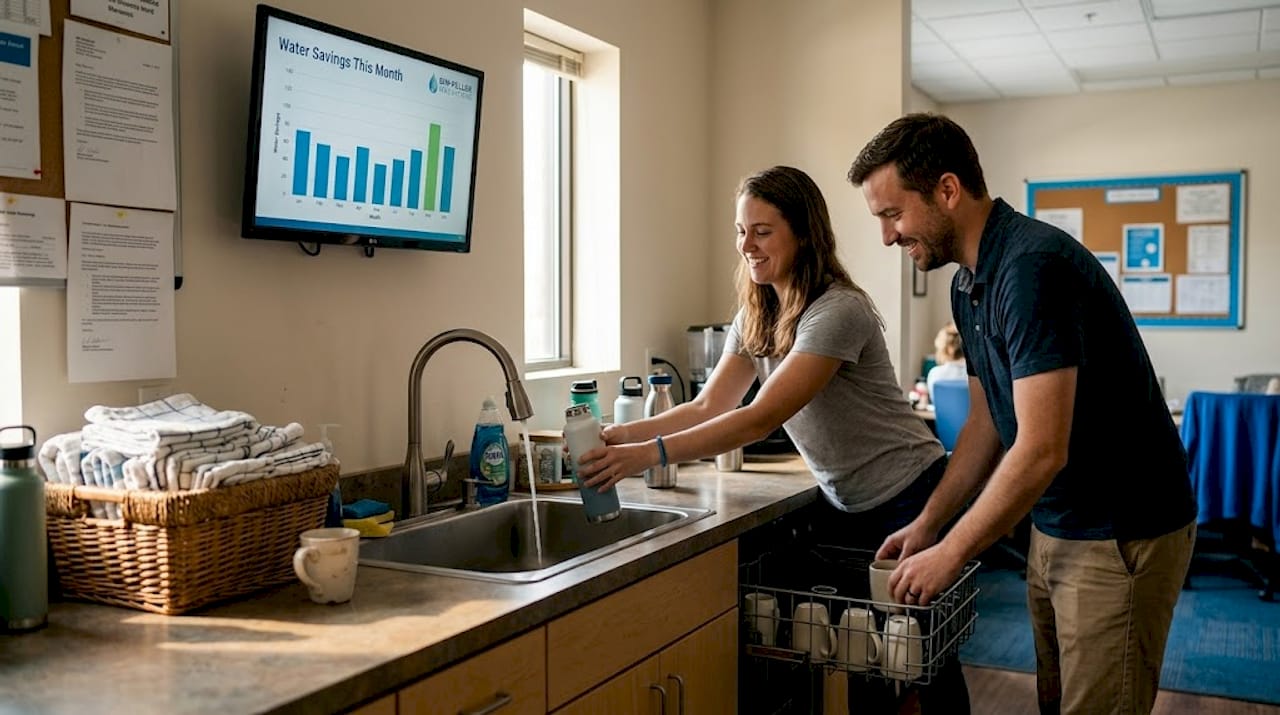
Building feedback loops is the foundation. Share energy and water consumption data with tenants and staff on a regular cadence, monthly at minimum. When people can see the impact of their behavior in numbers, usage patterns shift. Dashboards in common areas, email summaries, and integration with tenant apps all work.
Here is a quick-win engagement tactic list for facility managers:
- Post consumption benchmarks and targets in break rooms and near water fixtures
- Run a quarterly resource-saving competition between floors or departments with visible results
- Create a clear escalation path so tenants can report leaks or equipment issues easily
- Offer small rewards or recognition for teams that hit conservation milestones
- Brief new tenants on building sustainability goals during onboarding
For a structured approach, combine behavioral programs with the operational upgrades already underway:
- Launch a tenant awareness campaign alongside BAS tuning rollout
- Share before-and-after submetering data to demonstrate real impact
- Build resource efficiency targets into lease renewal conversations
"Resource management is most effective when both technology upgrades and occupant engagement are combined."
Using tokenization for engagement is an emerging tactic that converts verified savings into tangible rewards, making participation self-reinforcing. The property management guide also outlines how to embed these programs into standard operating procedures.
Compare and match strategies: what works best for your facility?
To select the best mix of strategies, compare options side by side and match them to your unique facility context. No single strategy fits every building type, budget, or compliance goal.
| Strategy | Best fit | Capital required | Energy/water savings | ESG reporting value |
|---|---|---|---|---|
| Audit + BAS tuning | All building types | Low | 10 to 30% | High |
| Fixture retrofits | Older buildings, retail | Low | 10 to 20% | Medium |
| LED lighting retrofit | All types | Medium | 30 to 50% (lighting) | Medium |
| Graywater/rainwater reuse | Class A office, industrial | Medium to high | 20 to 40% (water) | Very high |
| Full HVAC retrofit | Aging HVAC systems | High | 15 to 35% | High |
| Onsite solar/renewables | Owned buildings | High | Variable | Very high |
The pattern is clear: efficiency first, then renewables. BAS tuning yields up to 29% savings without capital expenditure, which makes it the logical starting point for virtually every facility profile.
For older properties, fixture retrofits and BAS tuning deliver the fastest payback with minimal disruption. Class A office buildings often benefit most from graywater reuse and detailed ESG reporting integration. Retail facilities tend to prioritize lighting efficiency and occupant engagement due to high foot traffic variability.
Use this decision checklist before committing to any major investment:
- Have you completed a current energy and water audit?
- Is submetering in place to validate savings claims?
- Has LCCA been applied to your shortlisted water options?
- Are tenants informed and engaged in the program?
- Does the selected strategy align with your current ESG reporting framework?
For the latest on emerging resource management trends and detailed analysis of CRE water reuse advantages, the comparison above gives you the structure to build a prioritized, defensible investment case.
The hidden leverage: Why behavioral and BAS-based strategies outpace expensive retrofits
Weighing these options reveals a crucial insight facilities can act on immediately. The instinct in most capital planning cycles is to equate investment size with impact size. That instinct is often wrong.
BAS tuning and occupant engagement programs routinely deliver 20 to 30% reductions in energy consumption with minimal upfront cost and near-zero operational disruption. Traditional retrofits, by contrast, move slowly through capital approval cycles, create tenant friction, and often take years to reach full performance. By the time a major retrofit is commissioned, the BAS-driven savings could have funded the next upgrade.
Real-world results consistently show that facilities prioritizing measurement, energy monitoring impact, and behavioral alignment achieve visible wins faster and build the internal credibility needed to justify larger investments later. The path is often blocked not by a lack of solutions but by starting with the most complex and expensive ones.
Start with what is measurable and actionable today. Tune the systems you already have. Engage the people already in your building. The savings are there, waiting to be captured.
Unlock your facility's full efficiency potential
With practical strategies in hand, choosing the right partners accelerates every outcome. At Simpeller, we specialize in making invisible water and energy waste visible through plug-and-play IoT sensor devices and an AI-driven platform built for commercial buildings. Our smartsink technology integrates with your existing infrastructure to track, manage, and offset consumption in real time. Verified efficiency gains convert into measurable ESG reporting value, renewable credits, or cross-subsidy contributions that support broader climate goals. Whether you are starting with a water audit or scaling an onsite reuse program, Simpeller gives you the data backbone and tokenized efficiency framework to turn every verified saving into lasting operational and sustainability impact.
Frequently asked questions
What is the fastest way to reduce resource waste in a commercial building?
Start with data-driven audits, submetering, and quick BAS tuning. BAS can reduce energy by 10-30% and requires no capital investment, making it the fastest path to measurable savings.
Which has greater ROI: onsite water reuse or LED retrofits?
Onsite water reuse delivers higher long-term ROI for water-stressed facilities, while LED retrofits offer faster payback with lower disruption. A lifecycle cost analysis will clarify which is the better fit for your specific building.
How much can energy efficiency improvements save annually?
Efficiency measures can eliminate 20 to 30% of energy waste, with annual savings reaching $60,000 or more per commercial building depending on size and baseline consumption.
Do you need major capital to implement efficient resource management?
No. Behavioral changes, BAS tuning, and minor operational fixes can deliver substantial gains before any large capital outlay. BAS tuning alone yields up to 29% savings without capital expenditure, proving that efficiency does not require a massive budget to start.