

TL;DR:
- Conduct comprehensive energy audits to identify inefficiencies with proven savings potential.
- Implement ISO 50001 systems for sustained energy management and continuous improvement.
- Upgrade key systems like VFDs, LED lighting, and power factor correction for quick, measurable savings.
Deciding where to focus your energy-saving efforts is one of the hardest calls a facility manager makes. Budgets are finite, stakeholders expect visible results, and the list of possible interventions grows longer every year. The good news is that industrial energy data from 2026 points to a clear hierarchy of actions, from foundational audits to smart IoT monitoring, that consistently deliver the biggest returns. This article walks you through that hierarchy in order, so you can stop guessing and start building a prioritized, evidence-backed efficiency plan that also supports your climate reporting obligations.
Table of Contents
- Start with comprehensive energy audits
- Implement ISO 50001 Energy Management Systems
- Upgrade key systems for fast-track savings
- Leverage smart technologies for real-time insights
- Optimize industrial processes and heat recovery
- The reality about energy-saving ROI most lists miss
- Empower your facility's energy transformation
- Frequently asked questions
Key Takeaways
| Point | Details |
|---|---|
| Begin with energy audits | Comprehensive audits uncover 15-30% savings by identifying hidden inefficiencies. |
| Adopt ISO 50001 systems | Sustained 10–20% reductions come from integrating energy management into everyday operations. |
| Upgrade key systems | Install VFDs, LED lighting, and correct power factor for fast, high-ROI improvements. |
| Utilize smart tech and analytics | IoT devices and sub-metering provide 10–15% ongoing savings—and actionable visibility. |
| Optimize processes for long-term gains | Process changes and heat recovery unlock an additional 8%+ in manufacturing efficiency. |
Start with comprehensive energy audits
Every effective efficiency program starts with an honest picture of where energy actually goes. Without that baseline, upgrades are little more than educated guesses. A structured audit gives you the evidence to justify spending, rank projects, and set measurable targets from day one.
The two most recognized frameworks are ASHRAE Levels 1 through 3 and the European standard EN 16247. Level 1 is a walkthrough that flags obvious waste. Level 2 adds detailed analysis and quantified savings opportunities. Level 3 goes further with investment-grade engineering calculations. EN 16247 follows a similar escalating structure and is increasingly required for regulatory compliance across global supply chains. Together, these frameworks ensure your findings are defensible to leadership and investors.
The metric that matters most in manufacturing is kWh per unit of production. This normalizes consumption against output so you can compare performance across shifts, lines, or sites without being misled by volume changes. Tracking this single number before and after any intervention tells you whether an upgrade actually worked.
A well-run audit reliably identifies inefficiencies with 15 to 30% savings potential across a site. That range is wide because every facility is different, but even the lower bound often justifies the audit cost many times over.
Here is a practical sequence for industrial audits:
- Define scope and boundaries (which systems, which meters, which timeframe)
- Collect 12 months of utility and sub-meter data
- Conduct a physical site survey with equipment inventories
- Analyze data to calculate energy intensity ratios and flag anomalies
- Prepare a ranked list of opportunities with estimated costs, savings, and payback periods
For additional guidance on energy audits and how they connect to broader resource efficiency, explore Simpeller's resource library.
Audits are not a one-time event. The most effective facilities run a Level 1 walkthrough annually and a full Level 2 every three years to catch new inefficiencies as equipment ages or production changes.
Pro Tip: Engage a cross-functional team for the audit, including operations, maintenance, and finance. Operations staff know where machines run hot or idle longest. Finance can identify the true cost of demand charges. Together they uncover what a single engineer would miss.
Implement ISO 50001 Energy Management Systems
An audit tells you where the problems are. An Energy Management System (EnMS) certified to ISO 50001 ensures you fix them systematically and keep improving. The standard uses the Plan-Do-Check-Act (PDCA) cycle: plan what you will improve, implement it, measure results, then correct and repeat. That loop prevents the all-too-common pattern of a single project delivering savings that quietly erode over two years.
Facilities that implement ISO 50001 correctly see 10 to 20% sustained reductions in energy use. The key word is sustained. Those gains hold because the system requires documented energy policies, defined performance indicators, and regular internal audits that hold teams accountable.
For sustainability coordinators, certification also serves a second purpose: it provides auditable evidence for ESG disclosures, investor reporting, and frameworks like the EU's ESRS2 and efficiency requirements. Insurers and procurement teams increasingly ask for it. Having the certificate on file shortens those conversations significantly.
A typical EnMS implementation follows these steps:
- Write a formal energy policy signed by senior leadership
- Establish an energy baseline using at least 12 months of verified data
- Identify significant energy uses (the equipment or processes that consume the most)
- Set measurable improvement targets with deadlines
- Train staff at every level, not just engineers
- Monitor performance monthly against baselines
- Conduct internal audits quarterly
- Review progress and raise targets annually
This is also directly connected to how ISO 50001 and sustainability reporting intersect, especially for organizations building tokenized or verified efficiency credentials.
Upgrade key systems for fast-track savings
Once your monitoring and management framework is in place, the next move is to attack your biggest energy consumers with targeted equipment upgrades. Three upgrades consistently deliver the fastest return on investment across both commercial real estate and manufacturing.
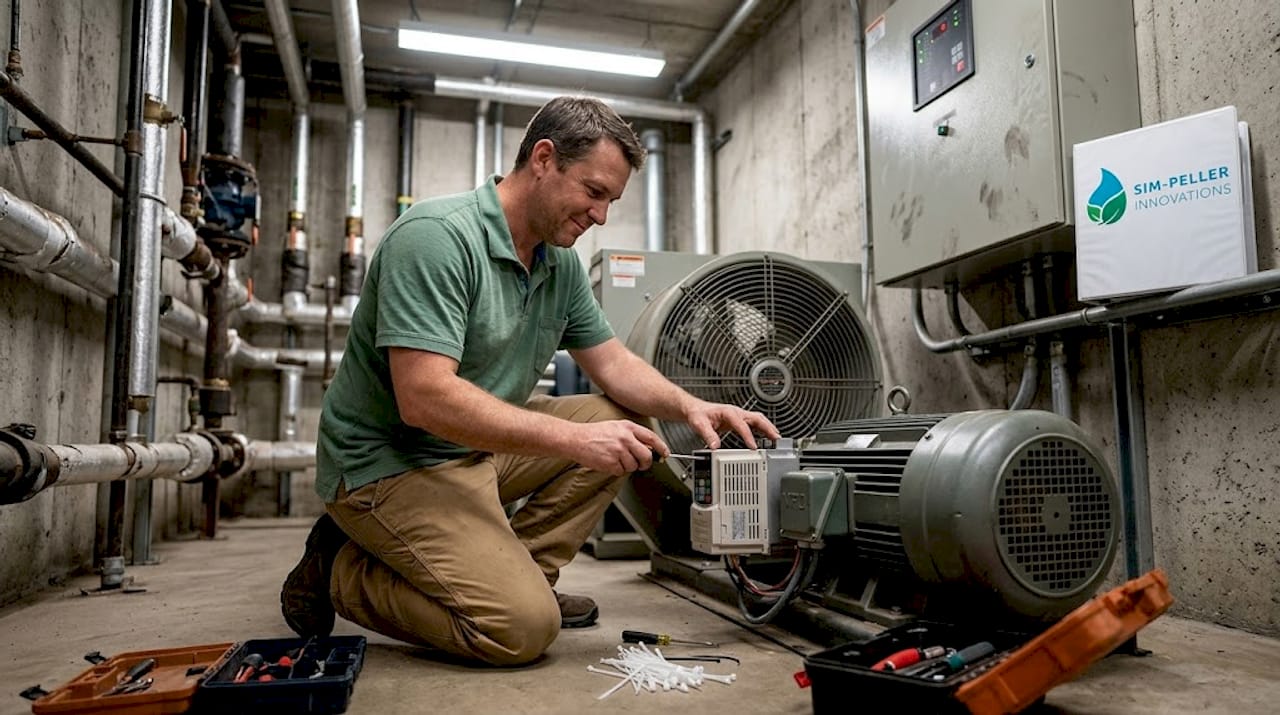
Variable Frequency Drives (VFDs) are the single most impactful upgrade for motor-driven systems. Motors running fans, pumps, and compressors at full speed when partial speed would do the job waste enormous amounts of power. VFDs modulate speed to match actual demand, and that saves up to 50% on motor energy because power draw drops with the cube of speed reduction.
LED lighting with controls cuts lighting energy by 50 to 75% compared to legacy fluorescent or HID systems. Pair LEDs with occupancy sensors and daylight harvesting controls and the savings compound further without any behavioral change from staff.
Power factor correction reduces the reactive power your facility draws from the grid. Utilities penalize low power factor through demand charges and reactive power surcharges. Correcting it with capacitor banks or active filters lowers your current draw and can cut utility costs measurably, sometimes 5 to 15%, depending on your tariff structure.
For energy-saving device picks ranked by sector and application, that resource breaks it down further.
| System | Typical energy savings | Typical ROI timeframe |
|---|---|---|
| VFDs for motors | 20 to 50% | 1 to 3 years |
| LED lighting with controls | 50 to 75% | 1 to 2 years |
| Power factor correction | 5 to 15% on bills | Under 2 years |
| HVAC optimization | 10 to 30% | 2 to 5 years |
Pro Tip: Combine hardware upgrades with sensor-based controls from day one. A new HVAC unit controlled by occupancy sensors performs 20 to 30% better than the same unit running on a fixed schedule. The sensors cost a fraction of the equipment but compound total savings significantly.
Leverage smart technologies for real-time insights
Upgrades deliver savings at installation. Smart monitoring protects and grows those savings over time. Without continuous data, degraded seals, blocked filters, or scheduling drift quietly erode performance gains within 18 months of any project completion.
Sub-metering is the foundation. Installing dedicated meters on major circuits, compressed air systems, and HVAC zones gives you granular visibility that whole-building meters cannot provide. When a sub-meter shows a 15% spike in compressed air consumption mid-shift, you know immediately rather than discovering it on next month's utility bill.
Smart technology delivers 10 to 15% operational energy cost reductions across commercial real estate when combined with predictive maintenance capabilities. That figure stacks on top of the savings from physical upgrades.
Key smart technology applications:
- Leak detection sensors on compressed air and water lines that flag anomalies before they become costly failures
- Predictive maintenance using vibration and temperature sensors to schedule servicing before breakdown, not after
- Occupancy-based controls for HVAC and lighting that adjust automatically as spaces fill and empty
- Cloud dashboards that let facility managers benchmark performance across multiple sites in real time
For deeper reading on IoT monitoring in facilities and on AI-driven facility management, those resources show how the data layer connects to operational workflows. You can also explore how monitoring energy waste translates into verified savings for ESG purposes.
"One facility manager we spoke with reduced unplanned downtime by 40% in the first year after deploying vibration sensors on critical motors. The energy savings were expected. The maintenance savings were a welcome surprise."
The main barriers are honest ones: upfront sensor and software costs, and the analytics skills needed to act on the data. Pilot programs on one production line before full deployment keep risk low and build internal confidence.
Optimize industrial processes and heat recovery
Process optimization is the most underestimated category in most efficiency lists. Equipment upgrades get attention because they are discrete, purchasable, and easy to quantify in a proposal. Process changes and heat recovery often require more analytical work but yield savings that compound across every operating hour.
A review of manufacturing audit findings shows that process optimization and heat recovery together account for over 8% of total site savings potential, with average site savings exceeding 17% when these measures are combined with equipment upgrades. In some facilities, well-targeted process redesign alone has delivered savings of 24 to 40%.
Steps to optimize industrial processes:
- Map all energy flows, including heat generated as waste by compressors, furnaces, and cooling systems
- Automate process controls to eliminate manual variability and idle-running equipment
- Install heat exchangers to recover waste heat for space heating, water preheating, or process reuse
- Review maintenance schedules to ensure equipment operates within designed efficiency parameters
- Train operators on energy-aware practices, because how a machine is started and loaded matters
For AI in industrial energy analysis and for staying ahead of resource management trends, those resources provide forward-looking context on where industrial efficiency is heading.
"Waste heat is not a byproduct. It is an asset waiting to be reconnected to your energy balance sheet."
The honest barriers here are economic thresholds (heat recovery equipment requires capital), a shortage of engineers with thermodynamic optimization skills, and rebound effects where increased production absorbs efficiency gains. Plan for all three from the start.
The reality about energy-saving ROI most lists miss
Here is something most efficiency guides skip: the numbers on paper almost never appear exactly as projected in practice. That is not a reason to avoid action. It is a reason to go in clear-eyed.
Efficiency gains can be muted by rebound effects and implementation hurdles like skills gaps. When a facility cuts its energy cost per unit, production often scales up to capture the savings as output rather than as a lower bill. That is not a failure. It is a business decision. But it means your energy bill may not fall as much as the audit projected.
The deeper issue is culture. No upgrade delivers results without the people to use it right. A VFD installed without operator training gets run in bypass mode within six months. A smart dashboard ignored by maintenance teams is just expensive hardware. Overcoming implementation hurdles requires change management alongside technology investment.
Our perspective, grounded in working with facilities across sectors, is that the organizations achieving the top end of efficiency gains treat energy management as an operational discipline, not a project. They budget for training, celebrate measurable wins publicly, and tie energy KPIs to departmental goals. That cultural infrastructure is what separates 10% savings from 30%.
Empower your facility's energy transformation
The framework in this article gives you the sequence: audit first, systematize with ISO 50001, upgrade high-consumption systems, layer in smart monitoring, and attack process-level waste. Each step builds on the last. But strategy without execution support stalls.
At Simpeller, our IoT platform and AI-driven analytics make energy and water waste visible at the asset level, turning monitored savings into verified, reportable ESG value. Whether you are starting with your first audit or scaling an existing program, explore our energy-saving devices guide to see which technologies align with your current stage. Your efficiency gains deserve to be measured, reported, and rewarded.
Frequently asked questions
What type of energy audit delivers the most impact?
Standards-based audits like EN 16247 or ASHRAE Level 2 deliver the most actionable value because they classify energy use and provide quantified savings opportunities with verified baselines for tracking improvement.
How effective are VFDs for reducing energy costs?
Variable Frequency Drives (VFDs) are highly effective, with up to 50% savings for fans, pumps, and compressors that operate under variable load conditions throughout the day.
What energy savings can be expected from ISO 50001 certification?
Facilities typically achieve 10 to 20% sustained reductions within the first few years, because the PDCA management cycle prevents performance from drifting back toward baseline.
Are smart technologies really worth the investment for facility managers?
Yes. Sub-metering and IoT sensors typically deliver 10 to 15% cost reductions and improve maintenance reliability by catching equipment degradation before it becomes a failure.
What are the biggest barriers to energy-saving success?
The main barriers are high investment thresholds, skills shortages, and rebound effects, where efficiency gains get absorbed by increased production rather than translating directly to lower bills.