
TL;DR:
- Many commercial facilities unknowingly waste water due to leaks and outdated systems. Implementing a structured water management plan with monitoring and reuse technologies can cut consumption by up to 45 percent. Continuous oversight and system integration are key to sustaining water savings and enhancing ESG performance.
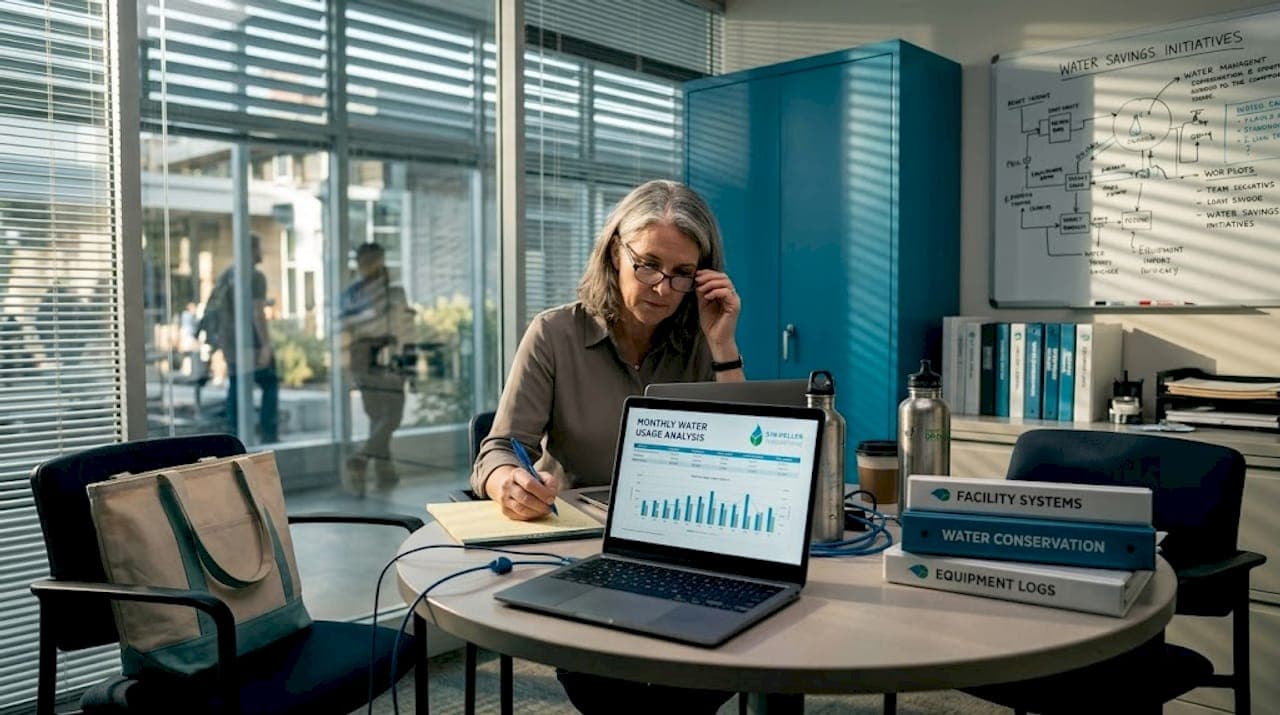
Most commercial facilities believe they have water management under control—until the utility bill arrives. The reality is that undetected leaks, outdated fixtures, and the absence of real-time monitoring are quietly draining thousands of gallons every month. Robust water management plans can reduce consumption by up to 45%, yet most properties never get close to that figure. A truly effective sustainable water solution combines strategic planning, proven reuse technologies, and continuous monitoring into a single, scalable system. This guide gives facility managers and sustainability officers a clear, step-by-step framework to cut costs, reduce waste, and generate measurable climate impact.
Table of Contents
- Why sustainable water solutions matter for commercial properties
- Core steps for a sustainable water management strategy
- Selecting and applying water reuse technologies
- Overcoming challenges and maximizing ROI in real-world application
- What most commercial water guides miss: Solutions that scale
- Ready to transform your facility's water footprint?
- Frequently asked questions
Key Takeaways
| Point | Details |
|---|---|
| Significant savings possible | Strategic water reuse can cut commercial facility water costs by up to 50%. |
| Use a phased approach | Assess current use, audit for waste, set targets, and monitor results for lasting efficiency. |
| Match solutions to needs | Select rainwater, greywater, or effluent recirculation based on your facility’s demand and quality requirements. |
| Real-time data is key | Continuous monitoring and maintenance is essential for maximizing ROI and compliance. |
| Start with high-impact areas | Begin with leak repair, irrigation, and toilet reuse to see immediate cost and water savings. |
Why sustainable water solutions matter for commercial properties
Water is not just a utility line item. For modern commercial properties, it is a compliance obligation, a reputational signal, and increasingly, a competitive differentiator. Facility managers who treat water management as a back-office concern are leaving significant money and ESG value on the table.
The financial pressure is real and growing. Water and wastewater rates in major U.S. cities have risen by an average of 40% over the past decade, and the trajectory points upward. Deferred maintenance on plumbing systems compounds the problem. A single leaking toilet can waste 275 liters per day, and most commercial buildings have dozens of fixtures that have never been individually assessed. Multiply that across a portfolio and the losses become staggering.
"Water efficiency is not simply about conservation. It is about building resilience, meeting regulatory obligations, and creating financial value that shows up directly on the balance sheet."
Beyond cost, regulatory mandates are accelerating. The EPA provides WaterSense assessment tools and ENERGY STAR Portfolio Manager to help commercial facilities track consumption and identify savings opportunities. Many municipalities now require annual water benchmarking for buildings above a certain size, with non-compliance penalties that can rival the cost of a full fixture upgrade program.
The business case for action includes several converging drivers:
- ESG reporting requirements: Investors and tenants increasingly scrutinize water intensity metrics as part of sustainability disclosures. Without verified data, ESG reporting lacks credibility.
- Operational risk: In drought-prone regions, water restrictions can interrupt operations entirely. Facilities with reuse systems in place carry far lower risk.
- Certification and incentives: LEED, WELL, and BREEAM certifications reward water efficiency with points that directly affect asset valuation and leasing premiums.
- Reputational value: Corporate tenants with their own sustainability targets increasingly prefer buildings that can demonstrate verified water performance.
Exploring the full picture of commercial water cost savings reveals that the return on investment from structured water management programs consistently outperforms other building efficiency upgrades, particularly when reuse technologies are layered on top of demand reduction measures. The facilities that move first will gain a lasting operational and competitive advantage.
Core steps for a sustainable water management strategy
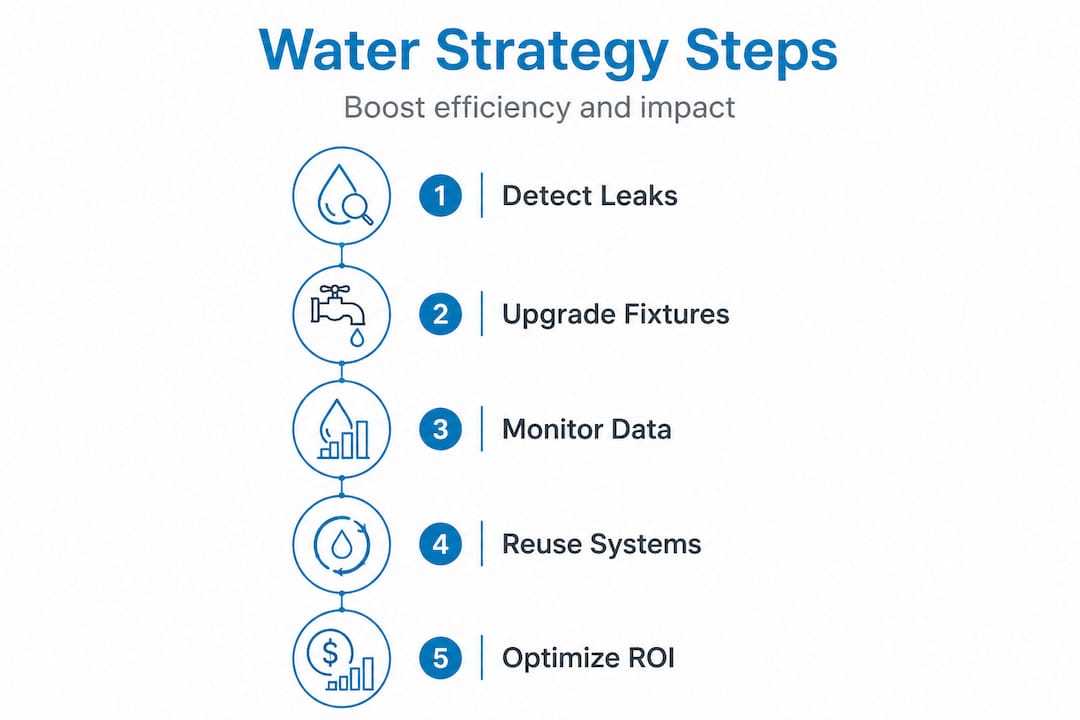
With the urgency established, the next challenge is knowing exactly where to start. The good news is that a structured, five-step process works reliably across building types and sizes. It removes guesswork and replaces reactive maintenance with deliberate, data-driven management.
The water strategy framework that consistently delivers results follows this sequence:
- Assess your baseline with sub-metering. Install sub-meters at key consumption points including restrooms, cooling towers, irrigation, and kitchen facilities. Without granular data, every subsequent decision is an educated guess. Sub-metering typically reveals 15 to 25% more waste than aggregate billing data suggests.
- Identify risks and inefficiencies. Analyze the sub-meter data to locate leaks, overuse patterns, and underperforming equipment. Pressure anomalies, overnight consumption spikes, and seasonal outliers are all diagnostic signals. A formal water risk assessment here also satisfies many ESG disclosure requirements.
- Set targets aligned to benchmarks. Use WaterSense and ENERGY STAR baselines to set realistic, time-bound reduction targets. Targets that are not anchored to credible benchmarks tend to be ignored or gamed. Connecting targets to tenant agreements or board-level ESG goals creates accountability.
- Implement priority interventions. Sequence your actions by ROI: leak remediation first, then fixture upgrades, then reuse systems. Each layer compounds the next. A building that fixes leaks first reduces the volume that any downstream reuse system needs to handle, which lowers technology costs.
- Monitor, report, and adjust continuously. Real-time dashboards powered by IoT-based water monitoring close the feedback loop. Without continuous monitoring, efficiency gains erode within 18 to 24 months as systems drift and maintenance slips.
The table below shows typical water reduction potential by strategy type based on industry performance data:
| Strategy | Typical water reduction | Payback period |
|---|---|---|
| Leak detection and remediation | 15 to 25% | Under 12 months |
| High-efficiency fixture upgrades | 20 to 30% | 1 to 3 years |
| Cooling tower optimization | 10 to 20% | 1 to 2 years |
| Greywater reuse for toilets | 20 to 35% | 3 to 5 years |
| Rainwater harvesting for irrigation | 10 to 20% | 2 to 4 years |
Pro Tip: Start your ROI analysis with leak remediation and toilet reuse. These two interventions alone often recover the full cost of an audit program within the first year, making the remainder of your efficiency program essentially self-funded.
Following smart management best practices also means integrating water performance data into your broader building management system so that facilities teams receive alerts in real time rather than discovering problems at month-end billing.
Selecting and applying water reuse technologies
Once you understand the strategy steps, selecting the right technology for your specific facility becomes far more straightforward. The three primary reuse categories in commercial settings are rainwater harvesting, greywater recycling, and treated effluent recirculation. Each has distinct strengths, and the right choice depends on your facility type, available space, local regulations, and target applications.
The following comparison highlights the key differences:
| Reuse type | Best applications | Treatment complexity | Supply reliability |
|---|---|---|---|
| Rainwater harvesting | Cooling towers, irrigation, toilet flushing | Low to moderate | Variable, weather-dependent |
| Greywater recycling | Toilet flushing, irrigation | Moderate | Consistent, tied to building use |
| Treated effluent recirculation | Industrial cooling, process water | High | Very consistent |
Rainwater harvesting is particularly well-suited for cooling tower makeup water. Rainwater for industrial cooling is economically feasible thanks to its naturally soft, low-conductivity profile, which reduces chemical treatment costs and scaling risk in cooling systems. The primary limitation is supply variability: in many regions, a properly sized storage tank is essential to buffer dry periods and maintain operational continuity.
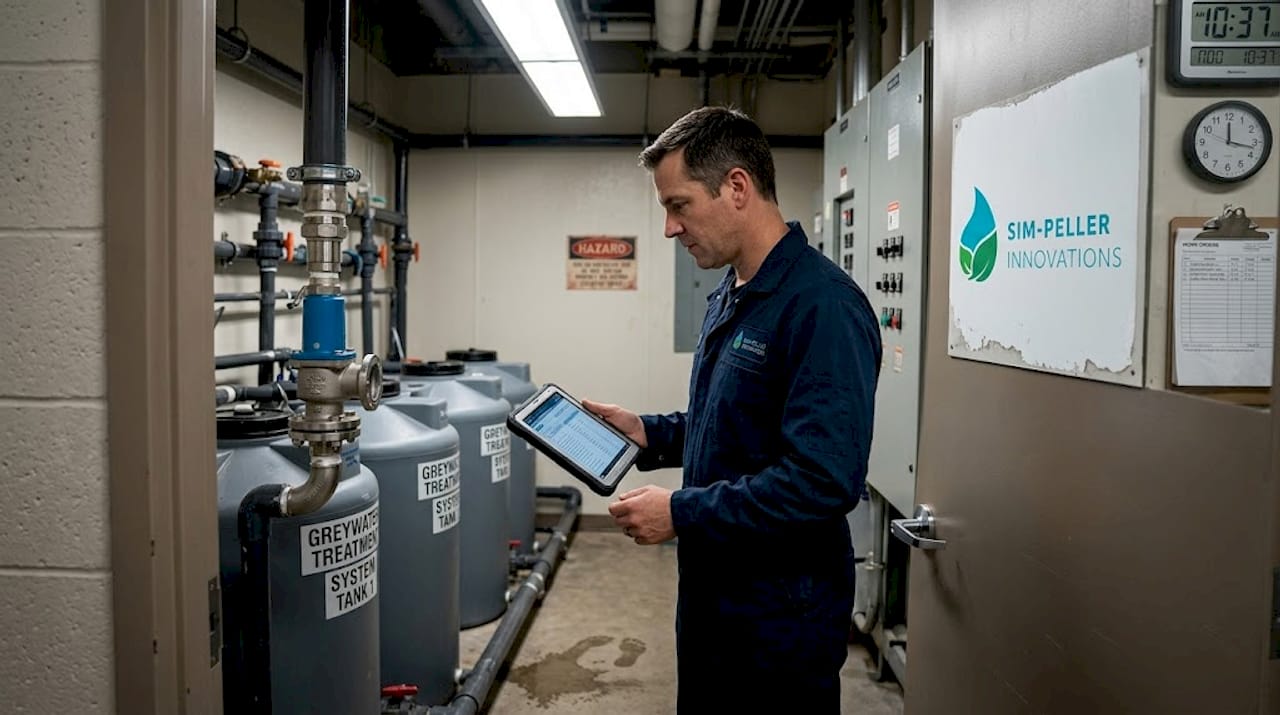
Greywater recycling captures lightly used water from sinks, showers, and laundry facilities, then treats and redirects it to toilet flushing or irrigation. The volume is predictable because it tracks building occupancy, making it easier to size tanks and pumps accurately. Treatment requirements are more demanding than rainwater, typically requiring filtration, disinfection, and in some jurisdictions, colorant addition for identification.
Treated effluent recirculation delivers the highest volume savings in industrial and high-demand commercial settings. Tata Steel reduced freshwater consumption by more than 2,000 KL per day through effluent treatment and recirculation, generating savings of approximately 8 lakhs per month. While this scale applies to heavy industry, the principle translates directly to large commercial campuses, data centers, and hotel complexes with significant process water demand.
When evaluating which reuse solution fits your building, work through these key questions:
- What is the actual daily volume available for reuse from each potential source?
- What is the quality requirement for the target application?
- What local permits or health codes govern non-potable water use?
- What is the available space for tanks, filters, and distribution infrastructure?
- What is the realistic payback period given your utility rates and consumption volume?
The onsite recycling guide covers sizing calculations and treatment specifications in detail. For broader strategic context on how reuse for commercial buildings can deliver 50% cost reductions alongside measurable ESG gains, the evidence is compelling across asset classes from office towers to logistics facilities.
Pro Tip: Always pilot a reuse system at small scale before committing to full installation. A three-month pilot on one floor or one cooling tower circuit reveals operational realities that no design specification will capture, and it significantly reduces the risk of costly redesigns.
Overcoming challenges and maximizing ROI in real-world application
Selecting a solution is only half the effort. The facilities that fail to sustain their water savings share a common pattern: they invest in technology and then treat it as a set-and-forget infrastructure upgrade. Water reuse systems are dynamic, and their performance depends on consistent operations and maintenance (O&M), adaptive management, and real-time oversight.
The most common failure points, and how to address them, are as follows:
- Supply variability causing system bypass. When rainwater tanks run dry during drought periods, operations teams often bypass the reuse system entirely and never reconnect it. Automated switching valves with monitoring alerts prevent this from becoming a permanent workaround.
- Treatment system degradation. Filter media, UV disinfection bulbs, and membrane systems all have service intervals. Skipping maintenance creates water quality risk and, in regulated applications, potential liability. Build O&M schedules into your facilities management platform.
- Mismatched treatment to application. Using a basic sediment filter for water destined for cooling towers invites biological growth and equipment damage. Fit-for-purpose treatment matching is a non-negotiable design principle that must be verified at commissioning and re-evaluated whenever the end use changes.
- No real-time monitoring loop. Without continuous data, you cannot verify that the reuse system is performing as designed. Sub-meters on both the reuse supply and the mains backup line allow you to calculate actual substitution rates and catch anomalies before they become expensive failures.
- Incomplete staff training. Facilities teams that do not understand how a reuse system operates will default to the path of least resistance when problems arise, which usually means bypassing the system. Training is not optional; it is part of the capital investment.
"Pilot testing before full-scale deployment, combined with a robust O&M program and real-time monitoring, is the difference between a water reuse system that delivers verified savings for years and one that quietly fails within 18 months." — Water Reuse Association, 2025 Industrial Reuse White Paper
The EPA WaterSense framework recommends prioritizing audits, leak detection, and sub-metering as the foundation layer before any reuse technology is added. This sequencing matters because it establishes verified baselines that make your ROI calculations credible for board reporting and ESG disclosure. It also ensures that you are reusing water in a system that is already optimized, rather than reusing waste from a leaky and inefficient network.
Integrating your monitoring workflow and IoT infrastructure into a single platform gives sustainability officers a real-time view across every consumption point, reuse loop, and efficiency metric in the building. This level of visibility transforms water from a managed cost into a managed asset with a performance record that supports carbon accounting and ESG reporting.
What most commercial water guides miss: Solutions that scale
Most articles on commercial water efficiency focus on single-point interventions: swap the fixtures, fix the leaks, install a rainwater tank. These are valid starting points, but they miss the compounding value that comes from thinking about water as an interconnected system rather than a list of independent projects.
The facilities that achieve the most dramatic and durable results treat water not as a cost to minimize but as a strategic asset to optimize. They layer demand reduction, reuse, and real-time data together into a system where each element amplifies the others. Fixing leaks reduces the load on reuse systems. Reuse systems lower mains dependency. Real-time monitoring catches performance drift before it erodes the savings from both. This is not a theoretical model—it is the pattern we consistently see in facilities that hit 40% or better consumption reductions.
The "silver bullet" mentality, focusing all resources on one high-profile technology, is where most programs stall. Innovative scarcity solutions show that the most resilient commercial water programs are built on integration, not intervention. The shift from project thinking to systems thinking is the most important upgrade a facility team can make, and it costs nothing to start.
Ready to transform your facility's water footprint?
Putting this framework into action starts with visibility. Simpeller's smartsink IoT devices and AI-driven platform give facility managers and sustainability officers the real-time data they need to assess baseline consumption, detect leaks instantly, and verify the performance of every reuse intervention. Rather than waiting for monthly utility bills to reveal problems, you get a live performance record that supports ESG reporting, carbon accounting, and operational decision-making. Explore advanced water-saving technology and discover how Simpeller helps commercial properties transform verified efficiency gains into measurable climate impact, lower operational costs, and scalable resource performance across your entire portfolio.
Frequently asked questions
What are the quickest ways to reduce water use in a commercial building?
Target leaks first, upgrade to WaterSense-rated fixtures, and install sub-meters to identify waste in real time. These three steps consistently deliver the fastest payback in any commercial property.
Is rainwater or greywater better for commercial water reuse?
Rainwater is softer and well-suited for cooling towers, but supply fluctuates with weather; greywater delivers a steadier volume tied to occupancy but requires more thorough treatment before reuse.
How much water savings can effective reuse deliver?
Well-implemented reuse strategies in large commercial facilities can reduce costs by 30 to 50%, particularly when combined with efficient fixtures as the first layer of demand reduction.
What tools help monitor and track commercial water use?
The EPA WaterSense tools including assessment checklists and ENERGY STAR Portfolio Manager are the standard starting point for benchmarking and tracking efficiency improvements across commercial and institutional facilities.
How critical is ongoing maintenance for water reuse systems?
Proper operations and maintenance are essential to prevent system bypass and failure; without scheduled servicing and real-time monitoring, even well-designed reuse systems degrade within 18 to 24 months.