
TL;DR:
- Water efficiency programs now offer customized, measurable incentives beyond simple rebates.
- Combining technology upgrades, behavioral rewards, and maintenance fixes maximizes water savings and rebates.
- Proper planning, documentation, and early utility coordination are key to maximizing financial and operational benefits.
Commercial facilities that treat water efficiency as an afterthought are leaving serious money on the table. Commercial water management can reduce consumption by up to 45%, and the programs designed to reward that progress go far beyond simple rebates. Yet most facility managers and operations directors still picture water efficiency incentives as small, one-size-fits-all credits that barely move the needle on the budget. The reality is sharply different. Today's incentive landscape includes customized reward structures, performance-based grants, behavioral programs, and even drought exemptions that can transform how your facility manages one of its most costly operational inputs.
Table of Contents
- The landscape of water efficiency rewards
- How rebates and incentives work: Requirements and process
- Technology upgrades vs. behavioral rewards: What delivers best ROI?
- Real-world applications: Maximizing reward impact in your facility
- Why conventional reward strategies often miss the mark
- Connect your water efficiency goals with proven solutions
- Frequently asked questions
Key Takeaways
| Point | Details |
|---|---|
| Major rewards available | Commercial facilities can qualify for significant rebates, custom incentives, and operational savings by embracing water efficiency. |
| Process matters | Careful application, pre-approval, audits, and verified tech upgrades ensure maximum rewards and avoid common pitfalls. |
| ROI varies by strategy | Tech upgrades provide scalable savings, while behavioral and maintenance strategies often offer quick ROI with lower upfront cost. |
| Equity & access issues | Most reward programs benefit larger facilities, but small sites can combine tactics for real savings. |
The landscape of water efficiency rewards
Water efficiency incentive programs have grown considerably more sophisticated over the past decade. Where rebate structures once offered flat credits for switching to low-flow fixtures, today's programs are designed around verified, measurable savings at scale. That distinction matters enormously for facility managers overseeing large commercial buildings or high-consumption manufacturing operations.
The programs generally fall into three major categories. First, there are standardized rebates, which apply fixed dollar amounts to qualifying equipment purchases such as high-efficiency toilets, urinals, or irrigation controllers. Second, there are customized incentives, which calculate rewards based on actual water savings projected and then verified through audits. Third, there are regulatory exemptions and special provisions, which grant participating facilities advantages during drought restrictions or water allocation periods.
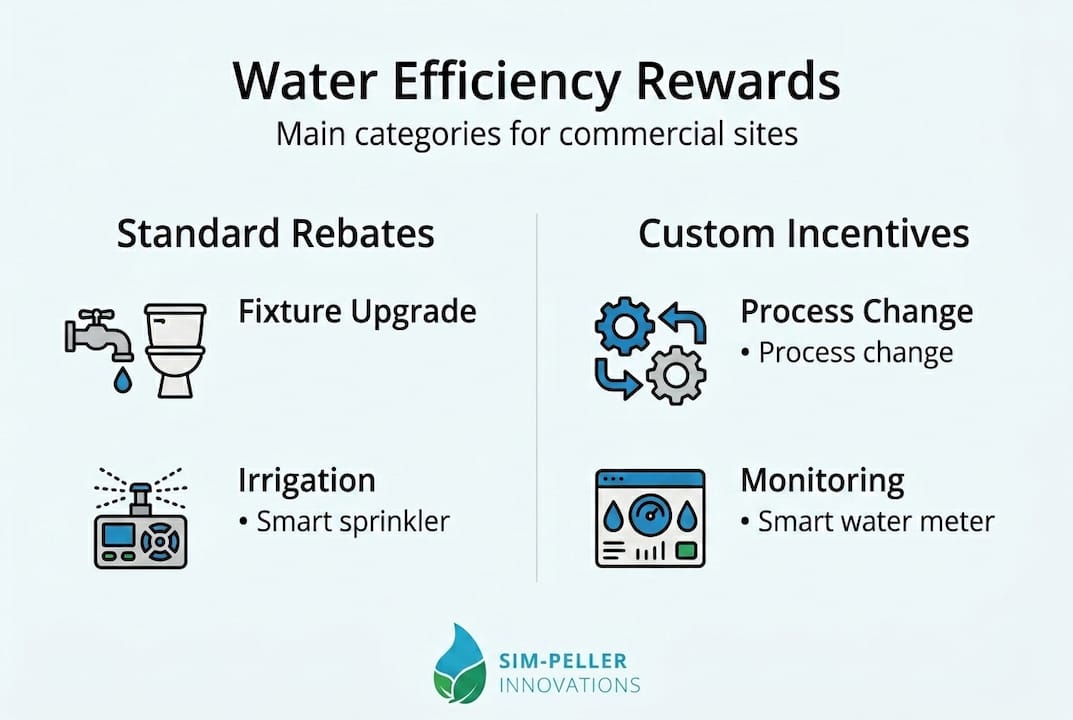
The Water Savings Incentive Program (WSIP) from MWDOC is one of the strongest examples of the customized incentive model. It provides tailored financial rewards for irrigation improvements, industrial process changes, cooling tower management, and efficient equipment upgrades. The customized structure means that a manufacturing facility with a complex cooling loop can receive a reward scaled to its verified savings, rather than being capped by a flat per-fixture rate.
On the regulatory side, the Guaranteed Water for Industry Program in San Diego exempts manufacturing and R&D facilities from drought-period water allocations, provided those facilities demonstrate water-efficient practices. That kind of exemption can be worth far more than any direct rebate during a declared water shortage, because it protects production continuity.
Understanding which program tier applies to your facility is the first strategic decision. Many innovative water solutions for industry begin exactly here, with a clear-eyed inventory of which incentive categories the facility can realistically access.
| Program type | Qualifying actions | Average reward size |
|---|---|---|
| Standardized rebate | Equipment replacement (toilets, urinals) | $100 to $500 per unit |
| Customized incentive | Process changes, cooling tower upgrades, irrigation overhaul | $5,000 to $15,000+ per project |
| Behavioral/gamified | Ongoing consumption reduction challenges | 3 to 5% savings with loyalty rewards |
| Regulatory exemption | Verified efficient practices certification | Protection from drought allocations |
Here is a quick summary of what facility managers need to evaluate when mapping their reward strategy:
- Whether the facility qualifies for customized or standardized programs based on water use volume
- Whether manufacturing or R&D operations make the site eligible for special exemptions
- Whether multiple programs can run simultaneously for stacked rewards
- Whether the facility has metering infrastructure in place to support audit-based verification
How rebates and incentives work: Requirements and process
Once you know the reward opportunities, understanding the process is essential. Many facilities miss out on significant incentives not because they lack eligible upgrades, but because they mismanage the application sequence. Rebates and customized incentive programs both require careful coordination with the administering utility or agency, and the order of steps matters.
The Water Savings Incentive Program outlines the core process clearly: pre-approval must come before the project begins, audits are conducted both before and after the upgrade, and savings must be verified against a measurable baseline. Customized programs for large projects involve caps on total reward amounts, and only new, commercially available technology qualifies. Used equipment and new construction are typically excluded from most programs.
A typical process for a mid-sized commercial facility looks like this:
- Initial assessment. The facility manager reviews utility program guidelines and identifies qualifying upgrades or process changes. This is also the stage for checking whether the facility needs submeters or flow controllers to establish a baseline.
- Pre-approval application. Before any work begins, the facility submits an application to the administering utility. Starting a project before receiving pre-approval is the most common and costly mistake.
- On-site audit. A utility or third-party auditor visits the facility to document current water use, equipment condition, and projected savings from the proposed upgrades.
- Project execution. The facility implements the approved upgrades or process changes within the program's specified timeframe.
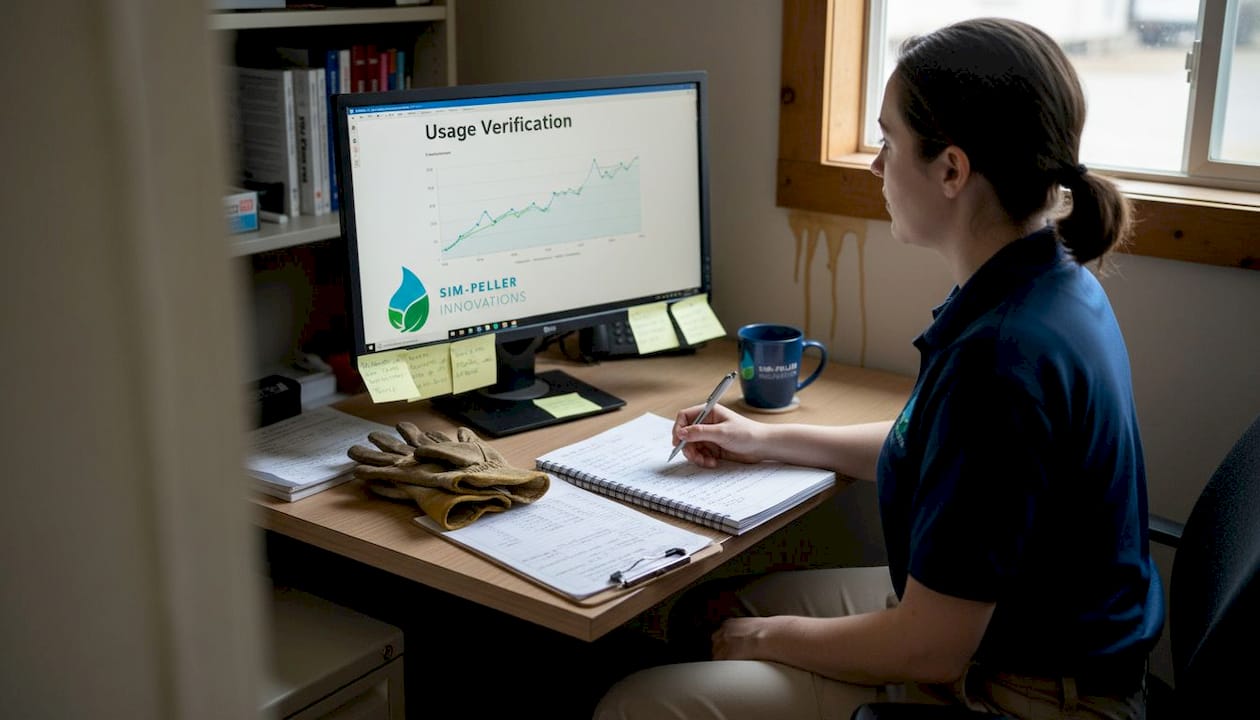
- Post-project verification. A follow-up audit or data review confirms that the actual savings match the projected figures. Submeters and IoT monitoring devices make this stage significantly smoother.
- Reward disbursement. Once verified, the rebate or customized incentive is paid out, often as a direct credit or check.
The role of facility management efficiency tools becomes critical at the verification stage. Without granular data on pre and post-upgrade consumption, facilities often receive lower rebates than they deserve simply because their documentation is too coarse to support higher savings claims.
Pro Tip: Contact your utility's conservation department before finalizing any upgrade plans. Early coordination often reveals additional qualifying measures you hadn't considered, and it allows utility staff to guide your documentation approach from the start, which can meaningfully increase the final performance-based rewards you receive.
Eligibility requirements differ by program but share some common threads. Most programs require that the facility be an existing account in good standing with the utility. New construction is almost universally excluded because the expectation is that new buildings already incorporate efficient design. Leased facilities may need landlord authorization before upgrades qualify.
Technology upgrades vs. behavioral rewards: What delivers best ROI?
With requirements clear, compare the actual return on different reward approaches. This is where facility managers need to think strategically rather than defaulting to whichever option seems most visible or most marketed.
Utility rebate programs are heavily weighted toward measurable technology upgrades: submeters, smart irrigation controllers, cooling tower conductivity controllers, high-efficiency process equipment. These upgrades deliver large, one-time savings that are easy to verify, which is exactly why utilities favor them. A cooling tower upgrade, for instance, can slash water use by 40% on its own, and that kind of documented reduction justifies a substantial customized incentive.
Behavioral and gamified programs work differently. Saving Water, One Badge at a Time research shows that loyalty-style incentives, such as points and badges for weekly consumption reductions, produce roughly 4.4% savings. That figure is modest compared to a cooling tower overhaul, but the cost to implement is a fraction of a hardware upgrade. The challenge is scaling these programs across large, multi-site operations where behavior varies widely by team, shift, and department.
Maintenance optimization sits in an interesting middle ground. Fixing pressure regulators, repairing leaking valves, recalibrating irrigation schedules, and cleaning strainers are low-cost interventions that often rival the ROI of a full equipment rebate, because they eliminate waste that's already occurring without any capital expenditure.
"The most underutilized water efficiency strategy in commercial facilities is not the next technology purchase. It's fixing what's already broken and then building the data infrastructure to catch the next leak before it becomes invisible waste."
Here is a straightforward breakdown to help you decide which approach fits your situation:
Technology upgrades
- High upfront cost, but eligible for significant rebate offsets
- Large, verifiable, and durable savings that justify customized incentives
- Best suited for high-consumption facilities with stable operations
- Requires baseline metering and post-upgrade verification
Behavioral and gamified rewards
- Low implementation cost with faster deployment
- Drives team engagement and cultural change around resource use
- Typical savings of 3 to 5%, harder to sustain without ongoing program management
- Works well alongside tech upgrades to maintain reduction after hardware gains plateau
The smartest strategy combines both. Use technology upgrades to capture the major rebates and lock in structural savings, then layer behavioral programs on top to cut costs with water savings further through ongoing consumption discipline. Facilities that do both consistently outperform those that treat incentives as a one-time project. Tools like energy-saving devices integrated with IoT monitoring can also bridge the gap, making behavioral patterns visible at the equipment level.
Real-world applications: Maximizing reward impact in your facility
Armed with knowledge on approaches, it's time to apply these rewards for real results. The gap between knowing about incentive programs and actually extracting maximum value from them often comes down to prioritization and sequencing.
Start with the highest-yield upgrades. Commercial water management demonstrates that facilities can reduce consumption by up to 45% and access rebates from utilities like EBMUD reaching up to $15,000 per project. That kind of number is not theoretical. It comes from targeting the right equipment categories.
The Commercial Water Rebates offered through MWDOC provide a useful benchmark for prioritizing upgrades. Cooling tower improvements yield roughly 40% water savings per unit. Drip irrigation conversions from conventional spray systems produce 15 to 25% reductions. High-efficiency toilets deliver around 20% savings per fixture. Ultra-low flush urinals are the standout performer, reducing urinal water use by up to 88% compared to conventional models. That last figure consistently surprises facility managers who haven't looked closely at fixture-level data.
Here is a practical action plan for maximizing your facility's reward capture:
- Audit before you act. Commission a water audit to identify the top three consumption drivers in your facility. Many utilities offer free or subsidized audits as an entry point into their incentive programs.
- Stack programs wherever possible. A cooling tower upgrade might qualify for both a MWDOC customized incentive and a state-level efficiency grant simultaneously. Program stacking is legal in most jurisdictions and can double the financial return.
- Prioritize process changes in manufacturing. Industrial process modifications often qualify for the largest customized incentives because the savings volumes are substantial and verifiable. Water reuse strategies at the process level are particularly powerful here.
- Install submeters before applying. Having granular data by process or zone puts you in a far stronger position during the audit and verification stages, and it supports ongoing ESG reporting.
- Combine onsite recycling with incentive programs. Greywater and process water recycling reduce draw from the main supply, which compounds the savings verified during post-project audits. Onsite recycling tips show how these systems integrate with rebate qualification.
- Document everything. Keep records of all baseline measurements, equipment invoices, contractor certifications, and utility correspondence. Missing paperwork is the most common reason rebate claims are reduced or denied.
A typical commercial facility that executes this strategy systematically, targeting cooling, fixtures, and irrigation in sequence, can realistically achieve a $10,000 or higher rebate from a single utility program while posting a 20 to 45% reduction in total water consumption. That combination has a direct, measurable impact on operating costs and strengthens ESG reporting with verified data.
Why conventional reward strategies often miss the mark
Here is the uncomfortable truth that most incentive program guides skip entirely: the facilities that benefit most from today's rebate and reward structures are generally the ones that already have resources, metering infrastructure, and dedicated operations staff. Smaller commercial tenants and single-site manufacturers often find that the administrative burden of pre-approval, audits, and documentation is disproportionate to the rewards available to them.
Equity issues in incentives are real. Larger facilities with dedicated engineering teams can navigate the customized incentive process efficiently. Smaller operations, particularly those without in-house technical staff, may qualify only for standardized rebates that don't reflect their actual savings potential. Manufacturing facilities with specialized processes may also need to demonstrate compliance with process-specific best management practices before qualifying for any exemption.
The practical wisdom here is to start where the barrier is lowest. Maintenance optimization and behavioral programs require minimal documentation and deliver real ROI without waiting for a pre-approval cycle. Once those gains are locked in and metering infrastructure is in place, the path to larger customized rebates becomes much cleaner.
Combining approaches is also where smart water management creates its most durable impact. Facilities that treat behavioral programs as an ongoing discipline, not a one-time campaign, and pair them with technology upgrades consistently outperform peers who rely on either approach alone. The goal is a system where efficiency improvements generate verifiable data, that data supports incentive claims, and those rewards are reinvested into the next phase of upgrades. That cycle, when running well, makes water efficiency self-funding.
Connect your water efficiency goals with proven solutions
Maximizing water efficiency rewards requires more than knowing the programs exist. It requires the right monitoring infrastructure to document savings, the right strategy to sequence upgrades, and the right platform to turn verified results into measurable value. Simpeller's IoT-enabled smartsink devices and AI-driven platform make invisible consumption visible, giving facility managers the data they need to qualify for incentives, verify savings, and report outcomes with confidence. Whether your goal is capturing utility rebates, meeting ESG targets, or building a case for operational investment, explore how commercial water efficiency solutions from Simpeller can support your facility's next move.
Frequently asked questions
What types of projects qualify for water efficiency rewards in commercial facilities?
Projects like irrigation upgrades, cooling tower management, efficient appliances, and industrial process changes typically qualify. The Water Savings Incentive Program covers all of these under its customized incentive structure for commercial accounts.
How much money can a facility earn from water efficiency rebates?
Rebates can reach $10,000 to $15,000 per project for large-scale upgrades, depending on the program and the volume of verified water savings documented through the audit process.
Are behavioral rewards or maintenance optimizations a better option than technology upgrades?
Behavioral incentives and maintenance optimizations can deliver comparable or better ROI for small and mid-sized facilities, but tech upgrades scale savings for larger sites. Maintenance optimizations rival rebates in ROI without requiring upfront capital, while behavioral rewards are low-cost but harder to sustain at scale.
Do water efficiency reward programs cover new construction or used equipment?
Most programs exclude new construction and used equipment entirely. Only upgrades to existing systems and new purchases of commercially available technology typically qualify for rebates or customized incentives.