
TL;DR:
- Advanced water management using IoT and AI significantly reduces water consumption and operational costs.
- Implementing closed-loop systems and process optimization can cut freshwater use by up to 90%.
- Cross-functional collaboration and lifecycle cost analysis are key to maximizing water efficiency benefits.
Industry accounts for 19% of freshwater withdrawals globally, yet most factories still rely on manual logs, monthly meter reads, and reactive maintenance to manage one of their most critical inputs. That gap between what is actually consumed and what gets measured costs facilities real money every day. Advanced water management, powered by IoT sensors and AI analytics, can shrink water intake by up to 90% in some operations while slashing utility bills, reducing downtime, and strengthening your ESG reporting. This article walks facility managers through the core concepts, proven strategies, and practical implementation steps to make that transformation happen on your floor.
Table of Contents
- Understanding water management in factories
- Core strategies and technologies for water optimization
- Unlocking cost savings and ROI with IoT and AI
- Implementing advanced water management in your facility
- A fresh perspective: What most factory managers get wrong about water management
- Take the next step toward water-smart operations
- Frequently asked questions
Key Takeaways
| Point | Details |
|---|---|
| Audit and optimize | Establish a water use baseline to spotlight savings with strategic upgrades. |
| Use smart tech | IoT and AI enable real-time monitoring, predictive maintenance, and cost reductions. |
| Maximize reuse | Closed-loop and recycling systems substantially cut intake and operational expense. |
| Assess full costs | Lifecycle cost analysis ensures investments deliver lasting ROI, not just quick wins. |
| Team collaboration | Cross-functional efforts drive better outcomes than siloed compliance routines. |
Understanding water management in factories
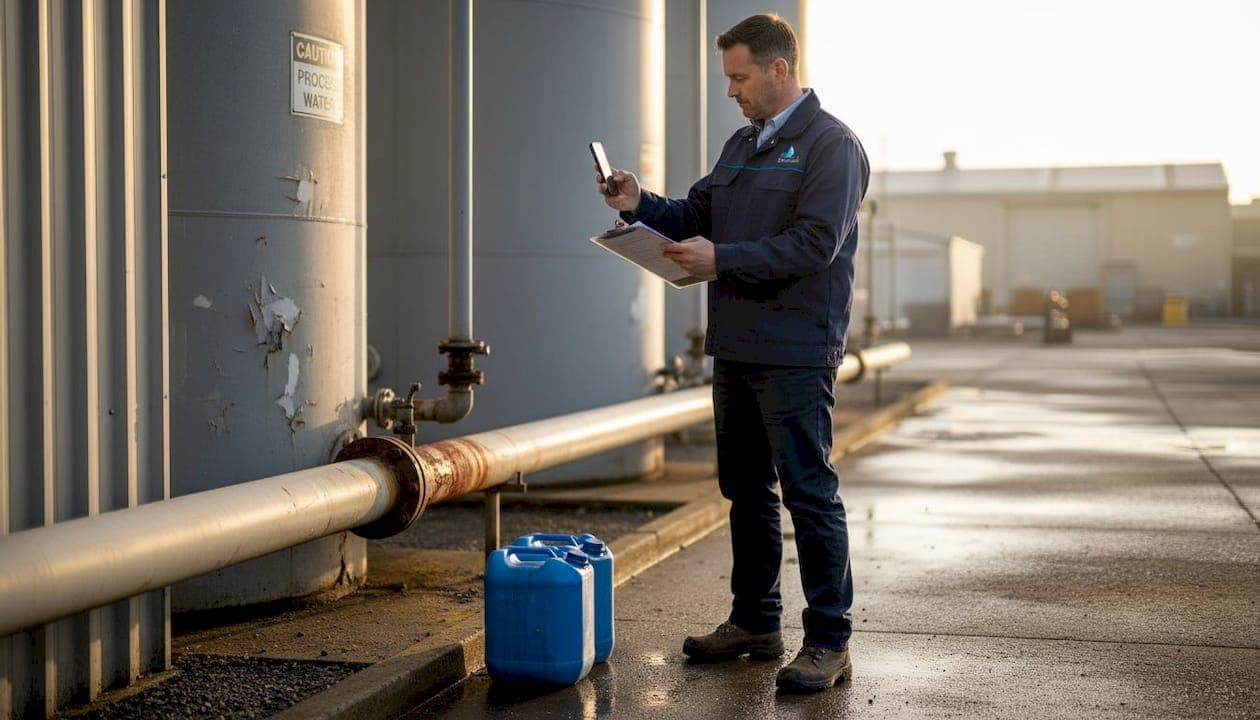
Water management in a factory setting means systematically monitoring, controlling, and optimizing every point where water enters, moves through, and exits your operations. It is not just about paying the water bill on time. The real objective is to reduce withdrawals, cut costs, stay compliant with discharge regulations, and build credibility with investors and regulators who increasingly demand sustainability accountability.
Most facilities use water across three main categories:
- Cleaning in place (CIP) and sanitation: Often the largest single draw in food, beverage, and pharmaceutical plants
- Cooling and heat exchange: Towers, chillers, and condensers cycling water through thermal processes
- Rinsing and process water: Parts washing, surface treatment, and product formulation
A structured water management program moves through four stages. First, conduct a baseline audit to map every inlet, outlet, and loss point. Second, analyze the data to identify where waste and inefficiency concentrate. Third, implement targeted upgrades. Fourth, monitor continuously and optimize as conditions change.
| Water use category | Typical share of total factory use |
|---|---|
| Cooling systems | 40-50% |
| Process and rinsing | 25-35% |
| Cleaning and sanitation | 15-25% |
| Domestic and other | 5-10% |
The payoff from getting this right is significant. Key strategies including audits, process optimization, technology upgrades, closed-loop systems, and wastewater reuse can drive dramatic reductions in intake. Closed-loop systems alone can cut freshwater intake by up to 90% by continuously recirculating treated process water instead of discharging and replacing it.
"The factories that treat water as a managed asset, not just a utility expense, consistently outperform their peers on both cost and compliance metrics." For more on how IoT & AI for efficiency transforms this asset view, explore our detailed overview.
Core strategies and technologies for water optimization
With the fundamentals in place, the next step is to understand what concrete strategies and technologies deliver the biggest optimization gains. The path from audit to action follows a clear sequence.
Step-by-step optimization approach:
- Audit current consumption and identify the top five waste sources
- Map water flow across all production lines and utilities
- Optimize existing processes before adding new equipment
- Implement enabling technologies to automate and monitor
- Track results against baselines and adjust quarterly
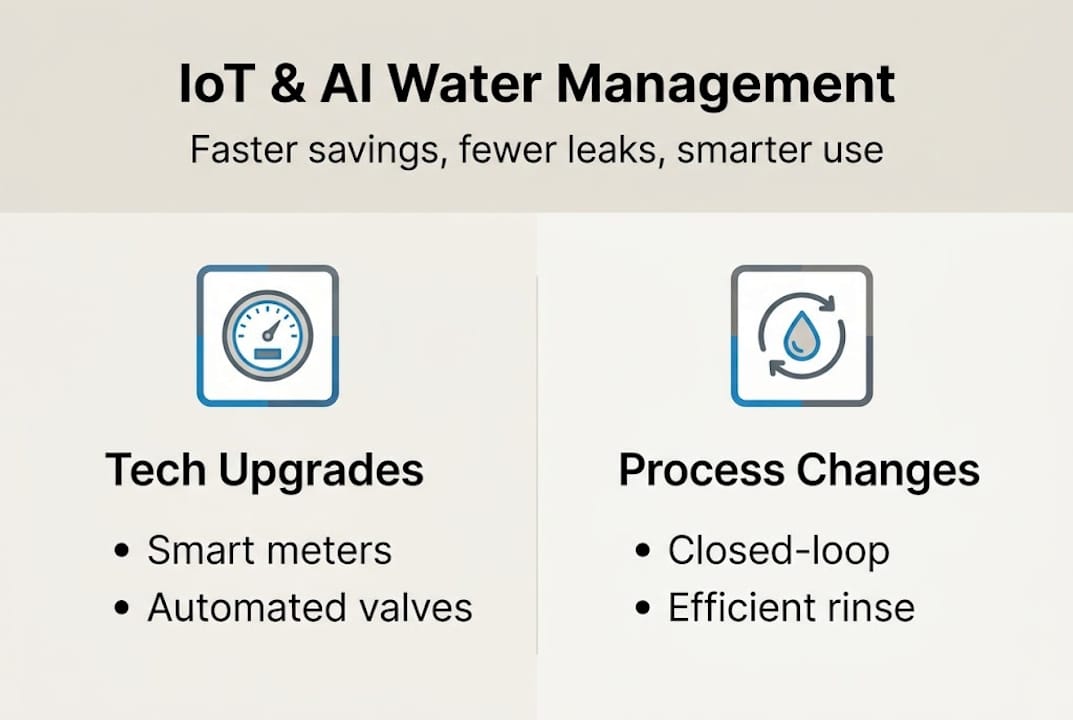
On the technology side, three upgrades consistently produce strong returns. Automated valves eliminate the human error that lets water run during idle shifts. Smart meters pinpoint leaks the moment they start rather than weeks later when the bill arrives. Variable frequency drive (VFD) pumps match motor speed to actual demand, cutting both water and energy waste simultaneously.
Process-level changes matter just as much as hardware. Counter-current rinsing, high-efficiency nozzles, and closed-loop reuse systems are proven methods that boost efficiency and reduce discharge volume. Combining these with smart monitoring creates compounding gains.
| Upgrade path | Estimated water savings | Typical payback period |
|---|---|---|
| Smart meters only | Up to 15% leak reduction | 12-18 months |
| Process optimization (lean) | Up to 30% reduction | 6-24 months |
| AI-driven analytics | 10-20% OPEX reduction | 18-36 months |
| Full closed-loop system | Up to 90% intake reduction | 3-7 years |
Industry benchmarks confirm that smart meters reduce leaks by 15%, AI-driven systems cut operational expenditure by 10 to 20%, and lean process optimization can shrink total water use by up to 30%. These are not theoretical figures. They reflect what facilities report after measured implementation.
Pro Tip: Start with smart metering on your highest-volume process line before investing in facility-wide upgrades. A single meter on a cooling tower or CIP circuit will generate the data you need to prioritize every other investment decision. Explore smart water management strategies and the full water savings guide for deeper context.
Unlocking cost savings and ROI with IoT and AI
After outlining core approaches, it is time to look at how IoT and AI specifically drive efficiency and ROI in factory water management. The technology has matured to a point where deployment is faster and cheaper than most managers expect.
IoT sensors placed at critical flow points give you a continuous, real-time picture of your water system. They track flow rate, pressure, temperature, and water quality simultaneously. Real-time monitoring with sensors for flow, pressure, and leak detection generates automated alerts the moment a reading falls outside your defined parameters. That means a burst fitting gets flagged in minutes, not discovered on next month's utility bill.
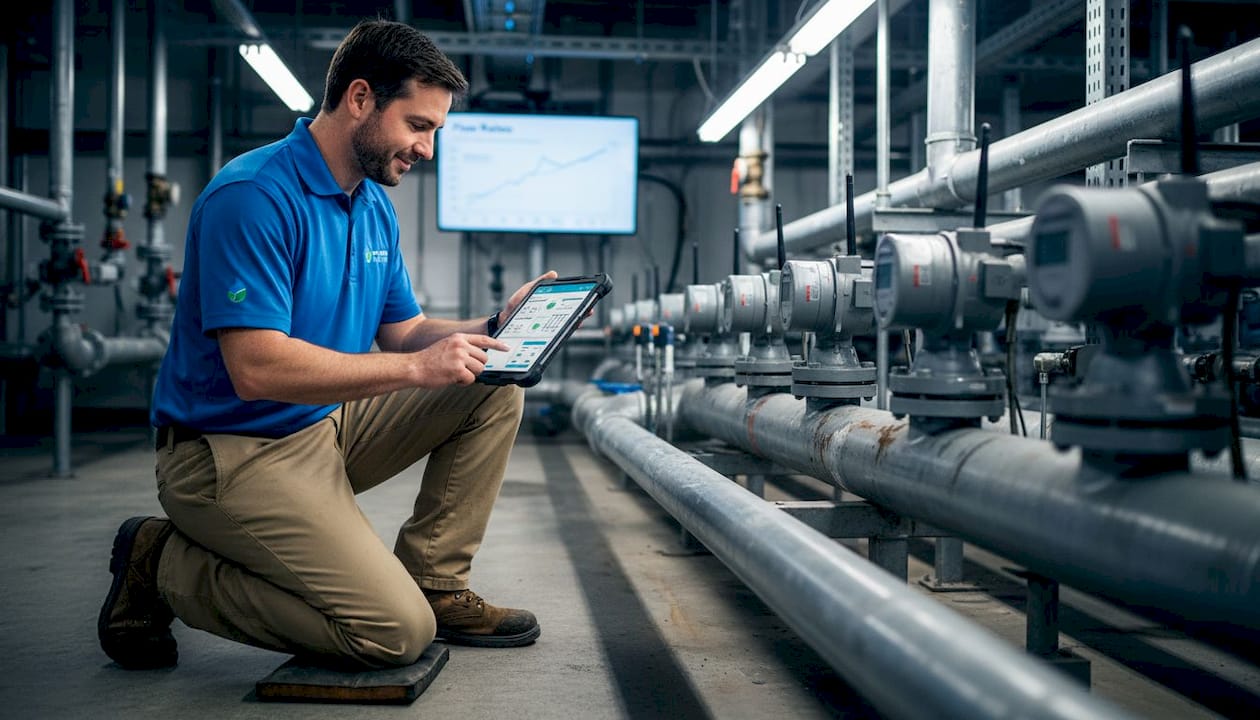
AI takes that sensor data and does something no manual system can: it learns normal patterns and flags anomalies before they become failures. It also routes water streams intelligently, directing lightly contaminated rinse water toward uses that do not require full potable quality rather than sending it straight to drain. AI-driven systems deliver a 10 to 20% reduction in operational costs and maximize reuse across process streams.
Four measurable outcomes from an IoT and AI upgrade:
- Reduced water volume purchased from municipal supply
- Lower energy costs from optimized pump and chiller operation
- Decreased unplanned downtime from predictive leak alerts
- Improved compliance reporting with automated data logs
Consider a mid-size automotive parts plant running three CIP cycles per shift. Before IoT installation, manual valve timing wastes roughly 800 liters per cycle through overshoot and idle-line losses. After deploying automated sensors and AI scheduling, that plant cuts cycle water use by 22% and avoids two unplanned maintenance shutdowns per quarter. The numbers add up fast.
Pro Tip: When evaluating IoT platforms, prioritize systems with open API integration so sensor data feeds directly into your existing SCADA or ERP without requiring a parallel data entry workflow. Read our AI-driven analytics guide and IoT workflow optimization guide for platform selection criteria.
Implementing advanced water management in your facility
Now that benefits are clear, here is how to put advanced water management into action with a practical step-by-step approach tailored for facility managers who need results, not theory.
Implementation roadmap:
- Establish a baseline. Pull 12 months of utility bills and cross-reference with production data to calculate water intensity (liters per unit produced).
- Set specific goals. Target a percentage reduction in intensity, not just total volume, to account for production fluctuations.
- Assess your options. Compare technology providers, process changes, and infrastructure upgrades using life cycle cost analysis (LCCA).
- Run a pilot. Deploy sensors and automation on one process line for 90 days before committing to facility-wide rollout.
- Monitor and report. Build a monthly dashboard that tracks water intensity, savings versus baseline, and maintenance alerts.
- Optimize continuously. Review the data quarterly with a cross-functional team and adjust targets as you hit benchmarks.
LCCA evaluates the full cost of water efficiency upgrades over their operating life, capturing maintenance, energy, and disposal costs that a simple capital comparison misses. This framework prevents the common mistake of choosing cheaper equipment that costs far more over five years.
Three pitfalls derail most implementation efforts. Ignoring total lifecycle cost leads to underinvestment in durable systems. Neglecting continuous leak monitoring means savings erode within months of launch. Applying a one-size-fits-all solution to a facility with multiple different process types produces mediocre results across the board.
Pro Tip: Engage your maintenance, operations, finance, and sustainability teams from day one. Staff who understand the why behind the changes catch problems earlier and maintain systems more diligently than those who receive new equipment without context. Check our onsite water recycling guide and water reuse guide for implementation-specific guidance.
A fresh perspective: What most factory managers get wrong about water management
Here is something worth saying plainly: the biggest obstacle to better water management is not technology or budget. It is the mindset that water management equals compliance, and compliance means doing the minimum required to avoid a fine.
That framing leaves enormous value on the table. When water is treated as a profit lever rather than a regulatory checkbox, the entire analysis changes. Lifecycle cost focus, which remains rare in most facilities, is genuinely transformative. A manager who calculates total cost of ownership over ten years will consistently choose better systems than one who approves the lowest capital bid.
Cross-functional collaboration is equally underused. Maintenance teams know where leaks hide. Operations staff understand process timing. Finance managers can model ROI scenarios. Sustainability leads track ESG exposure. When these groups work together from project start rather than in sequence, they consistently deliver far greater gains than siloed implementation teams. Explore innovative water scarcity solutions to see how forward-thinking facilities are already changing this dynamic.
Finally, analysis paralysis is real. Managers who wait for the perfect data set or the mature technology version miss years of compounding savings. Smart risks with IoT and AI pay off. The factories leading on water efficiency today are not the ones that waited until the technology was perfect. They are the ones that started with imperfect data and iterated forward.
Take the next step toward water-smart operations
The strategies covered here, from smart metering and closed-loop systems to AI-driven analytics and lifecycle cost analysis, give you a clear playbook for reducing water intake and cutting operational costs. Putting that playbook into action is faster with the right platform and support. Simpeller's IoT sensor devices and AI-driven platform make invisible waste visible, converting efficiency gains into measurable savings and ESG-ready data that facility managers and investors can both trust. Explore water-smart solutions designed for industrial operations and connect with our team for a tailored assessment. You can also browse our full library of facility water management resources to build your implementation roadmap step by step.
Frequently asked questions
What is the most effective water management strategy for factories?
Closed-loop systems and process optimization consistently deliver the largest water and cost reductions. Closed-loop systems can cut freshwater intake by up to 90% by recirculating and treating process water rather than discharging it.
How does IoT improve water management in manufacturing?
IoT sensors monitor flow, pressure, and quality in real time and trigger automated alerts when readings deviate from normal. Real-time sensors give facility managers the visibility to respond to leaks and inefficiencies within minutes rather than weeks.
What ROI can be expected from AI-driven water management?
Most manufacturers see a 10 to 20% reduction in operational costs after implementing AI for water monitoring and routing. AI-driven OPEX reduction compounds over time as the system learns facility-specific patterns and tightens control further.
Why is lifecycle cost analysis important for water projects?
LCCA reveals the true cost of water efficiency upgrades by including maintenance, energy, and replacement expenses that upfront pricing hides. The LCCA framework from the U.S. Department of Energy gives facility managers a structured method for comparing long-term ROI across competing options.