

TL;DR:
- Water offsetting allows organizations to fund projects that restore or conserve water to achieve water neutrality.
- Effective programs require watershed-specific projects with third-party verification to ensure credibility.
- Integrating onsite efficiency measures with credible offset projects strengthens ESG performance and risk management.
Commercial real estate is under mounting pressure to prove its environmental credentials, and water is fast becoming the next carbon. While energy efficiency has dominated ESG agendas for years, investors, regulators, and tenants are now scrutinizing how buildings consume, manage, and account for water. Water offsetting lets high-consumption facilities achieve water neutrality by funding savings or replenishment projects elsewhere, turning an invisible liability into a quantifiable ESG asset. This guide explains what offsets are, how they work in practice, and why forward-thinking sustainability managers are already building them into their 2026 strategies.
Table of Contents
- What is water offsetting and how does it work?
- The ESG impact: Why offsetting matters for commercial real estate
- Challenges and risks: What to watch out for
- Best practices: How to implement a credible water offset strategy
- Perspective: Why water offsetting is only part of the solution
- Amplify your water impact with innovative solutions
- Frequently asked questions
Key Takeaways
| Point | Details |
|---|---|
| Water offsetting explained | Offsetting means funding external water savings or replenishment to balance your property’s water use. |
| Boosts ESG performance | Offsets can significantly improve ESG scores and stakeholder credibility for commercial real estate. |
| Requires careful oversight | Effective offsetting needs local alignment, third-party validation, and ongoing monitoring. |
| Direct action still critical | The best strategy combines onsite conservation with certified offset programs. |
What is water offsetting and how does it work?
Water offsetting is not as abstract as it first sounds. At its core, water neutrality funding means your organization invests in projects that save or replenish an amount of water equivalent to, or greater than, what your facility actually uses. The goal is net-zero or even net-positive water impact, even when onsite reductions alone cannot close the gap.
Think of it the same way you think about carbon offsets, but for a resource that is simultaneously local, seasonal, and far more variable. A corporate campus in Phoenix cannot "grow" new groundwater on its footprint. It can, however, fund the rehabilitation of a degraded watershed fifty miles away, the installation of low-flow fixtures in affordable housing nearby, or the restoration of a riparian corridor that naturally recharges the local aquifer. Each of these actions saves measurable, verifiable gallons.
Common offset project types include:
- Watershed restoration: Replanting native vegetation, removing invasive species, and restoring stream channels to increase natural water infiltration and reduce runoff losses.
- Community fixture retrofits: Replacing toilets, showerheads, and irrigation systems in residential or municipal buildings, generating quantified savings per gallon replaced.
- Agricultural efficiency programs: Funding drip irrigation upgrades or soil moisture monitoring on farms, which typically account for 70% or more of regional water withdrawals.
- Aquifer conservation and recharge projects: Supporting managed aquifer recharge (MAR) programs that inject treated water back into stressed underground reservoirs.
- Greywater recycling programs: Installing greywater recycling systems in multifamily or commercial buildings to reduce freshwater demand at the community scale.
It is worth distinguishing offsetting from direct water use reduction. These are not competing strategies; they are complementary layers of a complete water stewardship plan. Proving that reuse cuts CRE water costs is the first priority. Offsetting fills the remaining gap when efficiency alone is not enough.
| Approach | Mechanism | Speed of impact | ESG credit type |
|---|---|---|---|
| Onsite reduction | Fixtures, sensors, recycling systems | Immediate | Operational intensity metric |
| Water offsetting | Funding third-party conservation projects | 3 to 18 months | Neutrality or positivity claim |
| Combined strategy | Both approaches in parallel | Fastest overall | Strongest ESG narrative |
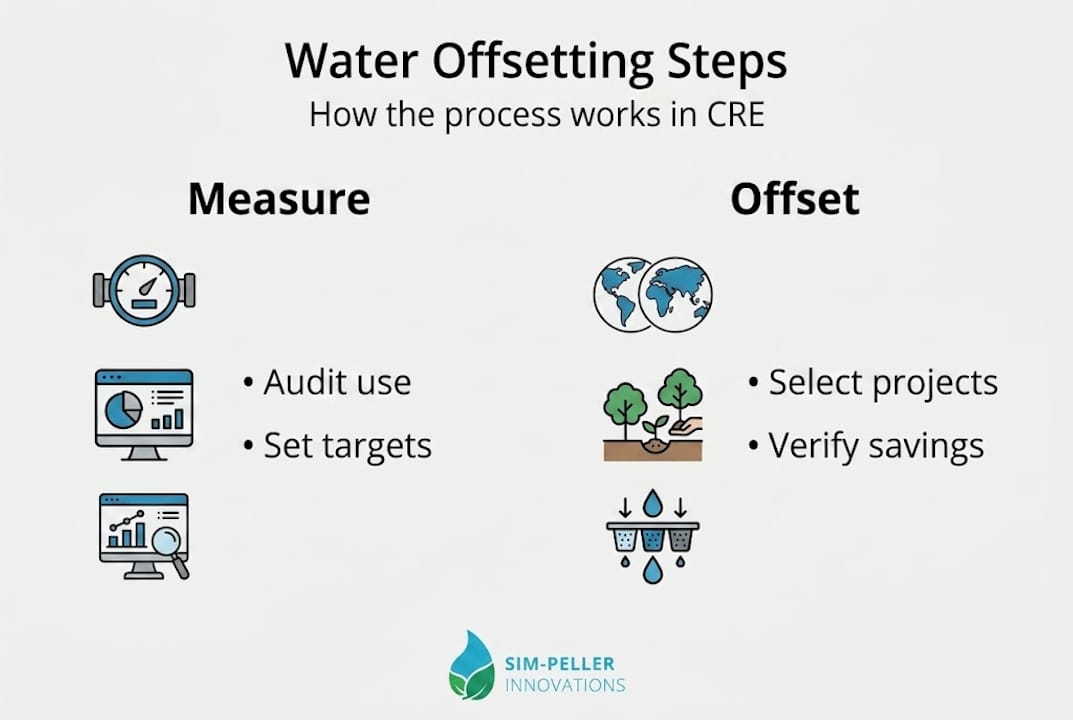
For facility managers, the typical offsetting process follows four clear steps. First, measure your total water footprint across all metered and unmetered sources. Second, set a reduction target and identify the volume that offsetting will need to cover. Third, select verified offset projects that match your watershed and water stress context. Fourth, secure third-party verification and report the outcome in your ESG disclosures. Each step requires data, and the quality of that data directly determines the credibility of your claim.
The ESG impact: Why offsetting matters for commercial real estate
Understanding the mechanics is one thing. Seeing why offsets are now a strategic necessity for commercial real estate is another. Institutional investors, green building certifiers, and corporate tenants are all tightening water-related requirements, and the gap between leaders and laggards is widening fast.
The scale of investment already underway sends a clear signal. Microsoft committed $16M across 49 projects saving 16 billion gallons of water. An ION-Meta partnership is set to conserve 26M gallons over five years in a Texas watershed. Rowan's data center achieved a 250% water offset through aquifer conservation, meaning it is actively restoring more water than it uses. These are not symbolic gestures. They represent a new standard of accountability that is migrating from the tech sector into commercial real estate.
"Water offsetting is not just a compliance tool. It is becoming a genuine differentiator for commercial portfolios competing for ESG-conscious tenants and investors."
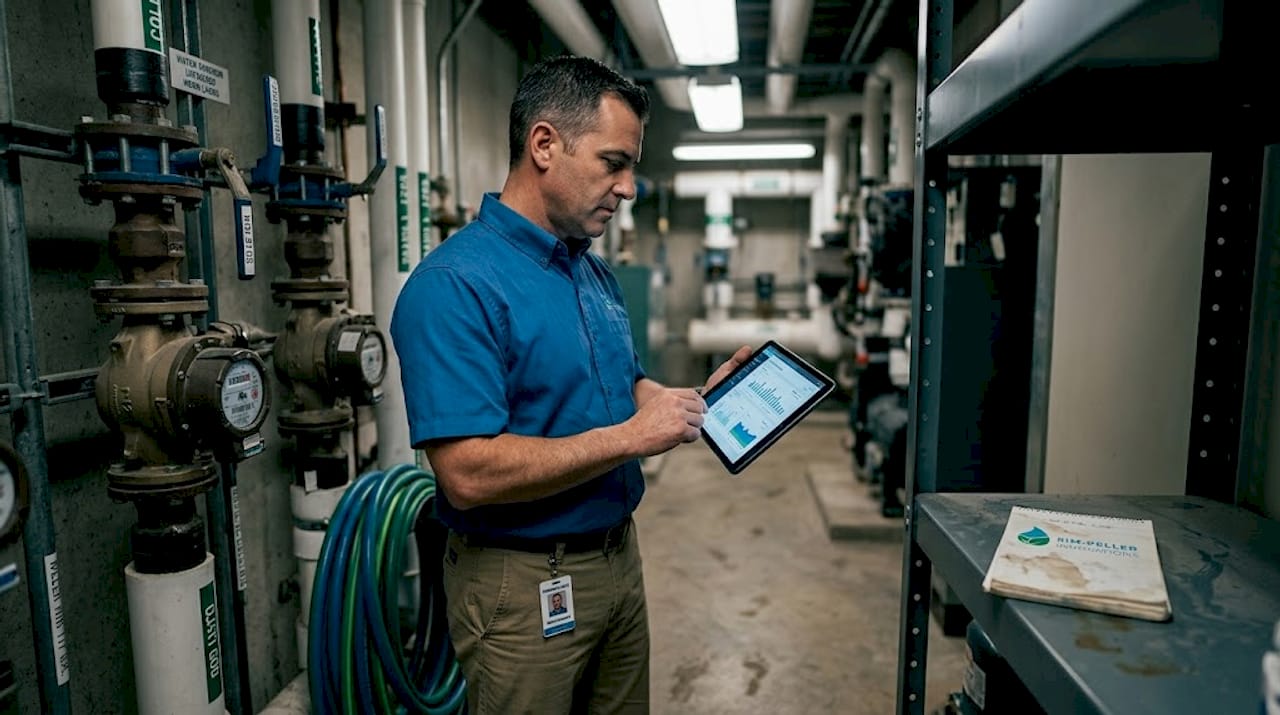
For facility operators, the financial case is equally compelling. Well-designed offset programs can reduce overall operational costs by 20 to 30 percent when combined with onsite efficiency measures, because they force a disciplined audit of where and how water is actually consumed. That audit almost always reveals waste that was previously invisible.
The social dimension should not be overlooked either. Projects that fund fixture retrofits in affordable housing qualify as Volumetric Water Benefit Agreements (VWBAs), a structure that combines ESG and social impact in a single verifiable package. For a commercial property with community impact goals baked into its investment mandate, this is genuinely powerful.
Why this matters specifically for CRE in 2026:
- GRESB (the Global Real Estate Sustainability Benchmark) has expanded its water intensity metrics and now rewards properties that demonstrate verified neutrality claims.
- SEC climate disclosure rules and European CSRD requirements are pushing water accounting to the forefront of annual reporting.
- Major corporate tenants, particularly those in technology, finance, and life sciences, increasingly include water stewardship requirements in lease negotiations.
- Lenders are beginning to price water risk into refinancing terms for assets in water-stressed geographies.
Pro Tip: When selecting offset projects for ESG reporting, prioritize those with third-party verification from recognized bodies such as the Alliance for Water Stewardship (AWS) or those qualifying as VWBAs. Third-party validation dramatically reduces the risk of your claims being challenged during investor due diligence or tenant audits.
Exploring performance-based water rewards is increasingly the differentiating move for sustainability teams that want their ESG story to stand up to scrutiny.
Challenges and risks: What to watch out for
The benefits are significant, but they do not arrive automatically. Effective water offsetting depends on navigating a set of practical risks that, if ignored, can turn a well-intentioned program into an ESG liability.
The location and timing problem
Unlike carbon, water is hyper-local. Saving a million gallons in a different river basin provides zero benefit to a facility drawing from an over-allocated aquifer in Texas or Arizona. Offsets must match watershed and timing to be genuinely effective, meaning the conservation impact needs to occur in the same stressed basin, ideally during the same seasonal period, when and where the demand is causing real harm.
This is not a minor technical point. It is the single biggest reason why loosely governed offset programs fail to deliver on their environmental promise.
Regulatory limits in stressed basins
In regulated regions, the math is deliberately conservative. In Arizona's ag-to-urban transfer programs, for example, credits are capped at 2 acre-feet per every 3 acre-feet saved, with a 5-year expiry on unused credits. Supply uncertainties in already stressed basins mean that even well-designed programs can face restrictions. Facility managers must understand the regulatory framework in every geography where they operate before making offset commitments to investors or tenants.
Greenwashing and transition-washing
Early-stage validation needs in the offset market create real risk for organizations that move too fast or choose projects without rigorous governance. "Transition-washing" is the emerging term for claiming credit for water savings that were already planned or that would have happened anyway without your investment. Registry systems, additionality requirements (proof that the project would not have happened without your funding), and independent audits are all essential guardrails.
"Without robust validation and local relevance, water offsets risk becoming a reputational liability rather than an asset."
What to watch for when evaluating offset projects:
- No third-party verification or registry listing
- Projects located outside the relevant watershed
- Savings that rely on modeling assumptions rather than measured outcomes
- No clear additionality demonstration
- Expiry dates or regulatory restrictions not disclosed upfront
- Providers who cannot explain their measurement methodology in plain language
Pairing your offset strategy with smart water management systems onsite gives you the baseline data quality needed to make defensible claims. You cannot credibly offset what you have not accurately measured.
Pro Tip: Before committing to any offset project, ask the provider for their measurement and verification (M&V) protocol. If they cannot hand you a clear, auditable document explaining exactly how savings are quantified, that is a red flag.
Best practices: How to implement a credible water offset strategy
With those challenges in mind, here is how to build a robust, reputable water offsetting program for your properties. The steps below are designed for facility managers who want to move from concept to verified action without creating new compliance risk.
1. Measure your full water footprint
Start with a complete water audit across all assets. This means metered consumption, irrigation, cooling towers, tenant submetering, and any water used in onsite manufacturing or food service operations. Many CRE portfolios dramatically underestimate their actual footprint because submetering data is fragmented or missing entirely. Close that gap first.
2. Set science-aligned reduction targets
Before you offset a single gallon, establish aggressive onsite reduction targets. Industry guidance suggests a minimum 20% direct reduction before offsetting begins, to ensure offsets supplement rather than substitute for genuine efficiency effort. Your reduction targets should reference local water stress levels, not just internal baselines.
3. Identify the volume requiring offset coverage
After applying all feasible onsite reductions, calculate the remaining volume that offsetting will need to address. Be conservative here. Overestimating your offset coverage and underdelivering on verified savings is a more damaging ESG outcome than a modest, well-documented claim.
4. Select verified, watershed-specific projects
Prioritize projects with VWBA certification or Alliance for Water Stewardship verification. Focus on projects in the same watershed where your facilities operate. Affordable housing fixture retrofits, agricultural efficiency upgrades, and aquifer recharge programs all offer strong verification frameworks and measurable outcomes.
5. Establish third-party reporting and disclosure
Water offset claims must be independently verified before they appear in any public ESG disclosure. Engage an auditor familiar with water accounting standards such as ISO 14046 or the CEO Water Mandate's Corporate Water Disclosure Guidelines. Report both gross consumption and verified offset volumes separately, never merged into a single "net" figure without transparent methodology.
6. Review and update annually
Offset project performance changes over time due to weather, land use shifts, and regulatory changes. Build in annual reviews of all active offset contracts and be prepared to adjust or replace projects that are underperforming against their verified savings targets.
Common mistakes to avoid:
- Treating offsets as a substitute for onsite reduction rather than a complement
- Selecting projects purely on cost rather than local relevance and verification quality
- Failing to disclose offset methodology in investor and tenant communications
- Claiming water positivity without independent audit confirmation
Reviewing a solid guide to water savings before launching your offset program ensures your baseline reduction work is as strong as possible, which makes your offset claims far more credible.
Perspective: Why water offsetting is only part of the solution
Water offsetting is a genuine innovation, and the momentum behind it reflects something important: the market is finally taking water risk as seriously as it takes carbon. That is progress. But there is an uncomfortable truth that gets lost in the enthusiasm around offset deals and neutrality claims.
Offsets work best when they are the final layer of a strategy built on deep operational change, not the first move made to satisfy an investor deadline. Facilities that lead with offsets before exhausting onsite efficiency options are essentially paying to externalize a problem they could solve internally, often at lower cost. The most credible ESG stories in 2026 will be built on a foundation of real reductions, verified through metered data and IoT-enabled monitoring, with offsets covering the genuinely irreducible residual.
The future of water stewardship in commercial real estate is integrated: onsite water recycling, greywater reuse, smart leak detection, and tokenized efficiency gains working in parallel with rigorously verified offset projects. That combination is not just better for watersheds. It is a stronger, more defensible ESG position that stands up to investor scrutiny, tenant demands, and regulatory review. Leadership means doing both, and doing them well.
Amplify your water impact with innovative solutions
For sustainability leaders ready to make water offsetting a real cornerstone of their ESG strategy, combining verified onsite reductions with credible offset programs is where measurable impact begins. Simpeller's IoT-enabled smartsink devices and AI-driven platform make it possible to track every liter, identify waste, and generate verified savings data that directly supports water offset claims and ESG reporting.
By converting efficiency gains into tokenized water credits, renewable PV credits, or cross-subsidy investments, Simpeller helps commercial real estate teams turn their water reduction work into transparent, auditable ESG value. Explore innovative water solutions to see how your portfolio can achieve real water neutrality backed by the data that investors and tenants now demand.
Frequently asked questions
What does offsetting water usage mean in practice?
Offsetting water usage means funding external conservation or replenishment projects that save or restore water equal to your facility's consumption, allowing you to claim water neutrality or positivity.
How do water offsets support ESG goals in commercial real estate?
Water offsets allow commercial properties to claim verified neutrality, improve GRESB and ESG scores, and demonstrate community stewardship, with well-designed programs delivering 20 to 30 percent reductions in operational costs when paired with onsite efficiency measures.
Are water offsets regulated like carbon credits?
Regulation varies by region. In some jurisdictions like Arizona, credits are capped at 2 acre-feet per 3 acre-feet saved and carry a 5-year expiry, with third-party validation required to prevent greenwashing.
What are the limitations or risks of water offsetting?
The main risks include poor local relevance, inadequate validation, and transition-washing. Offsets must match watershed and timing, and independent third-party verification is essential to ensure your claims hold up under scrutiny.