
TL;DR:
- Water waste significantly impacts costs, operation, regulatory compliance, and ESG reporting.
- Implementing leak detection, system upgrades, and real-time monitoring reduces water consumption and risk.
- Strategic water management enhances sustainability, regulatory compliance, and market competitiveness.
Water is one of the most underestimated line items on a commercial facility's budget, and that blind spot is getting expensive. A single undetected leak can waste up to 275 liters per day, and with commercial water rates climbing fast, that neglect compounds into thousands of dollars annually. For facility operators and property managers, water is no longer just a utility cost. It's a business continuity issue, a regulatory concern, and an ESG reporting variable. This guide breaks down the real cost of water waste, the operational risks of mismanagement, and the concrete steps that turn water efficiency into a strategic advantage.
Table of Contents
- The real cost of water: More than just the bill
- Water mismanagement: The silent threat to operations
- Regulatory, ESG, and LEED drivers: The value of water savings
- Transforming strategy into action: Essential steps for facilities
- A facility manager's perspective: Beyond quick fixes to strategic impact
- Take the next step: Transform your facility's water strategy
- Frequently asked questions
Key Takeaways
| Point | Details |
|---|---|
| Hidden costs | Facility water waste drives up expenses and causes operational risk far beyond what most budgets reflect. |
| Regulatory & ESG leverage | Smart water savings help meet rising regulatory, investor, and certification pressures. |
| Strategic approach required | Success comes from pairing tech-enabled monitoring with infrastructure fixes, not just behavioral changes. |
| Immediate savings impact | Auditing, leak detection, and modern upgrades deliver quick wins and sustained cost reductions. |
The real cost of water: More than just the bill
Building on the hidden significance of water expenses, let's look deeper at the true cost factors affecting your bottom line.
Most facility managers treat water as a fixed, predictable cost. It arrives on the monthly bill, gets paid, and moves to the back of the priority list. That mental model is dangerous. Water costs are not fixed, and the visible bill is only part of the story.
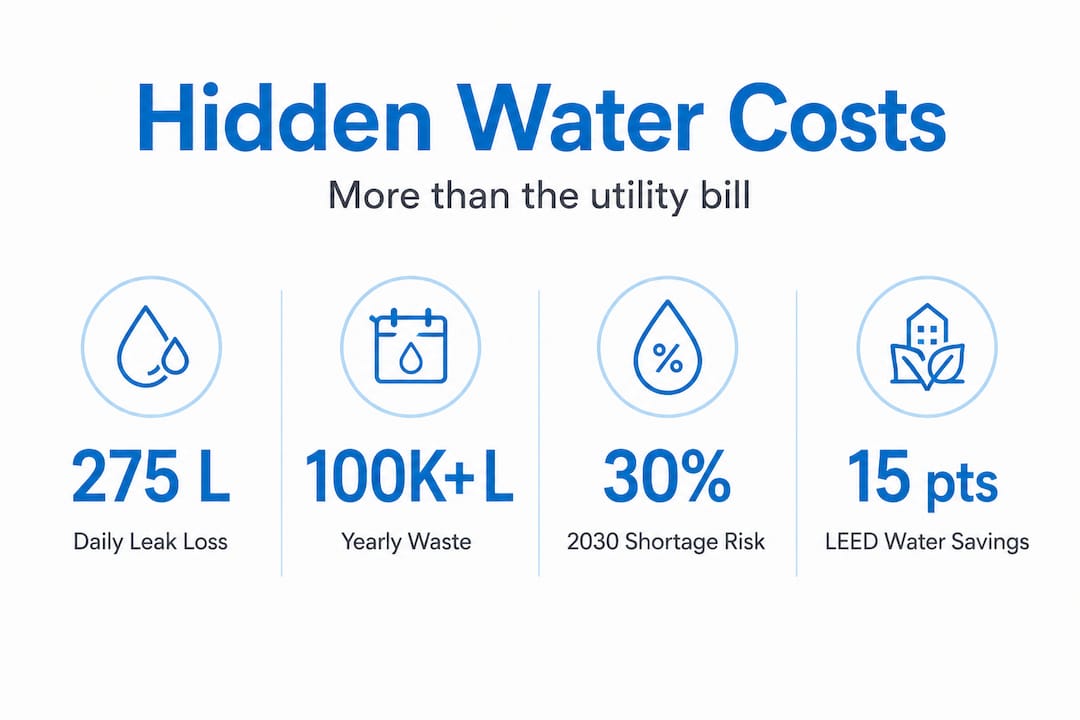
Direct costs are rising faster than inflation. Commercial water and sewer rates have increased significantly in recent years, with some markets seeing double-digit jumps. Water rates rose 21% in parts of the UK, and similar trends are playing out in North American and Australian commercial markets. When rates climb and consumption stays unchecked, the financial hit accelerates fast.
The hidden costs are where it gets serious. Beyond the utility bill, water waste drives up energy costs through inefficient heating and cooling, creates structural damage from undetected leaks, and inflates maintenance budgets for repairs that could have been prevented. A cooling tower running with faulty float valves, for example, can bleed thousands of gallons weekly without triggering a single alarm if there's no monitoring in place.
Here's a clear breakdown of the cost categories facility teams need to account for:
| Cost category | Examples | Risk level |
|---|---|---|
| Direct utility costs | Water and sewer charges | High, rising annually |
| Energy waste | Hot water heating, HVAC load | Medium to high |
| Leak damage | Structural repairs, mold remediation | High if undetected |
| Business interruption | Supply shutoff during shortage | Critical |
| Regulatory penalties | Non-compliance fines | Escalating |
A single leaking pipe or faulty valve loses roughly 275 liters per day. Over a year, that's over 100,000 liters wasted from one source. Multiply that across multiple systems in a mid-sized commercial building, and you're looking at a substantial operational drain that never appears as a single line item.
Supply risk adds another dimension. Global water demand will exceed supply by 30% by 2030, and when shortages hit, commercial facilities are prioritized for cutoff before residential users in many jurisdictions. That's not a distant risk. It's a business continuity threat that water-efficient facilities sidestep while their peers scramble.
Facilities that want to cut costs in facilities effectively must start by mapping both the visible and invisible components of their water spending. Quick wins in leak repair and fixture upgrades alone can shrink water bills by 10 to 20%, but the bigger gains come from treating water as a strategic asset, not just a utility.
Key water cost drivers to monitor:
- Aging pipe infrastructure with slow, undetected leaks
- Cooling towers and HVAC systems with manual or no controls
- Landscaping irrigation running on fixed schedules regardless of weather
- Unmetered sub-systems that make usage invisible
- Water-intensive industrial or food service processes with no sub-metering
Water mismanagement: The silent threat to operations
Understanding these costs, it's clear that water management failures represent a direct threat to both finances and operations.
The economic consequences of poor water management extend far beyond individual facilities. Water mismanagement supports 1.7 billion jobs globally in water-dependent sectors, and disruptions cascade quickly into supply chains, employment, and regional economies. For commercial property managers, this macro reality connects directly to operational risk.
"Water insecurity is no longer a regional environmental issue. It is a core business risk that facility managers cannot afford to delegate to a reactive maintenance schedule."
When a facility loses water access, even temporarily, the consequences are immediate. Food service operations shut down. Manufacturing lines stop. Office buildings become uninhabitable. The recharge time for depleted aquifers and reservoirs is measured in years, not days, meaning that rainfall alone doesn't solve a shortage once it takes hold. Facilities that wait for a crisis to act face much higher costs than those that build resilience in advance.
Aging infrastructure is a primary culprit in most commercial buildings. Systems installed decades ago were designed for different demand levels and don't carry the sensors or feedback loops needed to flag problems early. Cooling towers, in particular, are notorious for silent water waste. A tower losing water through evaporation, drift, or blowdown at a rate slightly above design spec won't trigger any alarms but can waste tens of thousands of gallons per month. HVAC systems with leaking heat exchangers add to the problem invisibly.
These are the commercial systems most vulnerable to hidden water loss:
- Cooling towers — High-volume evaporation and blowdown create large waste streams that require active monitoring to optimize.
- Irrigation systems — Fixed schedules and broken heads waste water regardless of soil moisture or weather conditions.
- Toilet and plumbing fixtures — Running toilets and leaking faucets account for a disproportionate share of preventable waste in occupied buildings.
- Unmonitored industrial processes — Any process that uses water without sub-metering creates a blind spot that makes efficiency gains impossible to verify.
Exploring water scarcity solutions built for industry and commerce shows how facilities in water-stressed regions are already adapting, and the strategies scale well to any market where costs or regulation are tightening.
Pro Tip: The most impactful single action for most facilities is a dedicated leak detection program. Thermal imaging, acoustic sensors, and real-time flow monitoring together can identify waste sources that visual inspections miss entirely. Prioritize this before any fixture upgrade, because you need to understand current losses before sizing the opportunity for improvement.
Regulatory, ESG, and LEED drivers: The value of water savings
Managing water isn't just about savings. It's also about meeting rising external demands and competitive benchmarks.
The regulatory landscape for commercial water use is tightening in nearly every major market. Local governments are imposing stricter reporting requirements, mandating efficiency audits, and introducing tiered pricing that penalizes high-volume users. For property managers with portfolios in multiple jurisdictions, keeping pace with these requirements manually is increasingly impractical.
Green building certification is a parallel and equally important driver. LEED O+M v5 awards up to 15 points for water efficiency measures, including reductions of 20% or more and verified water reuse systems. Those points directly affect a building's certification level, which in turn affects lease rates, asset valuation, and marketability to premium tenants.
Here's how water efficiency benchmarks stack up across the major frameworks:
| Framework | Requirement level | Water focus | Verification method |
|---|---|---|---|
| Local regulations | Minimum compliance | Reporting and limits | Utility data submission |
| LEED O+M v5 | 20%+ reduction, reuse | Up to 15 credit points | Third-party metering |
| Best-in-class ESG | 30 to 50% reduction targets | Full water accounting | Continuous monitoring |
ESG frameworks are pushing the bar even higher for institutional property owners. Investors, corporate tenants, and sustainability auditors increasingly expect water stewardship to be part of a building's performance profile, not an afterthought. Buildings that can demonstrate verified reductions with data-backed reporting command a real competitive advantage.
Properties pursuing CRE water cost reduction strategies and verified reporting are already seeing measurable benefits in tenant retention and asset positioning, and that gap between leaders and laggards is widening.
The stakeholders demanding water accountability now include:
- Institutional investors reviewing ESG disclosures for portfolio risk
- Corporate tenants with their own sustainability commitments and reporting obligations
- Insurance underwriters factoring climate risk into commercial property policies
- Municipal authorities tightening permits and adding surcharges for high-volume users
- Certification bodies like USGBC raising the bar with each new LEED version
For water management for sustainability to translate into competitive advantage, facilities need both the infrastructure to perform and the data infrastructure to prove it. Verification matters as much as the actual savings.
Transforming strategy into action: Essential steps for facilities
With requirements and benefits clear, here's how facility teams can put water savings into practice across commercial properties.
Knowing that water waste is costly and that regulation is tightening only creates value when you act on it. The good news is that there's a clear, repeatable process that works across building types and scales. The key is sequencing correctly so that each step builds on the last.
Here's the proven progression that high-performing facility teams follow:
- Audit current water use — Start with a full usage audit across all systems and sub-meters. Identify where water is consumed, in what volumes, and during which operating hours. This baseline is the foundation for every decision that follows.
- Prioritize leak detection and repair — Undetected leaks are among the largest sources of commercial water waste. Before investing in new fixtures or systems, make sure existing losses are found and fixed. This step typically delivers the fastest ROI.
- Upgrade high-impact fixtures — Replace aging toilets, urinals, and faucets with WaterSense-certified or equivalent high-efficiency models. In high-occupancy buildings, fixture upgrades alone can produce 15 to 25% reductions.
- Implement real-time monitoring technology — IoT sensors and AI-driven analytics turn water consumption from a monthly mystery into a live dashboard. Anomalies trigger alerts before they become expensive problems. This is the layer that makes efficiency gains durable.
- Engage occupants and operations teams — Behavioral change alone won't close the gap, but it reinforces infrastructure investments. Train staff on water-efficient practices, post usage data in shared spaces, and create accountability mechanisms.
Pro Tip: When evaluating technology investments, calculate ROI based on your specific local tariff rates, climate risk profile, and available utility rebates or government incentives. A smart monitoring system that costs $8,000 to install might pay for itself in under 18 months in a high-tariff market, but the same calculation looks different in a low-cost water region. Run the numbers for your actual conditions.
Exploring the full potential of performance-based water rewards helps facilities understand how verified savings can be converted into tangible value, including credits and incentives that offset the cost of efficiency upgrades. Pairing those rewards with a solid IoT water management guide for facilities gives teams the technical and strategic grounding to deploy monitoring at scale.
Quick wins for immediate impact:
- Fix all identified leaks before the next billing cycle
- Install aerators on all sink faucets (fast, low-cost, measurable)
- Set cooling tower blowdown controllers to optimal cycles
- Switch irrigation to weather-responsive smart controllers
- Conduct a toilet-dye test across all restrooms to catch silent running
Long-term investments with compounding returns:
- Sub-metering across all major water-using systems
- Greywater recycling and rainwater harvesting where code permits
- AI-powered leak detection integrated with building management systems
- Full water accounting for ESG reporting and LEED certification tracking
A facility manager's perspective: Beyond quick fixes to strategic impact
Stepping back, let's reevaluate the typical approach to water efficiency and why most guides miss the mark for real-world facilities.
Most water-saving guides hand facility managers a list of tips and call it a strategy. Fix this faucet. Brief the cleaning crew. Print some posters. That approach consistently underdelivers, and the reason is structural, not motivational.
The facilities that see the best results don't rely on behavior change to carry the load. They invest in infrastructure and technology that removes the dependency on human consistency. A smart sensor doesn't forget to check for leaks after a busy week. An AI platform doesn't skip the anomaly report when the operations team is short-staffed.
The shift that makes the real difference is moving from behavioral changes to infrastructure and technology. That shift isn't just about efficiency. It's about locking in savings that survive staff turnover, portfolio changes, and regulatory shifts. Strategic infrastructure investment creates a baseline of performance that compounds over time.
Real-time data is a force multiplier. When facility managers can see exactly where water is going, minute by minute, they make better decisions faster. They catch the leak before it floods a basement. They identify the rogue irrigation zone running at 3 a.m. They have the verified data that makes the LEED audit straightforward. Understanding water monitoring for facilities as a strategic tool rather than a compliance checkbox is what separates leaders from laggards in this space.
The uncomfortable truth is that the cost of not acting rises every year alongside rates, regulatory requirements, and supply risk. The window for low-cost compliance is narrowing.
Take the next step: Transform your facility's water strategy
If you're ready for practical solutions that go beyond theory, this is where to start.
At Simpeller, we work with facility operators and property managers to make water waste visible, measurable, and manageable. Our plug-and-play IoT smartsink devices and AI-driven platform give your team real-time insight into consumption, leak patterns, and efficiency gains across your entire property or portfolio. We don't just identify the problem. We help you convert verified water savings into measurable value through renewable credits, material-exchange vouchers, and transparent ESG reporting. Whether you're targeting LEED certification, investor-grade ESG disclosure, or simply want to slash operational costs, Simpeller gives you the tools and the data to get there.
Frequently asked questions
How much water can a commercial facility typically save?
With proven strategies, commercial properties can cut water use by 20 to 50% depending on building type, occupancy, and the scale of existing inefficiencies.
What is the fastest way to detect water waste in a facility?
Regular audits combined with smart monitoring devices are the quickest path to identifying waste, since undetected leaks are among the biggest and most overlooked sources of loss in commercial buildings.
How do water savings help with ESG and LEED?
Improved water efficiency directly earns up to 15 LEED points and supports ESG goals by reducing resource consumption, lowering climate risk, and enabling verified, transparent reporting.
Are water savings only important in drought-prone regions?
No. Water mismanagement impacts economic growth broadly, driving up costs, regulatory exposure, and operational risk in all regions, regardless of local rainfall patterns.