
TL;DR:
- Hotels can significantly reduce water use by conducting audits, benchmarking, and infrastructure upgrades.
- Implementing low-flow fixtures and smart systems provides quick, durable savings with minimal guest impact.
- Building a water-saving culture and leveraging technology ensures long-term water management success.
Water is one of the most underestimated cost centers in hotel operations. The industry benchmark sits between 1,200 and 1,500 liters per guest-night, yet best-in-class properties have pushed that figure down to 419 liters through deliberate, measurable action. That gap represents real money, real risk, and a growing expectation from guests, investors, and regulators alike. The strategies in this guide move beyond vague sustainability pledges. They cover auditing, infrastructure, operations, technology, and landscaping, giving operational managers and sustainability officers a clear, sequenced path to cut consumption without touching guest experience.
Table of Contents
- Establish a water management baseline
- Upgrade infrastructure for fast, lasting savings
- Maximize laundry and operational efficiency
- Leverage smart systems and recycling for long-term advantage
- Optimize landscaping and outdoor water use
- Why water reduction mindsets, not just measures, drive sustained results
- Unlock greater water savings with advanced platforms
- Frequently asked questions
Key Takeaways
| Point | Details |
|---|---|
| Start with measurement | Benchmark your property’s water usage per guest-night to target the biggest savings opportunities. |
| Prioritize proven tech | Low-flow fixtures and smart monitoring systems deliver rapid reductions with strong ROI. |
| Boost operational efficiency | Upgrade laundry routines and use behavioral nudges to enhance both utility savings and staff engagement. |
| Scale with smart systems | Invest in automation and greywater recycling for consistent, long-term water conservation. |
| Outdoor areas matter | Xeriscaping and targeted irrigation can dramatically cut hotel water use in landscaping. |
Establish a water management baseline
Before you can reduce water use, you need to know exactly where it goes. A water audit maps consumption across every department, from guest rooms and kitchens to laundry and mechanical systems. Conducting water audits alongside sub-meter installation gives you the granular data needed to separate genuine waste from unavoidable use.
The Hotel Water Measurement Initiative (HWMI) and the Water Use in the Hospitality sector Global Network (WUPGN) provide standardized frameworks that let you benchmark your property against peers. Without a common metric, comparing a 50-room boutique to a 500-room resort is meaningless. Both tools normalize data to liters per guest-night, which is the figure that actually drives decisions.
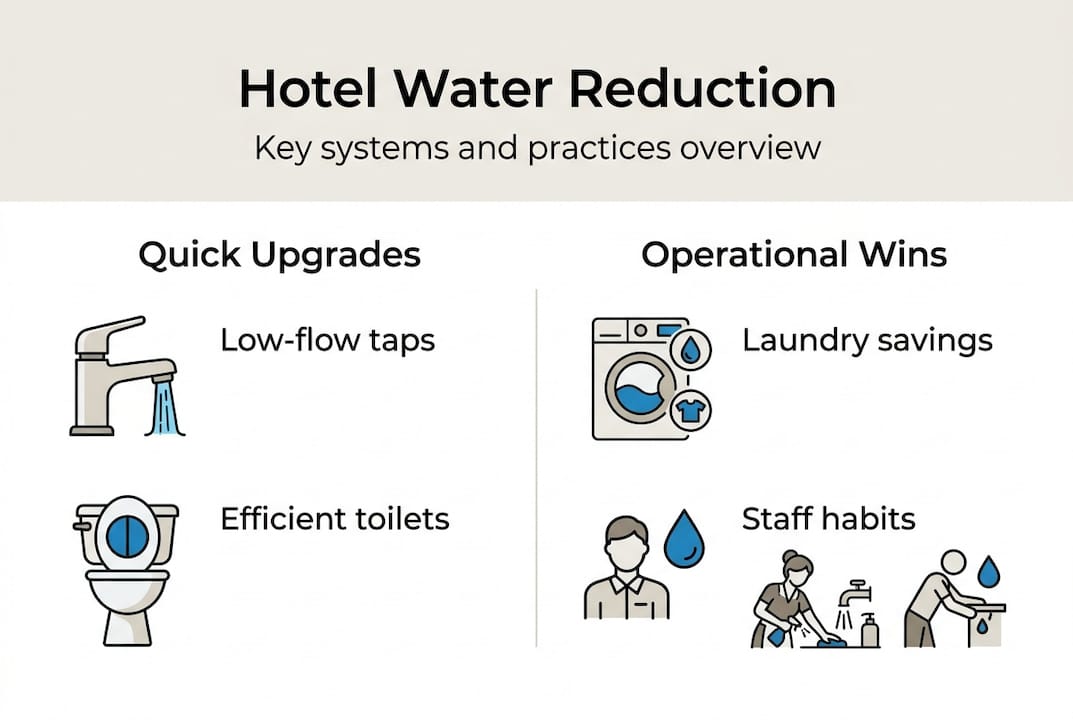
The table below gives a practical reference for what different hotel categories typically consume and what top performers achieve:
| Hotel type | Typical use (L/guest-night) | Best-in-class (L/guest-night) |
|---|---|---|
| Budget/limited service | 800 to 1,000 | 350 to 450 |
| Full-service midscale | 1,100 to 1,400 | 450 to 600 |
| Luxury/resort | 1,400 to 2,000+ | 600 to 900 |
To build a reliable baseline, work through these steps:
- Install sub-meters on laundry, kitchen, guest floors, and irrigation separately
- Pull 12 months of utility bills and normalize by occupied room-nights
- Map consumption by area using hotel water monitoring tools to pinpoint outliers
- Flag any area consuming more than 25% above its peer benchmark
- Set a target reduction percentage per area before moving to action
Key insight: Industry audits show that average hotel water use varies widely even within the same star category, which means benchmarking against your own historical data is just as important as comparing to industry figures.
One common pitfall is tracking only total site volume. Absolute numbers hide the story. A hotel running at 80% occupancy one quarter and 40% the next will show wildly different totals. Per-room and per-guest figures strip out that noise. Pairing your baseline with performance-based water rewards programs also creates financial incentives that keep teams focused on the numbers that matter.
The HWMI benchmarking tool is free to use and widely adopted across major hotel groups. Starting there costs nothing and immediately shows where your property stands relative to global peers.
Upgrade infrastructure for fast, lasting savings
Once you have a data-backed baseline, infrastructure upgrades deliver the fastest, most durable reductions. Low-flow fixtures including showerheads, faucets, and dual-flush toilets consistently rank as the highest-ROI intervention across hotel categories. A standard showerhead flows at 9 to 12 liters per minute. A low-flow model cuts that to 6 liters or less, with no guest-perceptible difference in pressure when installed correctly.
Here is a side-by-side view of the main retrofit approaches:
| Approach | Upfront cost | Payback period | Guest impact |
|---|---|---|---|
| Low-flow showerheads | Low | 6 to 12 months | Minimal if pressure-compensating |
| Dual-flush toilets | Medium | 12 to 24 months | None |
| Sensor faucets | Medium | 12 to 18 months | Positive (perceived hygiene) |
| Full bathroom retrofit | High | 24 to 48 months | Positive (premium feel) |
To plan and execute upgrades without disrupting operations, follow this sequence:
- Audit current fixture flow rates by floor and area type
- Prioritize guest room bathrooms and public restrooms first, as these drive the highest volume
- Pilot a single floor or wing before full rollout to validate savings and guest feedback
- Schedule installations during low-occupancy periods to minimize disruption
- Track post-installation sub-meter data for 30 days to confirm savings against baseline
- Use IoT water management sensors to automate ongoing monitoring after installation
"Retrofitting guest rooms with low-flow fixtures is consistently the single highest-return water investment a hotel can make. The technology has matured to the point where guests rarely notice the difference, but the meter absolutely does." — Water efficiency consultant, hospitality sector
Pro Tip: Do not start with back-of-house areas. Guest room and lobby restrooms account for the majority of discretionary water use. Fixing those first means faster ROI and cleaner data for your next budget cycle.
Communication matters too. A brief card in the room explaining that fixtures have been upgraded as part of the hotel's sustainability commitment turns a maintenance change into a brand story. Guests increasingly expect it.
Maximize laundry and operational efficiency
Laundry is the single largest operational water draw in most full-service hotels, accounting for roughly 30% of total site consumption. That makes it the highest-leverage area for behavioral and equipment changes combined. High-efficiency laundry machines, ozone systems, and linen reuse programs are the three pillars of a strong laundry strategy.
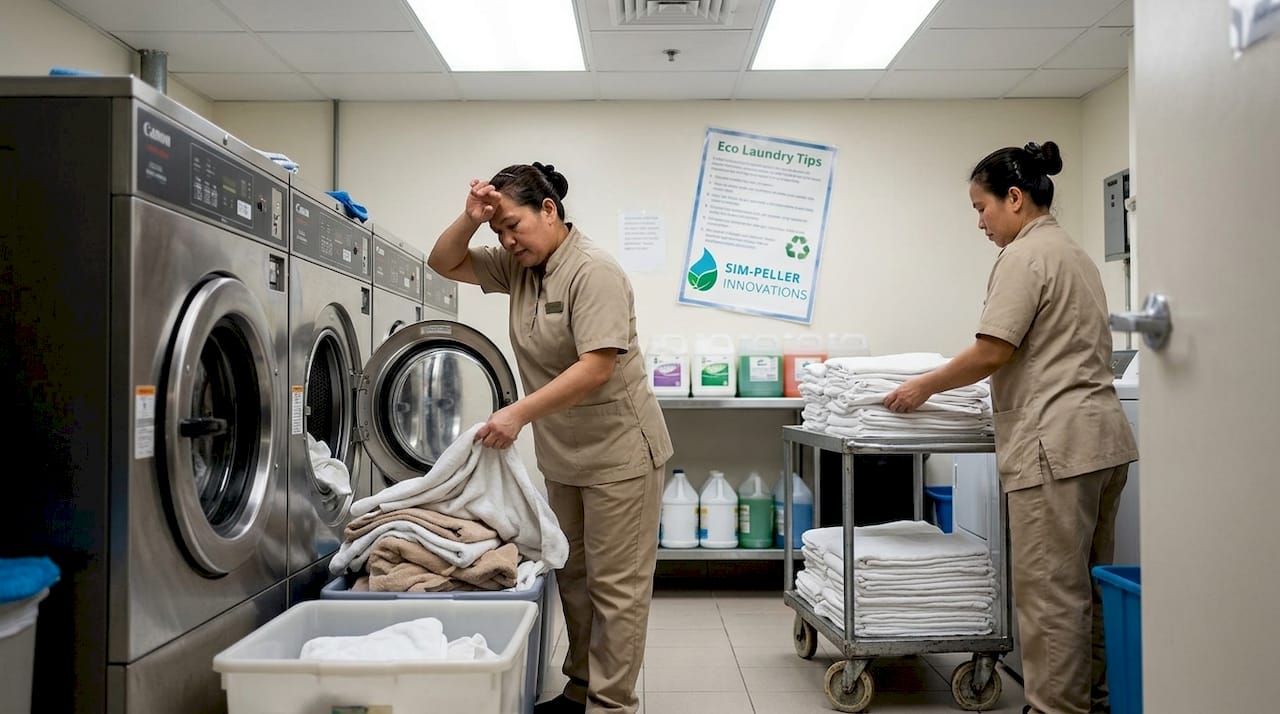
Ozone laundry systems are worth special attention. They sanitize at cold water temperatures, cutting both water and energy use simultaneously. Payback periods typically run 18 to 36 months depending on property size, but the combined utility savings make the math compelling.
Here are the operational tweaks with the biggest measurable impact:
- Replace top-load washers with front-load, high-efficiency machines that use 40 to 50% less water per cycle
- Install ozone laundry systems to reduce hot water demand and allow shorter wash cycles
- Launch a structured linen and towel reuse program with clear guest communication at check-in and in-room
- Train housekeeping staff on load optimization so machines always run at full capacity
- Audit linen change frequency by room type and stay length, and adjust defaults to reduce unnecessary washing
- Explore onsite water recycling to reuse rinse water from laundry for pre-wash cycles
One finding from recent research is counterintuitive but important. Guest information leaflets on water saving do not reduce direct in-room water consumption from showers or taps. Guests respond to social norms around linen reuse, but they do not consciously shorten showers because of a card on the desk.
Pro Tip: Use behavioral nudges for laundry participation and infrastructure changes for in-room savings. Trying to get guests to take shorter showers through signage alone is a low-return effort. Putting a 6-liter showerhead in the room achieves the result without relying on guest compliance.
Staff behavior is equally important. Kitchen teams running taps continuously, housekeeping pre-soaking items unnecessarily, and maintenance staff using hoses instead of pressure washers all add up. Short monthly briefings tied to sub-meter data keep the team connected to the numbers.
Leverage smart systems and recycling for long-term advantage
Once operational basics are optimized, technology and recycling systems take water management to the next level. Smart water management systems use real-time sensors to detect leaks, track consumption by zone, and automate irrigation schedules based on weather data. A single undetected pipe leak in a hotel can waste tens of thousands of liters per month before it shows up on a utility bill.
Greywater recycling systems treat wastewater from showers, sinks, and laundry for reuse in toilet flushing and irrigation. In a large hotel, that can offset 20 to 30% of total potable water demand. The infrastructure investment is significant, but the long-term operational savings and ESG reporting value are substantial.
To implement and scale these systems effectively:
- Start with AI-driven water analytics to identify leak patterns and consumption anomalies before committing to hardware
- Install flow sensors on main supply lines and high-use areas to create a real-time consumption map
- Evaluate greywater system feasibility based on property size, local regulations, and available space for treatment tanks
- Pilot greywater reuse for irrigation first, as it requires the least treatment and carries the lowest regulatory complexity
- Expand to toilet flushing reuse once the system is proven and compliant
- Integrate all sensor data into a central dashboard for continuous monitoring and automated alerts
"A 45-property hotel group reduced water use by 35%, dropping from 1,800 to 1,170 liters per guest-night, through a combination of efficiency upgrades, greywater recycling, and active stewardship programs. The result was $4.8 million in annual savings across the portfolio."
Smart systems deliver the most value in water-stressed regions and high-footfall properties where even small per-unit savings multiply quickly across millions of guest-nights annually. The sensor-based monitoring approach also generates the verified data needed for credible ESG reporting, which is increasingly a procurement and investor requirement.
Optimize landscaping and outdoor water use
Indoor efficiency gains can be partially offset by unchecked outdoor water use, particularly at resorts, golf properties, and hotels in arid climates where irrigation can represent 20 to 40% of total site consumption. Addressing landscaping is the final piece of a complete water stewardship program.
Xeriscaping with drought-resistant native plants and drip irrigation systems can slash outdoor water demand by 50 to 70% compared to traditional lawn and sprinkler setups. Native plants are adapted to local rainfall patterns and require minimal supplemental irrigation once established, typically after the first growing season.
Here are the most cost-effective outdoor upgrades to prioritize:
- Replace high-water turf areas with native ground cover, gravel, or permeable paving in low-visibility zones
- Install drip irrigation for planted beds instead of overhead sprinklers, which lose 30 to 50% of water to evaporation
- Add smart irrigation controllers that adjust schedules based on real-time weather and soil moisture data
- Collect and store rainwater for irrigation use where local regulations permit
- Audit irrigation zones with water-saving landscaping tools to identify overwatering and scheduling errors
- Schedule irrigation for early morning or evening to minimize evaporation losses
Statistic to note: In resort and arid-region properties, outdoor water use routinely exceeds indoor consumption during dry seasons. A smart controller alone, with no other changes, typically reduces irrigation water use by 15 to 25% by eliminating watering during rain events and adjusting for temperature.
Visible green spaces also carry a communication opportunity. Signage explaining that the hotel's gardens use native plants and recycled water connects the physical environment to your sustainability narrative. In high water-stress regions, this kind of community engagement builds local goodwill and reinforces your ESG positioning with guests and regulators alike.
Why water reduction mindsets, not just measures, drive sustained results
Here is the uncomfortable reality: most hotels that install low-flow fixtures and launch linen reuse programs see an initial reduction, then watch consumption creep back up within 18 months. The technology did not fail. The culture did.
The properties that sustain 30 to 35% reductions over multi-year periods share one trait. They treat water as a shared asset with visible accountability, not a utility bill that finance handles. Department heads see their sub-meter data monthly. Maintenance teams are trained to treat a dripping tap as a financial issue, not just a maintenance ticket. Leadership sets water targets alongside revenue targets.
Building a water savings culture means revisiting goals annually as regional water risks shift and guest expectations evolve. What worked in 2022 may not be enough in 2026, particularly as water tariffs rise and disclosure requirements tighten. The best operators treat their water program as a living system, not a completed project.
Measurement and technology are necessary but not sufficient. They create the visibility. Leadership and staff ownership create the behavior change that makes the numbers move and stay moved.
Unlock greater water savings with advanced platforms
Operational change at scale requires more than good intentions and spreadsheets. Simpeller gives hotels the infrastructure to make water savings visible, measurable, and financially rewarding. Our plug-and-play IoT sensors and AI-driven platform detect leaks, track consumption in real time, and convert verified efficiency gains into tangible value, whether that is reduced utility costs, ESG reporting credits, or tokenized water reuse assets.
For hotel groups managing multiple properties, Simpeller's platform scales across your entire portfolio, giving sustainability officers a single view of performance against targets. If you are ready to move from one-off retrofits to a continuous, data-driven water management program, Simpeller is built for exactly that.
Frequently asked questions
What are the fastest ways for hotels to reduce water usage?
Installing low-flow fixtures and conducting a water audit typically deliver the quickest measurable savings without impacting guest comfort. These two steps alone can reduce consumption by 15 to 25% within the first year.
How do greywater systems benefit hotels?
Greywater recycling systems let hotels reuse laundry and sink water for irrigation or toilet flushing, lowering total potable water consumption and reducing operating costs over time. The systems also generate verified reuse data that supports ESG reporting.
Do guest-facing water-saving campaigns actually work?
Studies show that in-room guest education mainly improves linen reuse participation but has little direct effect on shower or toilet water use. Infrastructure changes deliver the in-room savings that behavioral nudges cannot.
What is a good benchmark for hotel water use?
Industry benchmarks range from 1,200 to 1,500 liters per guest-night, but some best-in-class hotels achieve as low as 419 liters per guest-night through targeted efficiency programs. Normalizing your data to liters per guest-night is essential for meaningful comparison.
How much can water efficiency save a hotel per year?
Hotels have documented savings up to $4.8 million annually and water use reductions over 30% using combined efficiency, recycling, and stewardship strategies across a 45-property portfolio. Results scale with property size and baseline consumption levels.