

TL;DR:
- Continuous, data-driven optimization significantly reduces commercial building energy consumption.
- Proper data collection, benchmarking, and fault detection are essential for sustained savings.
- Over-instrumentation without purpose creates noise; focus on high-impact systems for better outcomes.
Commercial buildings run on assumptions far more often than their operators realize. A fixed HVAC schedule set three years ago, a lighting timer that doesn't account for actual occupancy, a chiller running at full capacity on a mild spring day — these are not edge cases. They are the norm. Smart building automation changes this by turning operations from static schedules into continuous, evidence-based optimization of major end uses, and the difference in outcomes is not marginal. This article cuts through the noise to show facility managers and sustainability officers exactly which datasets matter, which systems deliver real savings, and where most teams stumble before they ever see results.
Table of Contents
- How data transforms facility energy performance
- The data-driven energy management cycle
- Benchmarking and normalizing for peer comparison
- Analytics, fault detection, and predictive control: Data in action
- Why "more data" isn't always more savings
- Unlock actionable energy savings with Simpeller solutions
- Frequently asked questions
Key Takeaways
| Point | Details |
|---|---|
| Continuous optimization is key | Actionable, real-time data enables evidence-based energy savings well beyond static schedules. |
| Benchmarking reveals targets | Normalized energy performance data pinpoints lagging sites and prioritizes improvements accurately. |
| Analytics need quality data | Fault detection and predictive savings depend on granular, reliable, well-integrated systems. |
| Success is more than sensors | Interoperability, context, and strong commissioning unlock true financial impact, not just extra data streams. |
How data transforms facility energy performance
With most commercial buildings still relying on outdated setpoints and annual utility reviews, the gap between what a building consumes and what it actually needs to consume can be enormous. Modern operational data closes that gap, but only when it's structured, continuous, and connected to the right systems.
The core shift is from periodic adjustment to continuous optimization. Traditional facility management responds to problems after they appear, usually through a work order, a tenant complaint, or a spike in a monthly utility bill. A data-driven approach detects inefficiencies as they develop, often before they register as a cost. Shifting from static schedules to continuous optimization using real-time occupancy, weather, and tariff data delivers significant, measurable reductions across the major end uses in any commercial facility.
The end uses that respond most strongly to data-driven management include:
- HVAC systems, which typically account for 40 to 60 percent of a commercial building's energy consumption and are highly sensitive to occupancy patterns and outdoor conditions
- Lighting, where real-time occupancy data can reduce wasted output in unoccupied zones by 30 percent or more
- Plug loads and equipment scheduling, where demand profiling reveals phantom loads and off-hours consumption that manual walkthroughs consistently miss
- Water heating and circulation, where temperature setpoint data combined with usage patterns exposes significant standby losses
"The data doesn't just show you what happened. It shows you what's about to happen and gives you enough time to respond intelligently." — A recurring insight from commercial portfolio managers who have moved beyond reactive maintenance to proactive, data-led operations.
Real-world results back this up. Commercial office portfolios that have deployed integrated building automation with live analytics consistently report savings of 30 percent or more over their pre-optimization baselines. These are not short-term anomalies. They reflect the compounding value of energy-saving device choices that are informed and monitored by continuous data rather than guesswork. The buildings that achieve this level of reduction share one characteristic: their teams treat energy data as operational infrastructure, not as a reporting afterthought.
The data-driven energy management cycle
Once managers appreciate how continuous data reshapes the fundamentals of facility performance, the next step is understanding the structured methodology that makes improvement repeatable and verifiable. Energy optimization is not a one-time project. It is a cycle, and each phase of that cycle depends on the quality of data flowing through it.
Energy programs follow a clear methodology: establish a baseline, collect granular data, apply analytics, commission and tune systems, and then verify savings with Measurement and Verification (M&V). Skipping or rushing any of these phases is where most implementations fall apart.
Here is how the cycle unfolds in practice:
- Baseline establishment. Collect at least 12 months of utility data to capture seasonal variation. Normalize for weather, occupancy, and building type to produce a meaningful starting point. Without a credible baseline, you cannot claim verified savings.
- High-resolution data collection. Deploy submeters and sensors at the system and circuit level, not just at the utility meter. Granular data from HVAC subsystems, lighting circuits, and process equipment is what enables fault detection and targeted intervention.
- Analytics and fault detection. Apply analytics platforms to identify anomalies, inefficiencies, and trends. Fault Detection and Diagnostics (FDD) tools flag deviations from expected performance automatically, reducing the burden on your operations team.
- Commissioning and tuning. Act on what the analytics surface. Retro-commissioning HVAC controls, adjusting setpoints, correcting scheduling errors, and validating sensor accuracy are all operational steps that turn data findings into energy reductions.
- Measurement and Verification (M&V). Compare post-intervention performance against the adjusted baseline to confirm that savings are real, sustained, and attributable to specific actions. This step is critical for ESG reporting and internal accountability.
| Phase | Primary data source | Key output |
|---|---|---|
| Baseline | Utility bills, interval meters | Normalized energy profile |
| Data collection | Submeters, BMS, IoT sensors | High-resolution consumption data |
| Analytics/FDD | Analytics platform | Fault alerts, inefficiency rankings |
| Commissioning | Control system logs, sensor feeds | Tuned equipment, corrected setpoints |
| M&V | Verified pre/post comparison | Confirmed savings, ESG documentation |
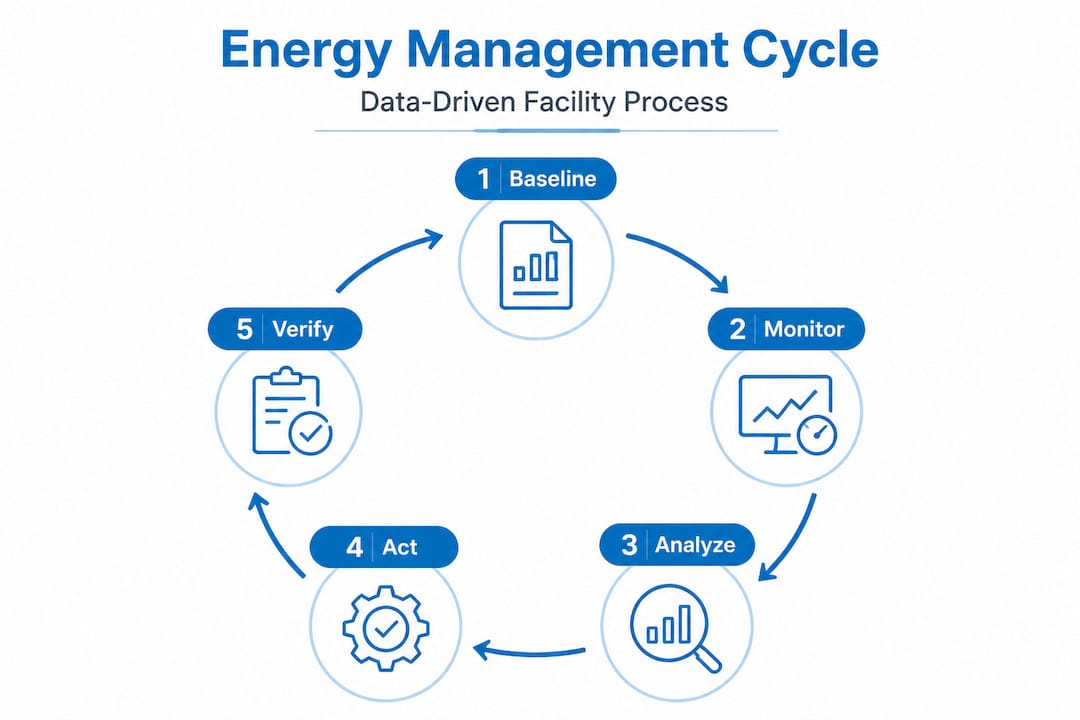
Monitoring energy waste at each stage of this cycle is what separates facilities that sustain savings from those that achieve a one-time reduction and then drift back to their old baselines. Teams that integrate M&V into property management best practices find that they not only hold their gains but continue improving year over year.
Pro Tip: Start your data-driven program with a single high-consumption system, typically the primary HVAC plant, before scaling. Demonstrating a clear ROI from one pilot system is the fastest way to build internal support and secure budget for a portfolio-wide rollout.
Benchmarking and normalizing for peer comparison
Establishing a structured improvement cycle is only half of the equation. Teams also need a reliable way to compare their performance against industry peers and internal targets. Raw energy consumption numbers are almost meaningless without context, and that context is what benchmarking provides.
Benchmarking energy performance with consistent data models normalizes usage for building type, climate zone, operating hours, and occupancy density. This normalization is what enables meaningful peer comparisons and guides teams toward the improvements that will have the greatest impact. Without it, a building in Phoenix and a building in Minneapolis are not comparable, and an office tower with 24-hour operations looks wasteful compared to a building that closes at 6 PM, even if it is actually more efficient per occupant hour.
Energy Use Intensity, universally referred to as EUI, is the gold standard metric for this purpose. EUI measures total energy consumed per square foot per year, expressed in kBtu/sq ft/yr. It is simple, consistent, and directly comparable across buildings of similar type and climate.
Key considerations when using EUI and benchmarking tools:
- Building type classification must be accurate. A mixed-use building that includes a data center will naturally carry a higher EUI than a standard office building. Misclassification leads to false conclusions about performance.
- Climate normalization is non-negotiable. Weather-normalized EUI removes the effect of an unusually hot or cold year, ensuring that performance comparisons reflect operational choices rather than meteorological luck.
- Source energy vs. site energy matters for cross-fuel comparisons. Source energy accounts for transmission and generation losses, giving a more accurate picture of total environmental impact when a facility uses both electricity and natural gas.
| Metric | What it measures | Strength | Limitation |
|---|---|---|---|
| Site EUI | Energy consumed at the building | Simple, direct | Ignores generation losses |
| Source EUI | Total energy including supply chain | Full picture | Requires conversion factors |
| ENERGY STAR Score | Percentile vs. peer buildings | Easy communication | Requires data entry accuracy |
Pro Tip: Use normalized EUI data for both internal portfolio comparisons and external benchmarking. When presenting to ownership or boards, ENERGY STAR scores are highly communicable, but internal decision-making should always rely on weather-normalized EUI to avoid misleading conclusions. Performance-based benchmarking follows the same logic across water and energy, treating verified performance as the foundation for every claim you make.
Analytics, fault detection, and predictive control: Data in action
Effective benchmarking gives teams direction, but turning data into sustained savings requires advanced analytics and robust system integration. This is where the mechanics of energy management get genuinely powerful, and where poor implementation can waste significant time and budget.
Fault Detection and Diagnostics, along with Building Management Systems (BMS) and predictive controls, form the operational core of modern energy management. FDD uses continuous sensor data to compare actual equipment behavior against expected performance models, flagging deviations automatically. A chiller running 15 percent harder than expected for a given cooling load, or an air handling unit with a stuck damper that's forcing the system to overcool and then reheat, are exactly the kinds of faults that FDD surfaces within hours rather than weeks.
"The value of FDD is not in the alerts themselves. It's in whether operators trust the alerts enough to act on them." — A finding repeated consistently across facilities that have evaluated analytics platform performance.
FDD and analytics depend entirely on granular sensor and BMS data. Poor data quality or integration issues can undermine effectiveness, generating false positives that erode operator confidence and cause teams to start ignoring the system entirely. This is a real and common failure mode. Common risks include:
- Data siloes between the BMS, energy meters, and analytics platforms that prevent the system from seeing the full picture
- Poor metadata tagging, where sensors are not labeled consistently, making it impossible for analytics tools to interpret readings correctly
- Sensor drift and calibration gaps that introduce errors into the data stream and degrade model accuracy over time
- Alert fatigue, where an excess of low-priority notifications causes operators to miss the critical ones
Predictive controls represent the next level of data application. Rather than reacting to conditions as they occur, predictive systems use forecasted weather, occupancy schedules, and real-time electricity pricing to pre-condition buildings and shift loads intelligently. The results are substantial. Predictive controls using real-time data and dynamic price signals can reduce peak demand by 40 to 65 percent and yield annual cost savings of up to 61 percent. These are not theoretical projections. They reflect demonstrated outcomes in real building environments.
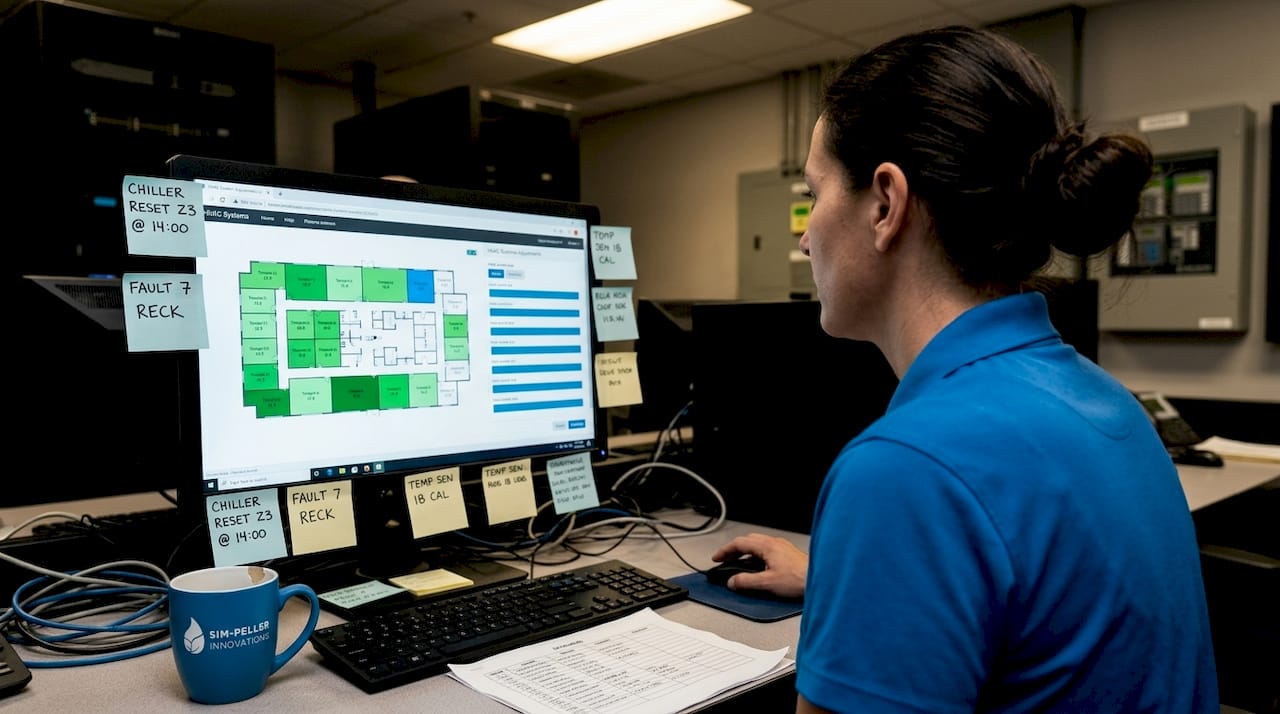
Connecting AI-driven analytics to building controls closes the loop between data observation and operational response. Teams that stay ahead of resource management trends are already integrating predictive controls with tariff data and demand response programs, positioning their portfolios to benefit from both operational savings and utility incentive payments.
Why "more data" isn't always more savings
Having watched how digital energy management has matured across commercial real estate, there is an enduring misconception that deserves a direct response: the belief that adding more sensors automatically produces more savings. It does not. In practice, the opposite is often true.
When teams instrument a building without a clear purpose for each data point, they create noise. Maintenance staff get buried in alerts that don't correspond to actionable problems. Analytics platforms produce outputs that no one trusts because the underlying data is inconsistent or poorly tagged. Data-driven energy savings hinge on interoperability, tagging, and commissioning — not on the sheer volume of sensors deployed. A facility with 50 well-integrated, properly commissioned sensors will consistently outperform one with 500 sensors scattered across systems that don't communicate with each other.
Context is everything. Building type, occupancy patterns, climate zone, operational hours, and tenant behavior all shape what the data means and what response is appropriate. A data anomaly in a hospital has completely different implications than the same anomaly in a suburban office park. Teams that strip away context and chase raw numbers end up optimizing the wrong things.
The practical guidance here is straightforward. Start with the systems that consume the most energy and where the data quality is already reasonably good. Ensure that your analytics platform can actually communicate with your BMS before you add any new sensors. Commission the sensors you have before buying more. Build operator trust by showing that the alerts the system generates are correct and actionable. And engage your advanced sustainability standards framework early, because verified, high-quality data is the foundation of credible ESG reporting, not an optional add-on.
Savings come from action, not from data collection. Data collection is only valuable insofar as it drives better decisions faster.
Unlock actionable energy savings with Simpeller solutions
Armed with a clear understanding of how data actually drives energy performance, the next practical step is finding the right tools and partners to make it real in your facility. Simpeller's IoT sensor platform and AI-driven analytics are built specifically to make invisible energy and water waste visible, giving your operations team the precise, actionable data it needs to cut costs, verify savings, and support transparent ESG reporting. Whether you're starting a pilot program on a single HVAC system or scaling across a commercial portfolio, explore how Simpeller energy and water solutions turn verified performance improvements into measurable financial and environmental value. The data is already there in your building. Simpeller helps you see it, act on it, and prove it.
Frequently asked questions
What types of data are most important for energy savings in commercial buildings?
Critical data types include real-time occupancy, HVAC performance metrics, utility tariff signals, and granular sensor feeds from building management systems, as combining occupancy, weather, and tariff data is what enables continuous, evidence-based optimization rather than scheduled guesswork.
How does benchmarking help commercial facilities reduce energy costs?
Benchmarking normalizes energy data for accurate cross-building comparisons and reveals where a facility's performance lags relative to peers, and tools like ENERGY STAR Portfolio Manager give teams the normalized framework to target the highest-impact improvement opportunities.
What is fault detection and diagnostics (FDD) in energy management?
FDD uses analytics to automatically identify equipment problems or inefficiencies based on granular building data, and high-quality sensor data with proper commissioning is what separates actionable FDD alerts from the false positives that cause operators to lose trust in the system.
How much energy or cost can predictive control save for commercial buildings?
Results depend on system design and building type, but predictive control with real-time price response has demonstrated up to 61 percent annual cost reduction and 40 to 65 percent peak demand reduction in real-world tested scenarios.