
TL;DR:
- Prioritize efficiency upgrades like LED lighting and HVAC improvements before installing renewables.
- Use automation and IoT monitoring to continuously optimize building performance and track savings.
- Deploy on-site renewables after establishing a stable, efficient baseline to maximize ROI and leverage incentives.
Facility managers and commercial property operators are under serious pressure right now. Operating costs are climbing, tenants demand greener spaces, and the list of energy-saving options grows longer every quarter. Solar panels, battery storage, smart automation, LED retrofits, bifacial modules, green financing — the choices can feel paralyzing. The good news is that a clear, sequenced approach cuts through the noise. This guide walks you through the most effective renewable energy savings strategies for 2026, ranked by impact and return on investment, so your team can make confident decisions without second-guessing every dollar.
Table of Contents
- Prioritize efficiency upgrades: The foundation before renewables
- Smart automation and real-time energy management
- Leveraging on-site renewable generation: Solar, wind, and hybrid systems
- Maximizing returns: Incentives, financing, and advanced tech
- Why sequencing and sustained measurement matter most
- Ready to transform your energy savings?
- Frequently asked questions
Key Takeaways
| Point | Details |
|---|---|
| Start with efficiency | Optimize lighting, HVAC, and controls first to reduce energy demand before investing in major renewables. |
| Automate savings | Leverage smart systems and IoT for continuous energy tracking and performance improvements. |
| Install renewables wisely | Select solar, wind, or hybrid systems with incentives and site suitability for the highest payback. |
| Maximize financial benefits | Layer tax credits, green financing, and advanced tech to shorten payback periods and boost long-term value. |
| Measure and adjust | Ongoing measurement and strategic sequencing are essential for sustainable, scalable energy savings. |
Prioritize efficiency upgrades: The foundation before renewables
With the context set, we first examine which foundational steps truly set up a commercial property for optimal renewable energy adoption.
Many facility teams make the same costly mistake: they jump straight to solar panels before fixing the energy leaks already draining their budget. Think of it like filling a bucket with a hole in the bottom. Installing renewables on top of an inefficient building means you're generating clean energy just to waste it. Shrinking your energy baseline first means every kilowatt of renewable capacity goes further, and your system size requirements drop, saving capital upfront.
Lighting is the fastest win on the board. LED commercial upgrades reduce energy use, cut peak demand, and last up to 50,000 hours, while also trimming HVAC load because they emit far less heat than older fluorescent or incandescent systems. Occupancy sensors layered on top of LED lighting can push cost savings up to 30% in underutilized spaces like conference rooms, restrooms, and storage corridors.
HVAC is the second big lever. Programmable thermostats and smart HVAC controls schedule system activity around actual occupancy and business hours, eliminating the common problem of full conditioning running through weekends or overnight. Some operators even unlock revenue from after-hours space rentals precisely because their HVAC can now be programmed to respond on demand rather than running continuously.
Other measures worth stacking together:
- Window films and weatherstripping reduce solar heat gain and infiltration losses, particularly in older building envelopes.
- Variable frequency drives (VFDs) on motors and pumps match power output to actual load rather than running at full speed regardless of demand.
- Power factor correction reduces reactive power penalties on your utility bill, a cost many facility teams don't even realize they're paying.
- Exploring energy-saving devices specifically designed for commercial facilities can surface options tailored to your asset class and operational schedule.
Pro Tip: Before investing in any paid audit, walk your building during off-hours. Lights blazing in empty corridors, equipment running on weekends, and systems with broken schedules are visible without a single piece of technology. Zero-cost fixes here fund the paid upgrades that come next.
The payoff of getting efficiency right before renewables extends beyond monthly savings. Lenders and green financing programs frequently assess energy use intensity (EUI) as part of their criteria. A lower baseline EUI signals a well-managed asset and can qualify your property for favorable rates. Pairing these measures with sustainability and efficiency retrofits also strengthens your ESG reporting position, which institutional tenants increasingly require at lease renewal.
Smart automation and real-time energy management
With baseline efficiency in place, the next level is digital — automating, tracking, and scaling your savings reliably.
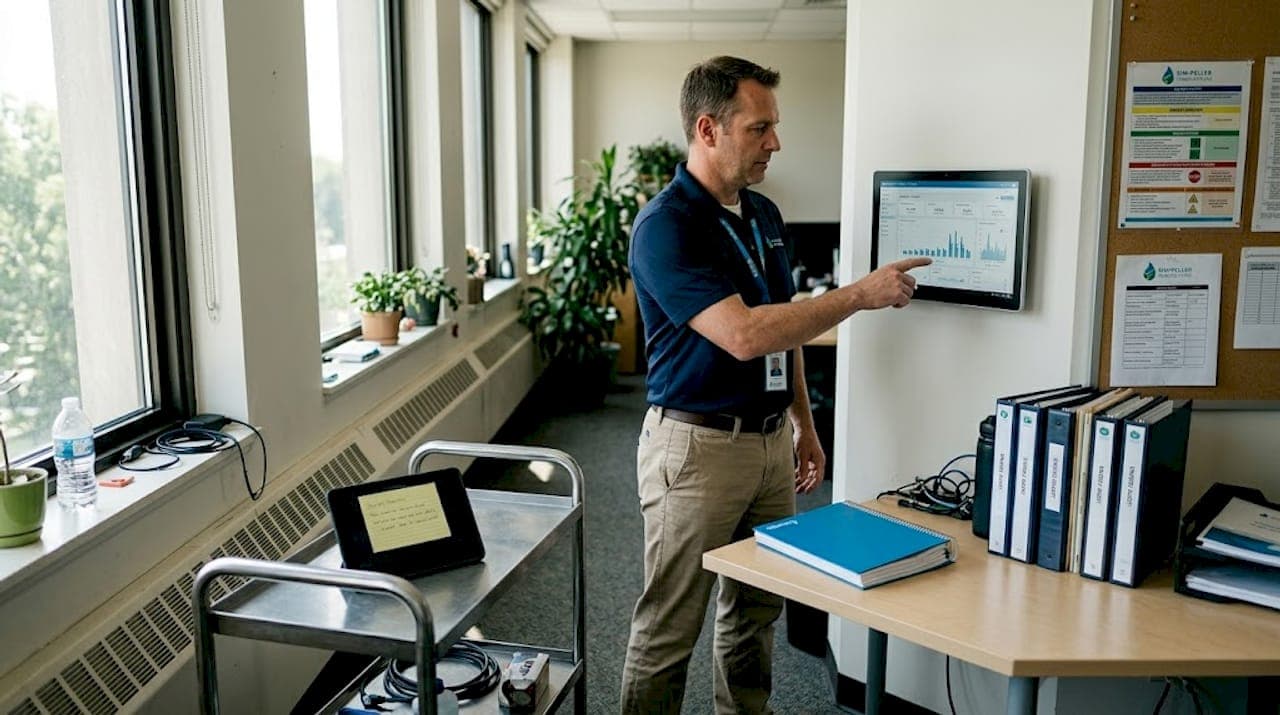
Efficiency upgrades create the floor. Automation keeps you from slipping back below it. Building Automation Systems (BAS) connect lighting, HVAC, elevators, and plug loads into a single control layer that responds to occupancy, weather, time of day, and even utility pricing signals. BAS, IoT monitoring, and solar integration together reduce energy waste and lower utility costs in ways no single measure achieves alone.
The numbers from real properties are compelling. Smart building automation consistently delivers 20 to 40% energy reductions across commercial portfolios. The Empire State Building's energy retrofit achieved a 40% reduction worth $4.4 million per year, and Landsec's portfolio-wide automation program produced a 42% emissions cut. These aren't outliers — they reflect what disciplined, data-driven automation delivers at scale.
What makes automation particularly powerful for facility operators is that it generates continuous, granular data. Every hour of operation becomes a data point you can analyze, benchmark, and act on. This matters for several reasons:
- Anomaly detection flags equipment running outside normal parameters before it becomes an expensive failure.
- Load shifting lets you move discretionary energy use to off-peak hours, cutting demand charges without affecting operations.
- Tenant billing accuracy improves dramatically when sub-metering data feeds directly from your BAS.
- Renewable integration becomes smoother because you know exactly when and where your building draws power, making solar generation profiles far easier to match against real consumption.
Leveraging IoT for facility efficiency also creates the audit trail that green certification programs and ESG frameworks require. You're not estimating savings anymore — you're proving them with timestamped, sensor-verified data.
"What gets measured gets managed. In commercial facilities, the buildings that achieve top-quartile energy performance almost universally share one trait: they have invested in continuous monitoring before — and after — any major upgrade."
Pro Tip: Use a cloud-based energy dashboard that consolidates multiple properties into a single view. This makes it easy to spot outliers in your portfolio — a building suddenly consuming 15% more than its peers is a red flag that pays for your entire monitoring subscription to investigate.
The link between water-energy savings innovation and smart automation is also worth noting. Water heating, cooling towers, and irrigation systems are often the hidden contributors to inflated utility bills. Integrating water monitoring into your BAS gives you a more complete picture of total resource consumption and opens additional avenues for verified savings.
Leveraging on-site renewable generation: Solar, wind, and hybrid systems
Once operational efficiency and automation are in motion, it's time to leverage renewables for significant operational resilience and savings.
On-site generation is the stage most property teams are eager to reach, and for good reason. Generating your own power insulates you from utility rate volatility, qualifies you for premium green lease terms, and builds long-term asset value. But rushing into it without the efficiency and automation foundation in place leaves money on the table.
Here's a practical stepwise approach to on-site renewable deployment:
- Commission a site assessment. Evaluate roof age, structural load capacity, orientation, shading from adjacent structures, and local solar irradiance data. For wind, assess average wind speeds at hub height and zoning restrictions.
- Model your consumption profile against generation potential. Compare hourly load data from your BAS against expected generation curves to determine optimal system size and storage needs.
- Identify applicable incentives. The federal Investment Tax Credit (ITC) and local utility programs significantly alter payback calculations. Factor these in before finalizing system size.
- Choose your technology mix. Solar-only works for most urban rooftops. Hybrid solar-plus-storage is increasingly cost-effective, particularly in markets with high demand charges. Wind suits open rural or industrial sites with consistent airflow.
- Calculate payback and EUI impact. Target systems that push your EUI reduction past 30%, since that threshold often unlocks green financing at favorable rates.
The scale of opportunity here is substantial. 40% rooftop PV coverage across US commercial building stock represents 385 GW of potential capacity, yielding approximately 25% utility bill savings totaling $28 to $37 billion annually and 409 TBtu of on-site energy use. For a single large property, that math can translate to six-figure annual savings.
| Technology | Typical payback | Best fit | Key advantage |
|---|---|---|---|
| Standard rooftop PV | 6 to 10 years | Urban flat roofs | Proven, widely incentivized |
| Bifacial PV | 5 to 8 years | Open areas, higher tilt | Up to 8.7% more energy yield |
| Solar plus battery storage | 7 to 12 years | High demand-charge markets | Demand shaving, resilience |
| Small wind turbines | 8 to 15 years | Rural or industrial sites | Complements solar seasonally |
| Hybrid PV plus wind | 6 to 11 years | Sites with mixed profiles | Smooths generation variability |
Installing solar and wind systems on commercial properties reduces fossil fuel reliance, hedges against future energy price increases, and qualifies the asset for green financing when energy and water use drop by 30% or more. That financing advantage compounds the ROI well beyond what simple payback calculations show.
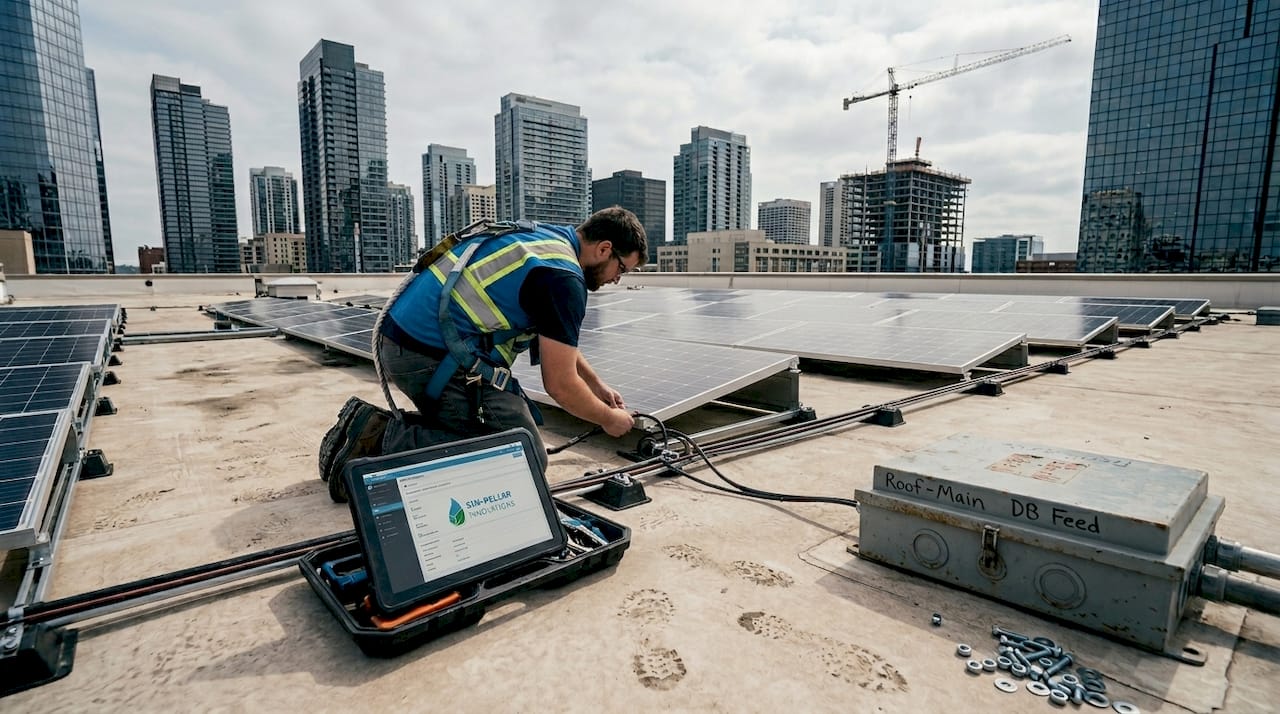
Critically, energy-efficient retrofits completed before renewable installation directly reduce the required system size. A building that cuts its baseline load by 25% through efficiency measures needs a proportionally smaller solar array to hit its self-sufficiency targets, reducing capital outlay and shortening payback simultaneously.
Maximizing returns: Incentives, financing, and advanced tech
With your renewable plan nearly ready, the final piece is maximizing the financial and technical impact through smart planning and advanced solutions.
Even well-planned renewable projects leave money behind when teams don't fully capture available incentives. The federal 30% Investment Tax Credit remains one of the most powerful tools available. Paired with accelerated depreciation under MACRS and state-level rebates, the effective first-year economic benefit can reduce net project cost by 40 to 50% in favorable markets. Green loans and PACE financing (Property Assessed Clean Energy) spread remaining costs across the useful life of the equipment, making cash flow neutral or positive from day one in many scenarios.
Advanced technology choices also significantly affect long-term returns:
- Bifacial solar modules capture reflected light from rooftop surfaces and surrounding structures, with NextEra bifacial deployments generating 8.7% more energy than standard monofacial panels at comparable cost.
- Battery energy storage systems (BESS) provide demand charge management and backup power. The FPL Manatee BESS installation at 409 MW and 900 MWh saved $135 million compared to gas peakers and maintained 99.2% availability — a benchmark for reliability.
- Single-axis trackers improve solar yield by 15 to 25% on ground-mounted systems, though they require more space and maintenance than fixed-tilt arrays.
- Exploring 2026 water-energy innovation that integrates water reuse with PV credits creates another layer of verified savings trackable for ESG reporting.
| Technology | Cost premium vs. standard | Energy yield improvement | Best application |
|---|---|---|---|
| Bifacial modules | +5 to 10% | +8 to 12% | Rooftops, ground mounts |
| BESS (battery storage) | Significant upfront | Demand savings, resilience | High demand charge sites |
| Single-axis trackers | +10 to 15% | +15 to 25% | Ground-mounted, open sites |
| Hybrid inverters | +3 to 8% | Optimized self-consumption | Solar-plus-storage |
Pro Tip: Use payback period and EUI reduction as your two primary decision filters. If a technology doesn't move your EUI meaningfully and doesn't pay back within your target horizon even with incentives layered in, it's not the right fit for this asset at this stage. Don't let vendor enthusiasm substitute for project-specific analysis.
Edge cases matter here too. Roof age and structural capacity frequently derail projects that look strong on paper. If your roof needs replacement within five years, factor that cost into the solar project and potentially schedule both together to avoid double mobilization costs. Labor and IT skills for managing advanced automation and monitoring platforms are another honest constraint: a powerful platform underutilized because your team lacks training delivers a fraction of its potential value.
Why sequencing and sustained measurement matter most
The most common conversation we have with facility teams who are frustrated by their energy results goes like this: they invested in solar or wind, saw modest savings, and can't understand why the numbers don't match the projections. Almost every time, the root cause is the same. They skipped the sequence.
Renewables installed on an unoptimized building generate clean power that flows straight into inefficiency. Automation layered onto a building with poor HVAC scheduling generates data that nobody acts on. Technology without management discipline is just expensive equipment. The properties that consistently land in the top quartile of energy performance share a different story: they fixed efficiency first, then automated and measured everything, then deployed renewables calibrated to a known, stable baseline.
The second overlooked factor is sustained measurement after implementation. Initial commissioning savings frequently erode within 18 to 24 months as setpoints drift, equipment ages, and operational habits creep back in. Only continuous facility data monitoring catches that erosion before it wipes out your ROI calculations. What you don't track, you can't defend in an ESG audit, a green lease negotiation, or a refinancing conversation.
The most valuable investment you can make after deploying any energy strategy is committing to verified, ongoing performance measurement. That data becomes your reporting currency, your negotiating leverage, and your guide to the next upgrade cycle.
Ready to transform your energy savings?
For facility teams looking to accelerate their savings journey, streamlined tools and expertise can make all the difference. Simpeller's AI-driven platform and plug-and-play IoT sensor devices make invisible energy and water waste visible across your portfolio, giving you the verified performance data that supports smarter renewable investment decisions. Whether you're benchmarking baseline consumption, tracking efficiency gains, or converting savings into renewable PV credits for ESG reporting, our solutions are built to scale with commercial properties of every size. Explore commercial energy solutions and see how Simpeller helps facility operators move from guesswork to verified, measurable results faster.
Frequently asked questions
What are the best first steps for renewable energy savings in a commercial building?
Start by upgrading lighting, HVAC, and automation systems to cut baseline usage before installing renewables. The U.S. Department of Energy recommends prioritizing efficiency measures including LED, HVAC, and insulation first, then applying BAS and IoT optimization before scaling renewable generation.
How much can solar panels save on commercial utility bills?
Commercial sites with large rooftop solar can cut utility bills by around 25%, with even greater savings for high-use properties. Mass deployment of 40% rooftop PV coverage across US commercial stock projects $28 to $37 billion in annual utility bill savings.
What incentives can commercial building owners use for renewables?
Federal programs like the 30% Investment Tax Credit, combined with PACE financing and local rebates, can offset the majority of upfront renewable system costs while also increasing long-term property value.
How important are automation and IoT for energy savings?
Automation and IoT solutions can cut total energy use by 20 to 40% by continuously optimizing building operations. Smart automation at scale, as demonstrated by the Empire State Building's $4.4 million annual savings, proves that digital controls deliver among the highest verified returns of any commercial energy strategy.